by
KATY COLLEY
KATY COLLEY argues that water companies have been acting like mafia bosses, shaking down consumers for decades… It’s time to fight back.

The results are in – the majority of the British public believe that water should be renationalised.
And it isn’t just the usual suspects. As Janice Turner in The Times noted on Friday last week, at the last count 58% of Tory voters agreed that water should be brought back into public ownership.
The crisis in Thames Water demonstrated what those who have been tracking this failing industry have known for some time – water companies have leveraged the captured consumer to acquire massive debt which they have been paying out to executives in grotesquely inflated salaries and bonuses and enormous dividends to shareholders.
Eventually, with debts outweighing the company assets, surging inflation and rising interest rates, this model would collapse, which it appears to be doing in spectacular style at the most indebted company.
Thames Water’s current debts amount to 80% of the value of the business. They are basically bankrupt.
On top of that, chronic underinvestment in our water infrastructure over thirty years leads Professor Richard Murphy to describe the all the water companies as ‘environmentally insolvent’, estimating firms would need an extra £260 billion now to deal with the sewage spills and fulfil their regulatory obligations.
That’s not even taking into account fines and the court costs they are facing on numerous fronts – for example, Leigh Day solicitors are preparing a group litigation case to take to the Competition Appeal Tribunal.
Even the boss of Severn Trent Water, on an inexplicable £4 million a year, admits in a private email in June that there is ‘significant pressure to do something about utilities’ in an attempt to fend off nationalisation.
Liv Garfield, who earns 24 times the UK Prime Minister, can see the writing is on the wall.
There is a consensus that the private ownership model of water is broken.
The question now is – what comes next?
Undoubtedly, it can’t be more of the same.
And yet last week OFWAT boss David Black declared that bills would need to rise to make up for the chronic underinvestment of the water firms.
He says there are ‘hard lessons to learn’ but it seems to me that it’s us taking the ‘hard’ bit – which is why I believe a national bill strike is not only justified but necessary to hasten the speed of change.
The water companies have got away with daylight robbery for so long because they have been able to bully and intimidate consumers into paying their bills, no matter what.
Mafia

I am reminded of that famous scene in Goodfellas when mafia boss Paulie takes a cut in a struggling restaurant business and proceeds to shake it down for every single penny:
‘Business is bad? F*ck you, pay me. Had a fire? F*ck you, pay me. The place got hit by lightning? F*ck you, pay me.’
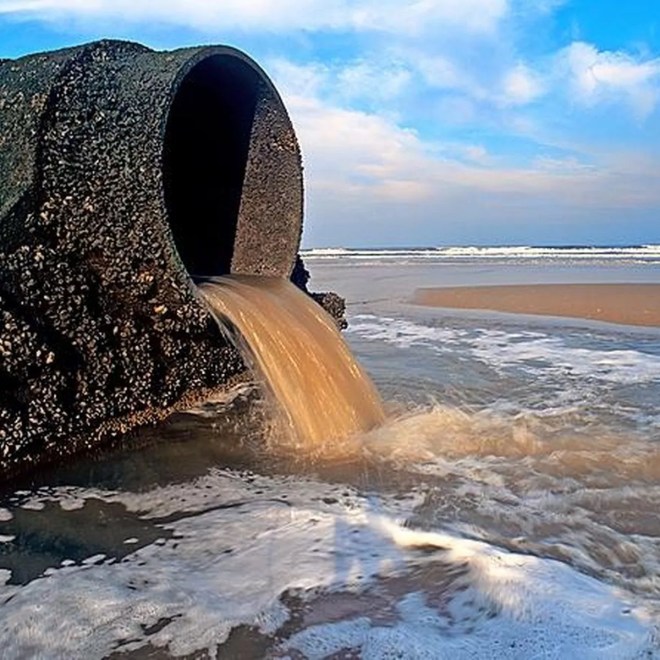
Water companies have been shaking down their customers for decades: ‘Sewage in the sea? F*ck you, pay us. Sewage in the rivers? F*ck you, pay us. Hose pipe ban in June? F*ck you, pay us.’
Is this really how we deserve to be treated? We paid our bills on time for years and we should expect the service we paid for, not ordered to pay 40% more to make up for the fact that these firms failed to invest in infrastructure to line the pockets of fat cats and foreign investors.
Water is a natural monopoly so I can’t go elsewhere for my water provision.
And since the payment of water bills falls under a statutory duty – like council tax – instead of consumer law, we have no way of registering our protest.
So whenever someone steps out of line the water companies get heavy. They threaten to take you to court to recover the money and from there, we are warned, all sorts of bad stuff will follow.
The threats are dire and frightening: legal action, instructions to our employers, a default registered against our credit file which will impact our ability to get loans, mortgages or even take out a phone contract.
So it’s a wonder really, in these circumstances, that the boycott movement exists at all.
A few brave individuals started it, refusing to be bullied into compliance
People like Julie Wassmer in Whitstable Kent who has boycotted Southern Water for two years, Matt Marlow from Manchester who has withheld his payment for six months from United Utilities and Angela Jones who has taken on Welsh Water for the last three years.
I joined the movement myself six months ago after a depressing year as a Southern Water customer when the red flags lined the beaches on some of our hottest days, I was made sick by swimming in the sea and we all learned that the company dumped sewage 16,000 times in 2022.
We had joined protests, signed petitions, written to the people in power – nothing seemed to make a difference. Enough was enough.
Even though I would continue to pay for my incoming water provision, I would no longer pay for my wastewater treatment charges.
What exactly was I paying for if raw sewage was flowing directly into the sea?
I joined up with a few like-minded souls from our local Clean Water Action Group and Hastings Boycotts Southern Water was born.
The interesting thing was that there was plenty of scope within the complaints system itself to withhold payment for significant periods of time. I told Southern Water I had an outstanding complaint and even though they referred me at first to a debt collection agency, this was quickly reversed when I mentioned that I was taking my dispute to the Consumer Council of Water (CCW). The case was sent back to Southern Water who now have it on a rolling hold while I escalate – and boy, am I escalating!
I have been to the Environment Agency as well as my local council and now I am preparing to take it to the Water Redress Scheme (WATRS). After that I intend to go to Ofwat and finally DEFRA. So far, no one has told me I have to pay.
After our group gained significant publicity we had a lot of enquires from people asking how we were doing it, so we set up the website www.boyottwaterbills.com to demonstrate how it is possible to defy the water companies bullying tactics while taking a principled stand.
In preparation we asked both WATRS and the CCW whether the companies had a right to chase us while we were making these formal complaints and neither could give us a definitive answer. It appeared we had waded into murky, unclear waters and it was here we decided to stay.
Since then we have informed hundreds of people of our actions and we know that eight out of the 11 water companies providing wastewater treatment services are being boycotted.
Grow
Now I believe the movement must grow to force meaningful change.
Even as these companies are slowly going to the wall, they are attempting to save the investments of their mostly foreign-owned shareholders because that is where their loyalties lie.
They do not care about the people or our environment– why do you think those CEO’s are paid so much?
I believe a wholesale bill strike is now the only way forward and, as We Own it proposes, there should be no bailout for shareholders but permanent public ownership so this cannot be allowed to continue in the same disastrous way.
It simply doesn’t work. The Observer investigation shows there is a revolving door between Ofwat and the water companies which undermines regulation.
And as Hugh Fernley-Whittingstall pointed out on BBC Question Time, there is a fundamental problem with our current model – the ‘accountability gap’.
If water returns to public ownership and we don’t like the way the government of the day is managing it, at least we know how to get rid of them.
In the current system, we are all being treated like Joe Shmoe, and, as the wise guys know, we can’t do nothing about it.
It’s time to close that gap, take back control of our water and stand up on behalf of the people in this country and every living thing that depends on clean water.
I don’t know about you but I’m not prepared to live the rest of my life like a schnook.
https://www.boycottwaterbills.com/
About:

Katy Colley lives in Brede, East Sussex with her husband and two children where they run Dogwood Cottage Campsite. Katy is a ghostwriter by profession and spends a great deal of time working at her shared beach hut in St Leonards on Sea. She is a passionate campaigner for Palestine and clean water.
Whitstable Views: How You Can Help
- Make sure you share and like our articles on Facebook and Twitter, and whatever other social-media platforms you use.
- Follow the site to get regular updates about new articles when they appear. Press the “Follow” icon in the bottom right hand corner of your screen and that will take you to the option to sign up. (It disappears as you move the text down, then reappears as you move it back up again!)
- Leave comments on the site rather than on Facebook. Let’s get a debate going. All of our contributors are willing to engage with you if you leave a comment.
- To all writers out there, we would LOVE you to make a contribution. Read our submissions page for details on how to go about that: https://whitstableviews.com/submissions/
- Finally you can donate. As little as £1 would help. Details on the donations page here: https://whitstableviews.com/donate/
 Whitstable Views