
The process for resolving complaints against a water company is not fit for purpose, claim angry water customers.
by
Below is an Open Letter sent to Environment Secretary Thérèse Coffey from water customers across England and Wales currently withholding payment in protest at inadequate provision of wastewater services – and duly reported in the national press on 21st September 2023. See: https://www.independent.co.uk/climate-change/news/environment-secretary-therese-coffey-england-wales-environment-agency-b2415850.html
Ten out of the eleven companies providing sewage treatment services are currently under active boycott for their failure to dispose of wastewater safely and responsibly, according to Katy Colley and Julie Wassmer from boycottwaterbills.com.
The letter, signed by fifty boycotters from seven water companies, details their varied experiences looking for resolution to their complaints.
It shows they have been given contradictory advice to seek redress from bodies which, under the current system, do not consider themselves capable of dealing with the complaints.
Indeed, the Water Redress Service (WATRS), which sells itself as the final arbiter of deadlocked disputes, states in one communication this dispute: ‘would be better suited to a court, or the regulator in the water sector’.
The Open Letter, titled: ‘Who acts for water customers? Nobody, it seems’ concludes:
‘We argue the system currently in place is a sham, designed to appear as if there is adequate recourse for customers but in reality deterring and penalising potential complainants. Not one of the bodies mentioned above is apparently empowered to act in our interests. The system is not fit for purpose. Toothless regulation has allowed water companies to routinely abuse their monopoly positions by providing an inadequate level of service, thus undermining the rationale for a regulated monopoly. We ask how the founding principle of water provision in this country is meant to be applied when there is no adequate system to ensure that the water companies “deliver outcomes that customers and society value at a price they are willing to pay“.’
Katy Colley, from Hastings Boycotts Southern Water, says: ‘We have been sold a lie – that if we are good customers and go through the proper channels, we will be listened to and taken seriously. Nothing could be further from the truth. The advice we have received is contradictory, absurd and designed to put off a customer from complaining in the first place. And all for nothing because in the end they want us all to go to court!’
Julie Wassmer, an author from Whitstable who has been withholding payment from Southern Water for two years and is now threatened with court action, says: ‘Importantly, the water companies have relied on a ‘Get out of Jail Card’ insisting that no legal contract exists between the companies and customers so we are “statutorily obliged” to pay—regardless of how unsatisfactory their service is.
‘The ‘independent’ complaints process supports this, without challenge, but is arguably anything but ‘independent’. In fact, the question of what rights individuals and businesses have against a water utility company is currently under consideration by the Supreme Court whose judgment is awaited in the Manchester Ship Canal Company Ltd v United Utilities Ltd No 2 appeal.
‘Boycotters are also now taking legal advice on launching their own counter claims, should they find themselves in court for non-payment, in order to confront the crucial legal question of what the water companies’ contractual obligations actually are to customers.’
Since the boycottwaterbills.com site was launched in June it has attracted thousands of visitors with many openly declaring they are now also boycotting their bills.
Over the summer a group from Lewes and another in Yorkshire joined the call to boycott water bills in protest at persistent sewage dumping.
‘It feels like a sea change is taking place over what people are willing to do,’ says Katy. ‘The recent Lewes and Yorkshire actions both demonstrate that there is such fury about this issue that the potential risks of withholding payment are palling in comparison to the damage that it being done on a massive scale up and down the country by these corporations. Simply put, the threats and intimidation employed by the water firms are no longer working to keep a lid on public anger.’
Matthew Topham, Lead Campaigner at public service campaign group We Own It, said:
‘Westminster must listen to the anger in the letter today. They have the power to bring water into public hands. It’s time to pull the plug on a system that has been a get-rich-quick scheme for overseas governments and shareholders. Now they must act.
‘England’s privatised water system is circling the drain. Decades of prioritising dividends over investment have left our sewers leaking and a debt mountain fifty billion pounds high. Trying to suppress the worst impulses of profit-hungry water companies has failed. Regulators are caught in an impossible bind between shareholders and the public. No other European country has followed England’s path down the u-bend. In fact, the cleanest waterways are in countries with full public ownership.’
The OPEN LETTER follows below.
(NB Signed by 50 water payment boycotters, a further 17 boycotters added their names after the letter was sent.)
FAO: The Environment Minister Dr Thérèse Coffey MP
CC: Rebecca Pow MP, Parliamentary Under-Secretary of State for Environmental Quality and Resilience
House of Commons London SW1A 0AA
19 September 2023
AN OPEN LETTER
RE: WHO ACTS FOR WATER CUSTOMERS? NOBODY, IT SEEMS
We are writing as dissatisfied water customers currently in the process of making formal complaints about the performance of our various water companies through the government’s consumer complaints processes.
The unanimous complaint is about persistent sewage spills and performance: specifically, that our water companies have failed to dispose responsibly of wastewater during the billed period. In recognition of this poor performance and negligent, unsafe provision, a number of us have withheld the part of our bill relating to wastewater disposal only.
All water companies in the UK are monopolies regulated by OFWAT. In OFWAT’s published Customer Engagement Policy Statement and Expectations policy of 2011, Principle 1 of the 7 overarching principles of good customer engagement states:-
‘Water companies should deliver outcomes that customers and society value at a price they are willing to pay.’
This is a founding principle of OFWAT’S own guidance, though it has since been updated in 2022 to state simply: the right outcomes at the right price, at the right time.
However, it appears this foundational principle is being roundly ignored and undermined by the lack of an adequate scheme for redress of customer complaints. On the contrary, we argue that consumers are being actively dissuaded from seeking redress by a system that threatens, punishes and bullies them into submission, silence and compliance. We outline below our experiences with the system.
Once our complaints have been unilaterally dismissed by our water companies, they advise us to go to the Consumer Council of Water (CCW) to seek resolution.
The CCW is a public body sponsored by DEFRA[1] and on the website homepage it claims it is: ‘Here to fight your corner – the voice for water consumers.’
We have discovered this is manifestly not the case. In the many complaints raised by us about our water companies persistent sewage dumping, the CCW states routinely that they are unable to deal with these complaints as the issue does not fall under their remit.
So who acts for the customer?
In one letter (CCW caseworker response 1) a CCW caseworker forlornly remarked:
‘I do understand that this is an incredibly emotive issue, especially in the current climate. One with which I personally can empathise with and understand your concerns totally.
‘In this instance I would recommend your next course of action would be to contact your local authority. I would also recommend contacting the Environment Agency.’
The caseworker also suggested contacting as the Next Step the Water Redress Scheme: a ‘free and independent dispute resolution scheme’.
In the meantime, we sought to clarify with the CCW whether we were obliged to settle the disputed amount with the water company while our complaint was outstanding.
In separate emails we were advised in writing of two contradictory positions (documents provided):
1) That, according to OFWAT guidelines, water companies are not supposed to pursue debt collection while a complaint is being investigated. (CCW Caseworker response).
2) And that, despite this guidance, the company can still report the customer to debt collection agencies and report their actions as ‘missed payments’ to credit reference agencies, potentially leading to court action and negatively affecting their credit score. (CCW Caseworker response 3).
This advice is absurd and, we argue, designed to put off complaints from being pursued by a customer. How is a complaint meant to be adequately investigated if the complainant is being threatened with debt collection, court action and a negative credit rating? The system appears to penalise anybody with a monetary dispute against their water company. And while there can be serious negative consequences for an individual to raise a complaint there appears no such consequence to a company failing to provide ‘outcomes that customers and society value at a price they are willing to pay’.
Those of us who have not been deterred by these threats have now reached the stage of submitting our complaints with the Water Redress Scheme. But we do not have much hope of resolution there either. When one customer submitted her complaint to be investigated it was initially accepted by WATRS. However, following an intervention by the water company in question, the case was withdrawn on the basis that the scheme is not authorised to adjudicate in such a matter (WATRS complaint rejected). Even if the complaint is accepted, our research reveals that in the past not ONE single complaint has been resolved in the customer’s favour.
So where is the dissatisfied water customer to go for resolution?
We argue the system currently in place is a sham, designed to appear as if there is adequate recourse for customers but in reality deterring and penalising potential complainants. Not one of the bodies mentioned above is apparently empowered to act in our interests. The system is not fit for purpose.
Toothless regulation has allowed water companies to routinely abuse their monopoly positions by providing an inadequate level of service, thus undermining the rationale for a regulated monopoly.
We ask how the founding principle of water provision in this country is meant to be applied when there is no adequate system to ensure that the water companies ‘deliver outcomes that customers and society value at a price they are willing to pay.’
Signed:
Katy Colley, Hastings, East Sussex – customer of Southern Water
Julie Wassmer, Whitstable, Kent – customer of Southern Water
Vikki Hobbs, Herne Bay, Kent – customer of Southern Water
Jo Bateman, Exmouth – customer of South West Water
Claire North, Barnham, West Sussex – customer of Southern Water
Jim Murray, Ovington, Hampshire – customer of Southern Water
Alison R Noyes, Hastings – customer of Southern Water
Liz Farr, St Leonards on Sea, East Sussex – customer of Southern Water
William Houston, Grange over Sands, Cumbria – customer of United Utilities
Dr Felicity Larence, Hastings, East Sussex
Katy Young, Brighton, East Sussex – Customer of Southern Water
David Weston, Ford, Devon – customer of South West Water
Melina Lafirenze, Cambs – customer of Anglian Water
Laura Coppin, Hastings, East Sussex – customer of Southern Water
Councillor Steven Wheeler, Whitstable, customer of Southern Water
Gill Davis, Much Wenlock, Shropshire, customer of Severn Trent Water
Olivia Cavanagh, Hastings, East Sussex – customer of Southern Water
Tim Wild, Shoreham by Sea, West Sussex – customer of Southern Water
Mike Slade, Hythe – customer of Southern Water
Julie Fuller, Margate – customer of Southern Water
Laura Sorensen, Meare, Somerset – customer of Wessex Water
Brian Sorensen, Meare, Somerset – customer of Wessex Water
Jonathan Kasparian, Whitstable, Kent – customer of Southern Water
John Devalle, Leeds, West Yorkshire – customer of Yorkshire Water
Rowena Rowling, St Leonards on Sea, East Sussex – customer of Southern Water
Cazzie Rawden – customer of Southern Water
Mary Carewe, Broadstairs, Kent – customer of Southern Water
Chris Dash, Canterbury, Kent – customer of Southern Water
Bob Fearnside, Whitstable, Kent – customer of Southern Water
Peter La Brooy, Brighton, customer of Southern Water
Marianne Fearnside, Whitstable, Kent – customer of Southern Water
Amy Richardson, Seaford, East Sussex – customer of Southern Water
Hilary Plews, Richmond, N. Yorks – customer of Yorkshire Water
Elane Heffernan, Whitstable, Kent – customer of Southern Water
Claire Kirby, Shrewsbury, Shropshire – customer of Severn Trent Water
Diane Langford, Whitstable – customer of Southern Water
Rob Morris, Whitstable – customer of Southern Water
Rod Black, Blackpool – customer of United Utilities
Frankie Green, Whitstable – customer of Southern Water
Christine Richardson, Seaford – customer of Southern Water
Amy Page, Seaford, East Sussex – customer of Southern Water
Carolyn Heaps, Eastbourne, East Sussex- customer of Southern Water
Ray Walton, Bournemouth, Dorset – customer of Wessex Water
Jessica Rose, Margate, Kent – customer of Southern Water
Elizabeth Campbell, Margate, Kent – customer of Southern Water
Chris Stanley, Whitstable – customer of Southern Water
Helen Delanghe, Firle, East Sussex – customer of Southern Water
Lois Cole, Sheffield – customer of Yorkshire water
Emma Gibson, Whitstable, Kent – customer of Southern Water
Clare Cassar, Chatham, Kent – customer of Southern Water
Beryl Cassar, Chatham, Kent – customer of Southern Water
Sam Glazer, St Leonards, East Sussex – customer of Southern Water
Mary Culhane, Friends of the River Exe – customer South West Water
Naomi Salaman Friends of Seaford Bay – customer of Southern Water
Ann Keen, Exeter, Devon – customer of South West Water
Jane Cumbers, Exmouth, customer of South West Water
Sophie Coleman, Exmouth, customer of South West Water
Emma Mani, Dacorum, customer of Thames Water
Helen Frederick, Seaford, customer of Southern Water
Chloe Fox, Exmouth, customer of South West Water
Chris Stone, Whitstable, Kent – customer of Southern Water
Matt Marlow, Stockport, Cheshire – customer of United Utilities
Ted Basset-Myers, Whitstable, Kent – customer of Southern Water
Marty Munday, Tankerton, Kent – customer of Southern Water
Sarah Ellington, Lewes, East Sussex – Southern Water
Grace Archer, Lewes, East Sussex – customer of Southern Water
Michael Deacon, East Sussex – customer of Southern Water
[1] Though purportedly a “non-departmental public body” CCW comes under DEFRA, and the Environment Minister is charged with determining its executives.
If you would like to join the payment boycott and/or need advice regarding withholding payment – see www.boycottbills.com
Written by
Katy Colley
Katy Colley lives in Brede, East Sussex with her husband and two children where they run Dogwood Cottage Campsite. Katy is a ghostwriter by profession and spends a great deal of time working at her shared beach hut in St Leonards on Sea. She is a passionate campaigner for Palestine and clean water.
Julie Wassmer
Julie Wassmer is a Whitstable-based author, TV writer and environmental campaigner. She has successfully fought a number of environmental issues, including fracking in Kent and tree clearances by Network Rail. Her Whitstable Pearl crime novels are now a major TV series, starring Kerry Godliman.
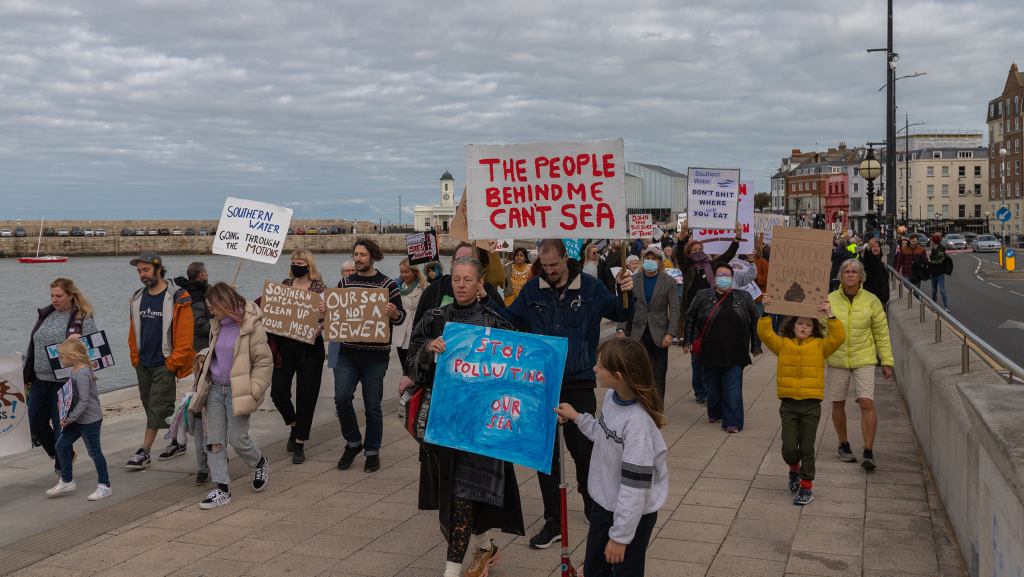
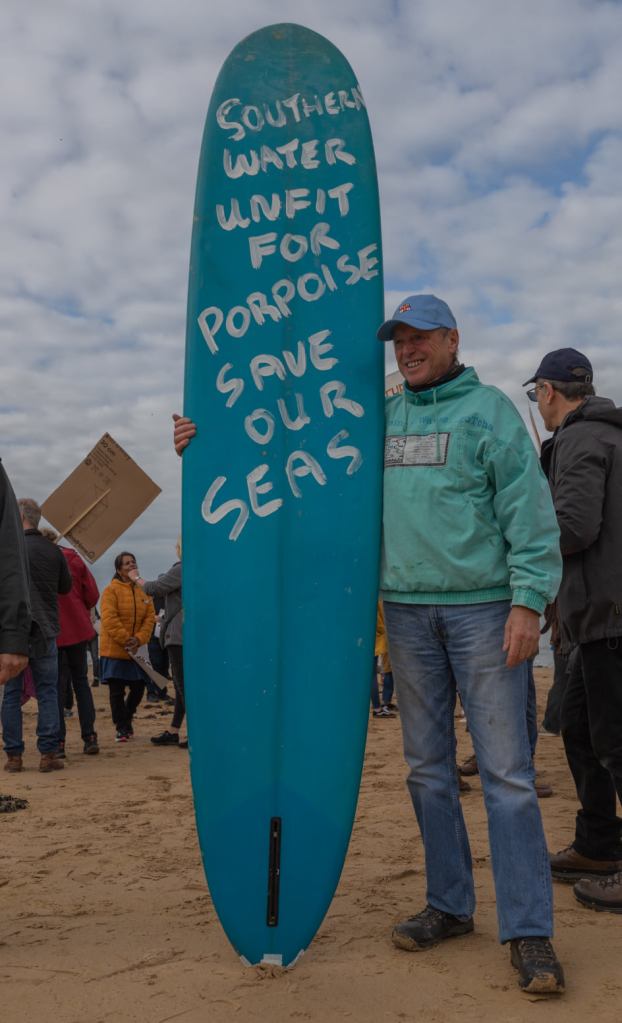
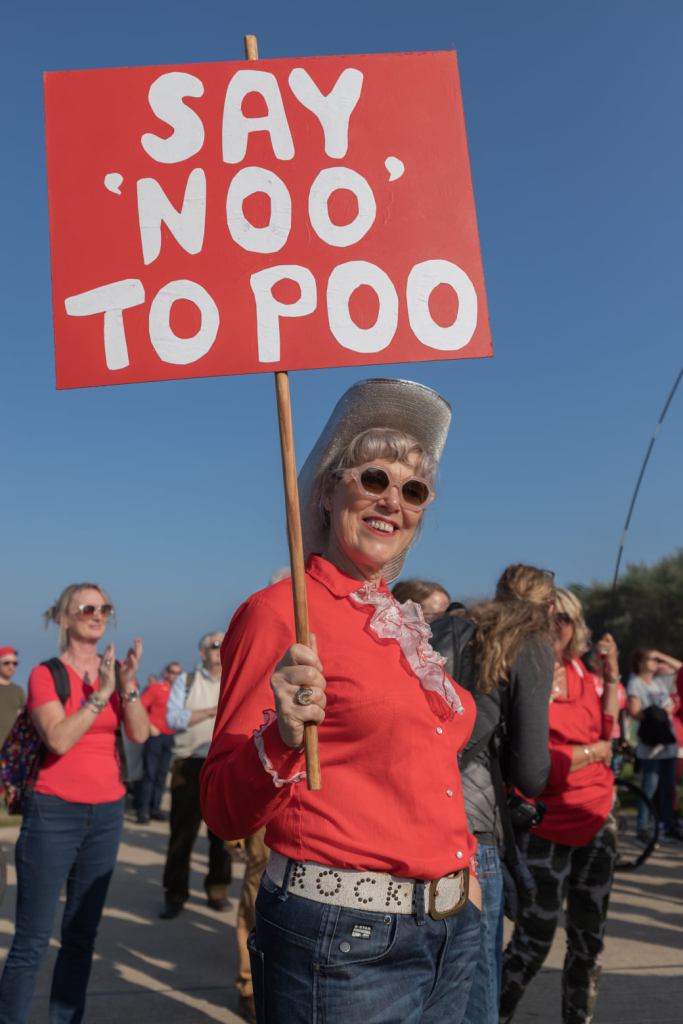
Photos from Margate and Whitstable protests
(All photographs by Andrew Hastings. Click on images to enlarge)






Whitstable Views: How You Can Help
- Make sure you share and like our articles on Facebook and Twitter, and whatever other social-media platforms you use.
- Follow the site to get regular updates about new articles when they appear. Press the “Follow” icon in the bottom right hand corner of your screen and that will take you to the option to sign up. (It disappears as you move the text down, then reappears as you move it back up again!)
- Leave comments on the site rather than on Facebook. Let’s get a debate going. All of our contributors are willing to engage with you if you leave a comment.
- To all writers out there, we would LOVE you to make a contribution. Read our submissions page for details on how to go about that: https://whitstableviews.com/submissions/
- Finally you can donate. As little as £1 would help. Details on the donations page here: https://whitstableviews.com/donate/
 Whitstable Views