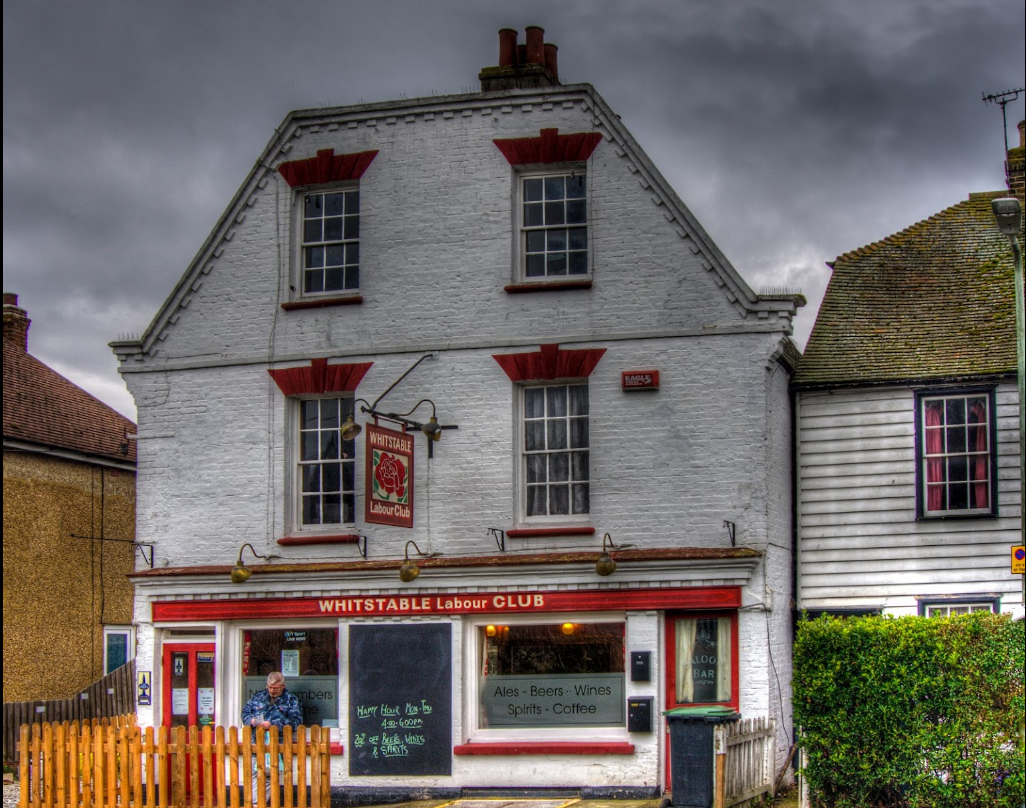
The Whitstable Labour Club and the case for socialism
by
There’s an old Chinese proverb: he who chops wood gets warm twice. Actually he gets warm more times than that: once when he collects the wood, once when he saws it, chops it and stacks it, and once again when he burns it on his fire. He also benefits in other ways. Walking in the woods while collecting the wood on a warm summer’s morning is balm for the soul, while sitting by the fire on a cold winter’s evening, watching the flames as they flicker in the hearth, is to bring the light of the woods into your home. Is there anything more appealing, more joyous, more life-affirming than that?
I like to imagine this basic human activity translated into an economic theory. If we can bring the same multi-layered purpose into our daily labour – if we can make everything we do beneficial on a number of levels – then we would be going a long way towards fulfilling our sacred duty on this Earth.
I’ve been involved with a club in Whitstable for many years. It’s called the Whitstable Labour Club. It is owned by its members, not by the Labour Party. When I first started going there, back in the 1980s, it was dying on its feet. Not enough people were using it and the revenues were disappearing in mysterious ways. This was during the Miner’s Strike of 1984-’85. The Miner’s Support Group used to meet there on a Friday evening to plan the following day’s activities.
One day one of the younger members suggested we hold a benefit. We did, and it was a hugely successful night. Money was raised for the miners while, at the same time, the increased bar takings helped with a much needed cash injection. It also brought young people into the club giving it new health and vitality. Very soon this became the model on which the club’s future was secured. We would hold regular benefits down there for a variety of different causes.
My good friend Julian Spurrier, a solicitor at the time, would get license extensions from the local magistrates for special occasions. Once the magistrates had granted the first extension for a benefit they were obliged to continue issuing them, which made the club a late-night venue. For a time it was the only one in the town.
The club was under the railways arches on the London to Margate line, a good distance from the nearest residential homes. You’d hear the trains rumbling by overhead every half an hour or so, as they headed on their journey between the two cities. The whole building would rattle with the sound. There were two rooms: a bar at the front and a function room at the back. The function room would serve as the venue. We’d put on bands and discos and raise money for our preferred causes.
Bands would practice in the back room and give their time for free. Everyone would benefit. The club made money. The causes made money. The bands got a free practice room, and the town got a place to dance late into the night. Some of the young band members liked it so much they set about decorating the room. They painted the arched ceiling a deep, midnight blue, onto which they sprayed silver stars. It was like a Greek Orthodox chapel on an Island in the Aegean. In the early days the staff would volunteer to work behind the bar, in exchange for beer. Later, once the revenues were secured, and the club started making money, we were able to pay for full-time bar staff and a manager.
We kept going like that for a number of years, until the owners of the building put up the rent so much that we could no longer afford to stay there. After that the club bought a pub across the road, the Golden Lion, which is where it is to this day. It was cheaper to buy than to rent.
A special breed of people


It’s no accident that it all started with a benefit for the Miner’s Support Group. Miners are a special breed of people. They work in dark, dangerous conditions, and they depend on each other to keep themselves safe. They learn to watch each other’s back. There’s a deep, abiding sense of community amongst miners and their families. It’s no wonder that the National Union of Mineworkers in Britain was always a stalwart of socialist values. And it’s also no accident that it was after its defeat in the strike that the Thatcher government began the process of rolling privatisation that has continued ever since, and that has blighted our nation, turning it into the basket-case of Europe.
What is socialism? According to my online dictionary it is: “a political and economic theory of social organization which advocates that the means of production, distribution, and exchange should be owned or regulated by the community as a whole.” Clause IV of the Labour Party constitution – until 1995 when Blair replaced it with a vague wish-list of liberal aspirations – put it as follows: “To secure for the workers by hand or by brain the full fruits of their industry and the most equitable distribution thereof that may be possible upon the basis of the common ownership of the means of production, distribution and exchange, and the best obtainable system of popular administration and control of each industry or service.”
The clause appeared on the back of my Labour Party card when I was a member in the ‘80s. It was written by Sidney and Beatrice Webb in November 1917 and described by the Manchester Guardian at the time as “not revolutionary, but… significant… There is now for the first time embodied in the constitution of the party a declaration of political principles, and these principles are definitely Socialistic.”
The key phrase is “the common ownership of the means of production, distribution and exchange” and the key word is “common”. It’s from the Latin, communis, meaning “public, shared by all or many.” Its cognates are: commune, communicate, communal, commoner, communist and comrade. The fact that one part of the British Parliament is called The House of Commons, and that we refer to the voluntary association of ex-British Empire states as the Commonwealth, should tell you something about the origins and purpose of these institutions. The regime over which Oliver Cromwell presided in the 17th Century was also known as “the Commonwealth”.
In the UK there is a form of property referred as common land or, simply, the commons. Often the land is privately owned, but people have common-law rights upon the land, to graze livestock, to collect wood or simply to walk upon it and to enjoy its delights. A person who is allowed these rights is called a commoner. In other parts of the country the land is held in common and belongs to no one. Until the 17th Century vast swathes of the British countryside was commonly owned property of this nature.
Enclosures of common land had been taking place throughout the Middle Ages, but accelerated in the 17th Century after the Civil War. This involved the removal of common law rights and the privatisation of land, ostensibly in the name of improvement. Sometimes this was done unilaterally by a powerful landowner, but more often by Acts of Parliament.
There’s an old protest rhyme that recalls this process, known as The Goose and the Common:
The law condemns the man or woman
Who steals the goose from off the common,
But leaves the greater villain loose
Who steals the common from off the goose.
Finders-keepers
In an article for Splice Today, Kenneth Silber informs us about an economist of the free market Austrian School, Israel Kirzner, who propounded the concept of “finders-keepers” in relation to property rights. As Silber puts it: “The idea was that entrepreneurs discover value that others haven’t perceived, and therefore have a right to profit from exploiting that value. Kirzner gave a hypothetical of someone finding a water source in a desert; the person would have a right to use this asset, not regard it as someone else’s or the community’s.”
Silber’s piece is called Exploring the Hypothetical, and is about the use of hypothetical arguments in political debates, but in the case of the increased wealth of landowners after the Enclosure Acts, there was no hypothetical involved. They took property that was once a common resource and used it for their own benefit, thus enriching themselves. It is this privatisation of wealth that is at the root of modern capitalism.
As I said in a recent article: “Modern notions of property, as exclusive to an elite owner class, sealed by legal documents hidden in vaults—a form of magic—originates in the British Isles. Tribal people have no such concept. For tribal people property is collective. It belongs to the whole.”
The same applies to that hypothetical water source in Silber’s piece. Tribal people would have seen it as immoral to have claimed a water source as your own when other members of the tribe were thirsty. That doesn’t mean they had no concept of property. They did: but it was collective property, property belonging to the whole tribe, not individual property. They would defend their tribal property against incursions from other tribes, just as animals protect their territory.

Tribal people also had personal possessions that didn’t belong to the tribe. There’s a dynamic here, between what is private, and what is public. Both are necessary. We need our private spaces, our private property, our homes and gardens, but we need our public spaces too. We need hospitals, schools, libraries, parks. We need public infrastructure, like roads and bridges. A well-run society strikes a balance between the two. In the old Soviet Union, there were no private spaces. Everything was publicly owned. They were very good at large scale enterprises, such as sending people into space, or building dams and armies, but you really didn’t want to go into a state-owned cafe, where the staff were surly, the menu limited and the food often unpleasant.
Meanwhile, in our modern post-Soviet world, everything is being privatised. Fewer and fewer individuals own more and more wealth and our public spaces are being ripped out from under us. The internet, despite having been developed in the public sphere, is now predominantly private, owned and a run by a few rich tech barons; not unlike those feudal barons of the Middle Ages, whose wealth and luxury depended upon exploiting a subjugated population.
Socialism, as an idea, is an attempt to strike the balance between the public and the private. It allows private enterprise, but uses taxes to redistribute wealth from the private to the public sector. It recognises that wealth is socially created: not just by the entrepreneur in his private fiefdom, but by his employees too, and by their families. It suggests that the individual factory owner is dependent on the public infrastructure that surrounds him – the educational facilities that teach his staff, the public parks and hospitals that make life liveable, the roads and bridges that allow him to distribute his products – and that he should help to pay for those things.
It also recognises that some industries are best kept in public hands. These are what is known as “natural monopolies”, where the public is best served by running them as services rather than as profit-generating industries. Public health is one of these. The rail industry, the postal industry, the power industry, the water industry, are four more. While we don’t want the state running our cafes, we also don’t want greedy, self-serving corporations running the vital services that we depend on for our well-being and survival.
People often deride the idea of socialism by saying that no such society exists, but this is not true. Some form of socialism exists in all countries, including the United States, and there are a number of highly successful countries that are predominantly socialist, such as Denmark, Finland, Iceland, Norway and Sweden. This is known as the Nordic model. This is not to speak of those communist countries, such as China and Vietnam, that have moved away from the old Soviet model and are now successful mixed economies, combining the benefits of private enterprise with state funding and development.
Britain, too, was a socialist country after the Second World War. That was the country that I grew up in. We had a working National Health Service, free at the point of use, free dental care, free education up to University level, child benefit, housing benefit and a welfare state. Most of our industries were state owned. This was a mixed blessing. Some were bloated by bureaucracy and were better off in the private sector, but others, such as British Rail, have fared badly since privatisation, replacing a cohesive industry with a mad patchwork of inefficient private companies, none of which serve the public well.
—Follow Chris Stone on X: @ChrisJamesStone
Article originally appeared here.
About CJ Stone
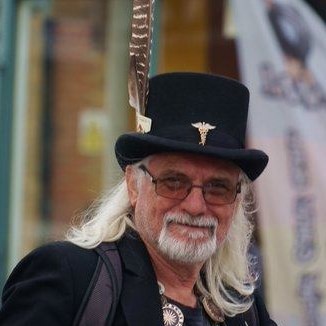
CJ Stone is an author, columnist and feature writer. He has written seven books, and columns and articles for many newspapers and magazines.
Read more of CJ Stone’s work here, here and here.
Whitstable Views
How to use it!
- Make sure you share and like our articles on Facebook and Twitter/X, and whatever other social-media platforms you use. Join us on Facebook here: @whitstableviews
- You can read and contribute articles for free but in order not to miss any, please subscribe to get regular free updates.
- To do so, press the “Subscribe” icon on the bottom right hand corner of the screen. This will take you to the option to sign up. (It disappears as you move the text down then reappears at you move it back again!)
- Please engage by leaving comments on the website, rather than on social media. Let’s get a debate going. All our contributors welcome the chance to engage with YOU.
- To all writers out there, we want to hear YOUR views too, so do submit your own articles. Read our submissions page on how to do this: https://whitstableviews/submissions/
- Finally, to keep Whitstable Views alive and independent please donate if you feel able to do so. As little as £1 would help. Details are on the donations page here: https://whitstableviews.com/donate
 Whitstable Views
3 Comments