
Julie Wassmer: Boycott Waterbills. Photo by Perou
Why I will make a counter claim against court action
by
In 2021, in protest against Southern Water’s unacceptable record on sewage dumping, I began withholding payment for the wastewater element of my water bills – and I continue to do so in spite of threatened court action.
In July of that year, Southern Water had received a £90m fine for its illegal activities in sewage dumping – a record sum that was widely reported and which therefore brought the issue of sewage pollution to national attention. But this sum was actually far less than the £126m the company had been ordered to pay in fines and penalties following an Ofwat investigation two years earlier. Could a criminal fine really be a deterrent when it was clearly cheaper for water companies to break the law?
More robust direct action was needed than simply turning up with a placard once a year
Ultimately, the £90m fine went to the Treasury and in no way helped to remedy the damage done to the environment and although I took part in massive protests staged by campaign groups like SOS-Whitstable, on beaches in my home town of Whitstable, and in Margate, I soon realised that more robust direct action was needed than simply turning up with a placard once a year to hear high profile speakers and electioneering councillors grandstanding while repeating the same mantra.

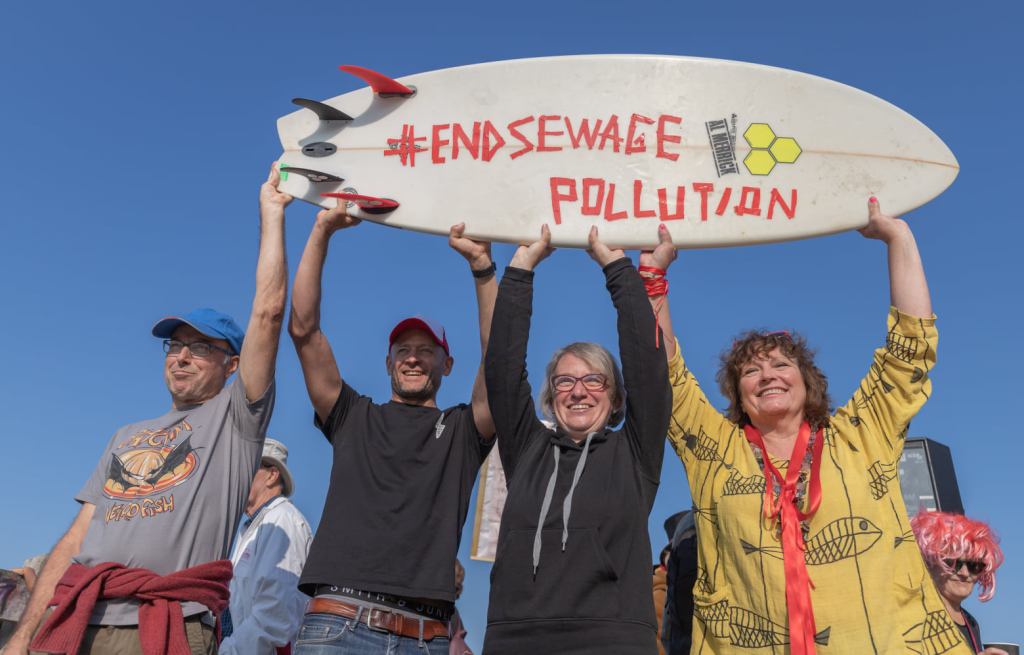
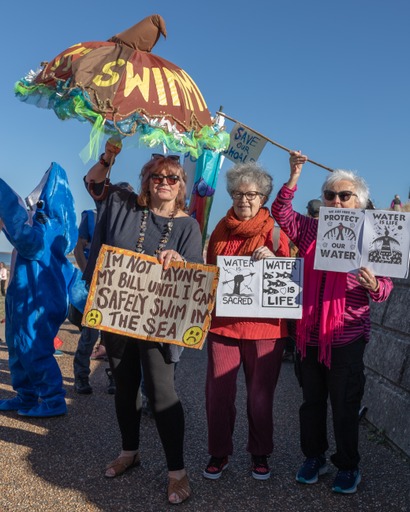
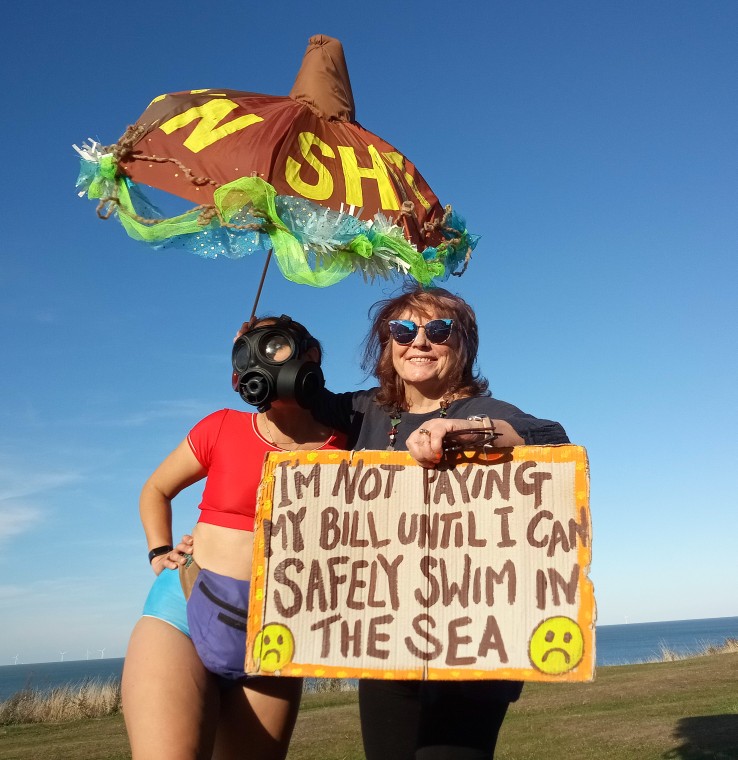
(Click on images to enlarge)
We know the problem. What’s the solution? In the absence of any real consequences for these polluting companies, I began boycotting payment to Southern Water, along with three other local residents, and strong vocal support from Bob Geldof.

Billing for Southern Water’s wastewater services in my area is actually undertaken by South East Water. The latter is also responsible for water provision, for which I have continued to pay, while withholding all further wastewater payments to Southern Water. Both companies were duly notified of the boycott action and while South East Water has consistently shown respect and understanding for my position, in August 2023 they were obliged to send me a document entitled a guide to pre action protocol for debt claims – essentially a warning of impending court action to recover the wastewater sum I have withheld since 2021 – which now amounts to over £1,000.
I intend to make a counter claim against the water companies
While I have received several Final Notices, and a “courtesy call” warning me of imminent legal action, I still await formal notice of court action for debt recovery. Today, I notified South East Water that should they take steps to sue me for non-payment, I intend to make a counter claim against their action, in order to challenge the assertion made by water companies regarding our obligation, as customers, to pay.
In a Letter Before Claim sent to me in August 2023, South East Water informed me as follows:
“The Water Industry Act 1991 is an Act of the United Kingdom Parliament relating to the water supply and the provision of wastewater services in England and Wales. As such, South East Water (the water undertaker) has powers under Section 142 (1)(a) & (b) and section 144 to fix and recover charges from any persons to whom the undertaker provides services. South East Water has a statutory obligation to supply occupants for the water service provided to them; therefore no written contract is needed.”
As mentioned, I have continued to pay South East Water for all the water provision services they have provided to me as “undertaker”, but the crucial assertion contained in that statement, is one which all water companies in England and Wales rely upon – namely, that since no written legal contract exists between the companies and water customers, we are statutorily obliged to pay, in the same way residents are obliged to pay council tax. Implicitly, this excludes any opportunity for protection for customers under the Consumer Rights Act 2015, which offers recourse against any company that gives unsatisfactory services.
The companies’ position is based on a very old legal decision and it’s one I intend to challenge
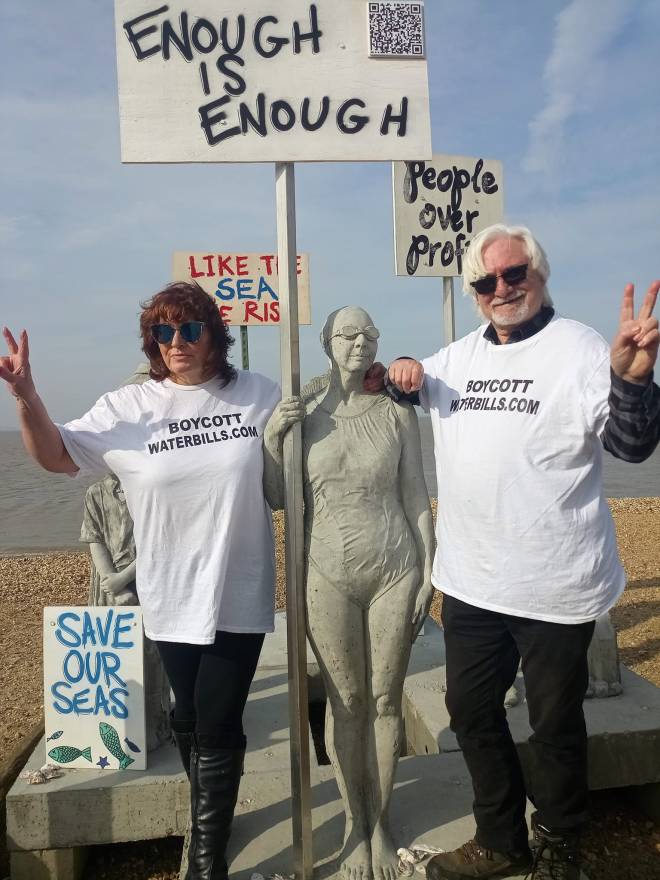
Over the last year, I have been advised by leading law firms, a KC and a judge, no less. Importantly, I now understand that the water companies’ position is flawed. While their obligations are indeed governed by statute, this does not exclude them from having an (express or implied) contract with the customers to whom they provide services. In fact, the companies’ position is based on a very old legal decision and it’s one I intend to challenge.
It isn’t easy living with the constant threat of debt recovery via court action, but neither is it easy to accept the environmental damage that’s still being done to our seas and waterways by sewage dumping from companies that have continued to profit from an industry that should never have been privatised. In February last year, Southern Water was ordered to pay £330,000 after raw sewage escaped into a Hampshire stream for up to 20 hours, killing approximately 2,000 fish because of faulty equipment at a pumping station.
An insufferable status quo
A Corbyn-led government would have re-nationalised our water industry. The Green Party also supports renationalisation – but what hope is there now when we are stuck with a pseudo-Labour administration that continues to support the insufferable status quo while making polite noises about tougher regulation from Ofwat – the so-called ‘regulator’ that has already given its agreement to water bills rising by 36% over the next five years, forcing struggling households to pay twice over for decades of their own underinvestment.
The truth is, we have no choice as customers about the water company we use, as each company has a monopoly over service. Privatisation was meant to lead to improved customer service through competition – as well as lower bills – but instead, the opposite has happened. Since the ’90s, investment from the water companies has decreased by 15% while the companies have built up a debt mountain of £60 billion, paying their shareholders a staggering £72 billion. ( £2 billion a year on average).
English water companies are more than 70% owned by overseas shareholders, banks and equity funds and our bills have increased by 40% in real terms since privatisation.
Water is a precious resource which we need to conserve – particularly as the impact of Climate Change becomes greater, but the Environment Agency has warned that by 2050 some rivers will see 50-80% less water in summer months and water companies are leaking away up to a quarter of their supply. (2.4 billion litres a day).
As for pollution, water companies discharge raw sewage into our rivers and seas more than 1,000 times on average every day. (Over 9 million hours since 2016).
A complaints process unfit for purpose

Two years ago, I teamed up with payment boycotters in Hastings to develop the website www.boycottwaterbills.com.
Reluctant to actively recruit others to withhold payment without giving full warning of possible repercussions, we simply aimed to offer useful information to anyone wishing to take independent action by boycotting payment for unacceptable wastewater services. We found ourselves inundated with responses from potential boycotters, to whom we explained the existing complaints process – a process that was then duly shortened and found to be totally unfit for purpose with respect to sewage pollution as my fellow Hastings campaigner Katy Weitz and I reported to the press via a copy of our letter to the then Environment Secretary, Therese Coffey MP. See:
A Kafkaesque scenario
The Consumer Council for Water (CCW) and the Water Redress Scheme (WATRS) which is administered by the Centre for Effective Dispute Resolution (CEDR) ultimately inform complainants that only Ofwat and the Environment Agency (EA) are able to deal with complaints into sewage dumping. While the EA’s funding has been cut by 50% over the past decade, Ofwat is known to have operated a “revolving door” between those working at the water companies and its own organisation so what possible chance is there of holding the companies to account in such a Kafkaesque scenario?
While press statements are ever forthcoming from companies like Southern Water trying to impress us with their “Turnaround Plan”, ultimately talk is cheap, especially from a company about which Ofwat CEO, Rachel Fletcher, said in 2019, after a damning discovery of Southern Water’s manipulation of wastewater samples: “It was not just the poor operational performance, but the coordinated efforts to hide and deceive customers of the fact that are so troubling.”
Why on earth should we believe Southern Water now?
A legalised scam
Privatisation of the water industry has been a failure; a widely regarded “legalised scam” which has benefited only the companies, their executives and their shareholders.
Our website www.boycottwaterbills.com was able to confirm payment boycott action in all eleven wastewater company areas involving, we believe, thousands of customers. Extinction Rebellion has since taken up this cause with its own Don’t Pay for Dirty Water Campaign – and so a movement of payment refuseniks grows ever stronger. How else can we as customers register our fury at this situation, which continues to damage our environment, wildlife and health except by exercising the only consumer choice we now have – not to pay for it?
Shamefully, last year Southern Water dared to issue a statement about the importance of payment, claiming: “Customers’ bills not only pay for our services, they also play a big part in helping us support our most vulnerable customers, including those in need of financial assistance, those with long-term illness or disability, the elderly, and parents with young children. This allows us to offer payment holidays, special tariffs, debt write-offs, bill reductions and grants.”
Notably, the company failed to mention the “debt write-offs” that have been offered to payment boycotters as incentives to give up their action. Ashley Clark, a Whitstable-based former Conservative councillor and police officer, who boycotted payment as far back as 2021, found himself forced to issue the following warning to Southern Water on receiving a threat of debt recovery:-
“Please desist from this unpleasant activity and note that I will entertain no further correspondence from yourselves on the issue. If you send the debt collecting thugs around I will have no alternative but to call the police. I owe you nothing.”
After his statement was published by the press, he was then duly offered 50% off his outstanding bill, while 100% was wiped off the withheld bill of a payment boycotter based in Walmer, Kent.
If Southern Water considered those boycotters deserving of such “write offs” why not offer them to all four million of the company’s customers, not just those highlighting the Southern Water’s record of atrocious environmental pollution?

My fellow Whitstable resident and payment boycotter, Chris Stanley, who is also facing court action for non-payment says:
“I am an 82-year-old, retired magistrate. I used to swim regularly in the sea, two minutes from my house. Swimming is good for my mental and physical health – particularly as I age. Recently, I had a life-saving operation. Swimming would have helped my recovery, but sewage discharges were so frequent that swimming was not advisable. I do not see why I should pay the full bill for a service which is not provided in full. I do not see why I should pay the full bill without compensation for the detriment (removal of the swimming amenity much of the time, and detrimental impact on physical and mental health) caused.”
Along with thousands of others, Chris and I are determined to stand firm in the face of court action. In my own case, I’m fully prepared to respond to legal action with a counter claim. The water industry in this country, shamefully supported by successive governments, is a national and international disgrace. Should these companies go to the wall, so be it.
Southern Water, bring it on.

Julie Wassmer is a Whitstable-based author, TV writer and environmental campaigner. She has successfully fought a number of environmental issues, including fracking in Kent and tree clearances by Network Rail. Her Whitstable Pearl crime novels are now a major TV series, starring Kerry Godliman.
Whitstable Views
How to use it!
- Make sure you share and like our articles on Facebook and Twitter/X, and whatever other social-media platforms you use. Join us on Facebook here: @whitstableviews
- You can read and contribute articles for free but in order not to miss any, please subscribe to get regular free updates.
- To do so, press the “Subscribe” icon on the bottom right hand corner of the screen. This will take you to the option to sign up. (It disappears as you move the text down then reappears at you move it back again!)
- Please engage by leaving comments on the website, rather than on social media. Let’s get a debate going. All our contributors welcome the chance to engage with YOU.
- To all writers out there, we want to hear YOUR views too, so do submit your own articles. Read our submissions page on how to do this: https://whitstableviews/submissions/
- Finally, to keep Whitstable Views alive and independent please donate if you feel able to do so. As little as £1 would help. Details are on the donations page here: https://whitstableviews.com/donate
 Whitstable Views
One Comment