Nominative determinism and the crisis of identity
by
Reg
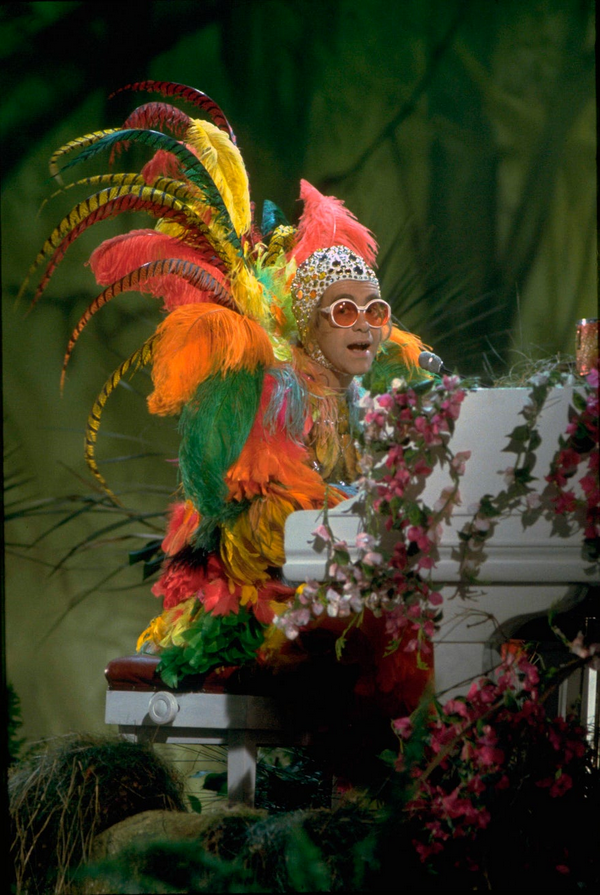
What do Reg Dwight and Elton John have in common? If you’re a fan, you’ll probably already know that they are one and the same person. Reg Dwight was Elton John’s birth name, the name his mum and dad christened him with and that he was known by during the years he was growing up.
His friend, Tony King, knew him before he changed his name. This is how he describes their first meeting:
It was at Dick James’s Office that I first met Elton – or Reg as he was at the time. He was fantastically shy back then, wouldn’t say boo to a goose. He didn’t seem at all like the person who’d be charismatically wowing audiences in a few years’ time; he was kitted out in a jean jacket and jeans – double-denimed if I remember.
Later, of course, Elton John became almost as famous for his outlandish dress sense as he was for his song writing. Here’s King’s description of him at Madison Square Gardens in 1974 when he welcomed John Lennon onto the stage:
Elton rose from his piano to greet him. His glasses were as large as John’s were small. He’d been wearing a sort of two-piece jump suit, white and studded with sequins. By this point in the concert, the jacket had long gone and he was bare-chested, bar the sparkling pair of braces that were holding up his trousers.
How different this person is to the dowdy, double-denimed shy creature that King met in Dick James’s office all those years before. It’s like they are two entirely different people, two different characters occupying the same space, the same physical body. The only difference between them is their names.
When I interviewed King about his book, I asked him when the change took place? He said it was after a sell-out tour of the United States. He was being lauded as the next big thing after the Beatles. He said Elton John took his style from other piano players, like Little Richard and Liberace. Piano players have a tendency to get lost behind their instrument and have to do something to bring attention to themselves, he told me.

The term “nominative determinism” refers to the way that people tend to gravitate towards areas of work that their name suggests. It was first used in the magazine New Scientist in 1994 after the popular “Feedback” column noted several studies carried out by researchers with remarkably apt surnames. These included a book on polar explorations by Daniel Snowman and an article on urology by researchers, Splatt and Weedon. This began a regular feature in the magazine where readers would send in examples of these career-name overlaps.
The obvious follow up question to this has to be, can a change of name change your destiny? If nominative determinism is a thing, then maybe people who change their names can change who they are or who they are perceived to be. That clearly seems to be the case with Elton John, who is obviously a much more expansive and confident person under his new name than he was when he was Reg Dwight.
I have a number of friends who have changed their names over the years. These include Rocky van de Benderskum, Jon Eldude, Lou Purplefairy, Mog Ur Kreb Dragonrider, Pixi Morgan and King Arthur Uther Pendragon.
Arthur

Actually the last four of those names can be lumped together, as they are all members of King Arthur’s Loyal Arthurian Warband (LAW). I’ve known Arthur since the 90s. We wrote a book together which includes the story of how he came to change his name. He was born John Timothy Rothwell. He was a biker, the president of a famous biker gang. One day he was in the squat that served as the clubhouse with one of the members, someone they called the Whippet. He’d been having a crisis of identity. Who was he? He wrote all of his numerous names on a board – King John, Mad Dog, Bacardi, his social security number, his army number, all of the names he’d ever been known by – and handed the board to the Whippet. “I’m bored,” he said. At the centre was the name King John. It was the name he was commonly known by at the time, after a local monument, Odiham Castle, known as King John’s Castle, where they used to hold full moon parties.
The Whippet said, “you’re not King John, you’re King Arthur.” He’d been reading The Secret Tradition in Arthurian Legend by Gareth Knight. He threw the book over and Arthur started to read. Every time he turned a page a new phrase would leap out at him. It was like the book was describing his own life. At the end of the night he was convinced that it was true and very soon after changed his name legally. Thus began his life as King Arthur Uther Pendragon.
In the book we try to find explanations for this strange transformation. Is he the reincarnation of Arthur, we ask? Is there a spirit of Arthur that he is embodying? Is it it a fantasy? Is it magic? Arthur own formulation goes like this: “there’s a pre-Roman Arthur, a post-Roman Arthur and a post-Thatcher Arthur, and that’s me.”
Later a friend made another suggestion. He said that, by adopting the name, Arthur had evoked something – the spirit in the myth maybe – and that it probably came as big a surprise to Arthur as it did to everyone else. You can see the name as a sort of mantle, a title rather than a name, with a set of responsibilities which go with it. Fortunately Arthur has managed to live up to his role and is internationally famous as one of the Chief Druids who preside over Stonehenge on the four nights of the year when there is managed open access for members of the public. The principle one is the summer solstice which begins at sunset of the 20th June, straddling the night till the dawn of the 21st.
Of the other Arthurian names: Lou Purplefairy is one of Arthur’s loyal lieutenants, Mog Ur Kreb Dragonrider is a profoundly deaf person who thinks that he was Arthur’s son in a previous life, and Pixi Morgan has now passed away. I wrote an obituary for Pixi here.
Jon

Jon Eldude is also a member of the Loyal Arthurian Warband, although less closely associated with them than the rest. Jon has changed his name a couple of times. First he was Jonathan Elliott, then Jon Eldude. Now he has reverted to Elliott again, although he is generally known as Eldude by his friends.
The name is a reference to the Dude, played by Jeff Bridges in the Coen brothers’ movie, The Big Lebowski. He’s one of Jon’s heroes. He’s the model of the laid-back hippie that Jon would like to be. Unfortunately Jon has a temper. By his own admission he’s more like John Goodman’s character, Walter Sobchak, than he is the Dude. He’s been arrested a couple of times, the last time for putting a stink bomb in a ballot box in the local elections in 2013. It was during the sarin scare. When the election agent found the vials, wrapped up in a ballot paper on which was written the word “revolution”, she thought it might be something dangerous and she was upset. Jon heard the news on the local radio station. He decided that he needed to explain and rang the station. The producer was angry and shouted down the phone at him. He called the police, who already had Jon on their radar from an earlier incident. They came to his house and arrested him.
The other incident happened about a month before. He’d leapt upon the then Prince Charles’ car before the inauguration of the Archbishop of Canterbury at Canterbury Cathedral. He didn’t know it was Prince Charles as the windows were blacked out. He thought it was the then Prime Minister, David Cameron. He was arrested for that too and bound over to keep the peace for a period of six months, which meant that he was breaking the conditions of his sentence by admitting to the stink bomb prank. He was sent to jail for six months, of which he served three.
The reason he’d done this is that he was pissed off. He’d seen some politicians on TV the night before and they had annoyed him with their lies and deceptions. He thought the whole system was designed to exclude ordinary people and he wanted to show his anger. Hence the stink bomb. He hadn’t considered the sarin scare, nor what the election agents might feel, nor had he considered the consequence of breaking his conditions.
This is much more like Walter Sobchak than it is the Dude. In the film John Goodman’s character is always flying off the handle, never stopping to think what might happen. Maybe that’s why Jon decided to change his name to Eldude: in order to be more laid back like his hero, less like Walter Sobchak.
I was there when he signed the papers. I counter signed them as his official witness. I was a witness too to the look of excitement in his eyes. There was a fierce light there, a gleam of exultation as he passed me the papers to sign, as if he what he was doing was indelibly important, as if he was laying claim to his destiny with this simple act. I was surprised, therefore, when I addressed him as Eldude some years later, to discover that he had reverted to his original name again. Why was that, I asked?
It was because of his dad, he told me. He’d gone to the care home where his dad spent his last days and told him that he’d changed his name. His dad said that it was childish. That broke his heart. He knew his dad had hated his own father, who was a drunken bully who he had to hide from whenever he came home from the pub. But Jon loved his dad. He remembered the commandment in the Bible, to honour thy father and mother. He was proud of the Elliott name and the history that went with it. He thought, “I love my father. I want to honour him.” So he changed his name back again.
He’s still Jon Eldude to me though. It’s how I refer to him in conversation with his friends. He’s well known around Whitstable and Canterbury, much loved despite his occasional bouts of depression. He’s a Dudeist Priest in the Church of the Latter Day Dude, the mock religion created by journalist Oliver Benjamin in 2005. You can read the Dudeist Manifesto here or become ordained yourself here. According to the website, previous incarnations of the Dude include Lao Tsu, Heraclitus, Snoopy the dog, Quincy Jones, Jennifer Lawrence and Kurt Vonnegut. The website describes its philosophy in the following terms: “Life is short and complicated and nobody knows what to do about it. So don’t do anything about it. Just take it easy, man.”
Needless to say Jon no longer leaps on passing cars with members of the Royal Family in them. Nor does he drop stink bombs into ballot boxes. Instead he does what the film recommends: “The Dude abides.”
Rocky

Nomenclature reassignment is a bit like gender reassignment, but not quite as drastic. It doesn’t involve any surgery. All it asks is that people recognise you by your new name. My final example is Rocky van de Benderskum. He stood as the Member of Parliament for the Canterbury Constituency in 2005 for the Legalise Cannabis Alliance. I was his election agent. You can read about that here.
He says he’s lived several different lives. He worked for a ship’s computer company for a while, selling computers to shipping companies. He’s been (but not in this order): a bus driver, a merchant seaman, a teacher and a soldier. The last one was a mistake. He meant to join and then leave again just to shut his dad up. He had a friend who had done this. In those days it was possible. You could sign up and then leave within a five day period. So he signed up and then tried to leave, only to find that the rules had changed. The five days grace period started when he signed the forms at the army recruitment office, but that was two weeks ago, long before he first attended barracks. Consequently he was stuck in the army for the next four and a half years.
I asked what his army number was but he refused to tell me. It was “two four two double shuffle, knife, fork and spoon,” he said.
After that he was a tree surgeon, self-employed. But then his tools and his works van were stolen. He wasn’t insured. He thought, “you know what, fuck it!” He got someone to buy all his stuff, including a brand new bed. The guy offered £100 for the lot. Rocky pointed to one of his paintings on the floor. “It’s a deal as long as you take that painting as well.” The man agreed and that was that. He gave up the rent on his flat and he was homeless.

He was on the streets for a while, but that wasn’t much fun. Later someone offered him a bender for £10. A bender is a type of temporary accommodation, originating in the Roma community, made of pliable hazel switch and tarpaulin. The cut stems, known as withies, are stuck into the ground and bent over to make arches, then tied together at the top to make a dome. The entire structure is covered in tarpaulin to create a remarkably resilient shelter. He set his bender up in Penny Pot Woods near Canterbury, but it wasn’t very salubrious. Later he learned to make them himself from scratch. That was how his life as Benderskum began.
He lived this way for a number of years, in the woods. He did a computer course while he was there. Not that he had a computer in his bender. He went to the library and the adult education centre for that. But it meant that, even while he was living this primitive, back-to-nature lifestyle, he was also up to date on all the latest technology: a sort of techno-shaman of the cantheist tribe. Cantheism is his religion. He believes that humankind co-evolved with cannabis, and that cannabis has always been our companion in our wanderings around the planet.
My contention in this article has been that changing your name can change your identity. It can change your relationship to the world. Reg Dwight changed his to Elton John, overcame his shyness and altered the way he looked. Arthur Uther Pendragon took on the mantle of a mythical King and became a leading figure in the world Druid movement. Jon Elliot became Jon Eldude and learned to abide. Rocky, on the other hand, says he’s always been Rocky. That was the name he was born with. It’s the “van de Benderskum” part that has changed.
He says that he has always been an oddball. Even as a kid he didn’t fit in anywhere. The surname he was given never felt like his. It was only when people started calling him Benderskum that he felt that he had discovered his true name. He always was a Benderskum, he thinks, it’s just that he didn’t recognise it before.
Since then he has developed Acute Myeloid Leukaemia and has had to undergo chemotherapy. The cartilage between his bones has been destroyed, and he is very often in severe pain. He also has osteopenia, hyperthyroidism and fungal pneumonia from all the chemo, radioactive stuff and genetically modified hormones they pumped into him as part of his cure. He walks with sticks and lives in council accommodation in an apartment block on an estate in Canterbury. There are masks all over his walls. He paints a lot, which he describes as “scribbles”, and writes poetry, which he refers to as “Benderdrivel”. He says it’s not worth the paper its printed on. He also has a regular radio program, on Radio Illumini, here. He lives quietly and has a prescription for his cannabis, which helps to soften the rigours of his condition.
So that’s it: a brief rundown of a few people I know who have changed their names. There are many more. People do it for all sorts of reasons. Pop stars to make themselves look cool, revolutionaries to hide their identities or to strike a pose. Subcomandante Marcos, for example, always appeared with a mask on his face, while “Stalin” means “man of steel”. Criminals and con-merchants often change their names. Some do it for good reasons, some for bad. For some it has lead to fame or fortune, or to fixing their portrait on the walls of history; to others far less. For the people in this article it involved taking control of their lives, subverting the power of the patronymic, while becoming the people they were meant to be.
Story originally appeared here.
About CJ Stone
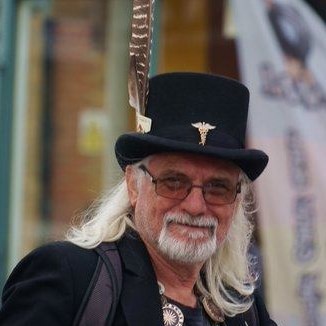
CJ Stone is an author, columnist and feature writer. He has written seven books, and columns and articles for many newspapers and magazines.
Read more of CJ Stone’s work here, here and here.
Whitstable Views
How to use it!
- Make sure you share and like our articles on Facebook and Twitter/X, and whatever other social-media platforms you use. Join us on Facebook here: @whitstableviews
- You can read and contribute articles for free but in order not to miss any, please subscribe to get regular free updates.
- To do so, press the “Subscribe” icon on the bottom right hand corner of the screen. This will take you to the option to sign up. (It disappears as you move the text down then reappears at you move it back again!)
- Please engage by leaving comments on the website, rather than on social media. Let’s get a debate going. All our contributors welcome the chance to engage with YOU.
- To all writers out there, we want to hear YOUR views too, so do submit your own articles. Read our submissions page on how to do this: https://whitstableviews/submissions/
- Finally, to keep Whitstable Views alive and independent please donate if you feel able to do so. As little as £1 would help. Details are on the donations page here: https://whitstableviews.com/donate
 Whitstable Views