A chemical romance in the Isle of Avalon, after which the writer is knighted for the third time
by
Witness

Every so often I will get to the end of a book and be so impressed that I will have to start reading it again. It’s a rare but notable thing. There must be something in the book to which I can relate on a personal as well as an intellectual level. One of these books was Witness Against the Beast: William Blake and the Moral Law by E.P. Thompson.
Thompson, you might know, was the avowedly Marxist historian most famous for The Making of the English Working Class, a study in the shift in social relations that took place during the Industrial Revolution. It is probably the most influential work of academic history ever to come out of the United Kingdom, and Thompson is one of our most well known historians. Witness Against the Beast is Thompson’s final work, an altogether smaller book, focussing on the poet and engraver, William Blake, who was alive during this period. It’s an attempt to discover the specific tradition out of which Blake’s ideas arose.
I first heard about in in the early 2000s. A friend told me that he had seen it on the shelves of Julia and Trevor Seath’s bookcase. (Whitstable readers will know who they are.)
I was engaged in writing my co-authored book, The Trials of Arthur, at the time. This is about an ex-biker turned Druid who identifies with the historical-mythical figure of King Arthur. The co-author was Arthur Pendragon himself, the subject of the book. It involved a lot of journeying to Glastonbury and the West Country to meet Druids and other such magical folk, while consuming copious amounts of hard cider, and discussing Celtic history and mythical kings in an atmosphere of weird mystical speculation.
Meanwhile I lived (still live) in Kent, in the South East, an Anglo-Saxon stronghold. I felt very split. On the one hand I had what I called my Western Mind, which was the one supposedly writing the book. This was mystical, speculative, poetic in nature, engaged in such ideas as reincarnation and Celtic legend. It was most engaged in Glastonbury. On the other I had my Eastern Mind, where I lived, which was pragmatic, political, down to earth, caught up in protesting against the War on Terror, which was the current issue at the time. I must admit that my Eastern Mind was in the ascendant and that not much in the way of writing was taking place. I preferred standing outside Barclays Bank on Whitstable High Street handing out leaflets and organising against the war.
I went to Julia’s house and told her I’d heard that she had a copy of Witness Against the Beast and asked if I could borrow it. She very graciously allowed me to take it home with me. I immersed myself in it completely. As I say, it is an attempt to discover the intellectual tradition out of which Blake was operating. He was no academic. He was a working engraver, skilled but eccentric. You can see him as an artisan rather than as an artist, self educated: more like a cabinet maker or a tailor than an oil painter exhibiting portraits in the Royal Academy or a scholar involved in polite academic debate.
What Thompson does is to locate a particular strand of English intellectual history that he calls Antinomianism, or the English Dissenting Tradition. “Antinomian” means “against the law”. It’s a form of Christian thinking that eschews the Jewish law of the Old Testament, and focusses instead upon the idea of free grace in the New. Grace is given by the love of God, and no amount of adhesion to strict laws can determine whether you will receive it or not. It’s a form of millenarian enthusiasm that has its roots deep in the Christian faith. In Britain it was at its most overt during the English Civil War when the censorship laws had broken down and there was a rash of mystical, political and revolutionary tracts available, attached to various dissenting groups, including the Baptists, the Quakers, the Fifth Monarchists, the Levellers and the Diggers, amongst others. He traces Blake’s milieu back to that time and to that tradition.
Progress

Thompson opens the book with a discussion of The Pilgrim’s Progress by John Bunyan, which was written in the period of repression following the restoration of the monarchy in 1660. Bunyan began his work while in prison. He had been holding religious services outside the auspices of the established church. In other words, The Pilgrim’s Progress is a work of dissent. It was at this point that my sense of personal engagement kicked in.
Bunyan was the composer of the hymn To Be A Pilgrim, which had always stirred my heart when we’d sung it during assembly in my school years. Along with Jerusalem, it was one of my favourite hymns; and now here was Thompson, another hero, laying out a direct connection between the two. I began to imagine a strand of history of which I was a part, a secret lineage that led directly from Bunyan in the 17th Century, to Blake at the turn of the 18th and 19th, to Thompson in the 20th, to me now, at the beginning of the 21st, protesting against a war.
Later things got muddled up in my head. Arthur had grown tired of the delays and had arranged for me to stay in Glastonbury, the famous Isle of Avalon, at a friend’s house. There are well-known mythical and historical links here to the legend of Arthur. Camelot was supposed to have been located at nearby Cadbury Castle, while Arthur is said to have been transported to Avalon to recover after his wounding at the Battle of Camlann. It is from here, so the legend goes, that he will return when the Isles of Britain are in mortal danger.
I was working on the book by day and then reading it out to my friends in the evening. It was a very creative time. The book was making progress. One day Arthur turned up and we threw a party. Lots of alcohol and other organic compounds were being consumed. Eventually, exhausted by it all, I went to bed, but, being overstimulated, couldn’t sleep. I found myself caught up in a vivid fantasy. I decided that I had been Chretien de Troyes in a previous life. Chretien was the 12th century author of a series of book-length poems about the court of King Arthur which kick-started the enthusiasm for what was known as The Matter of Britain. It was an enthusiasm that swept the Continent, leading to many books on the subject in a variety of languages written over a period of centuries. Chretien was at the root of this. Specifically he had come up with (or read about) the notion of the Holy Grail, the symbolic object that lay at the heart of the story.
Romance


Chretien never met Arthur, of course, who (if he ever existed) would have been a Dark Ages battle chieftain rather than a medieval knight. That’s what our modern Arthur was like: a biker chief on his iron steed, more rough and ready than the romantic depiction. I decided I was Chretien, the inventor of the literary Arthur, meeting the historical Arthur for the first time. The Grail story involves a procession. Four objects are paraded before the seeker. Jessie Laidlay Weston, in her book From Ritual to Romance, identified the four objects with the suits of the Tarot, which she referred to as the Grail Hallows, these being: swords, staves, cups and disks.
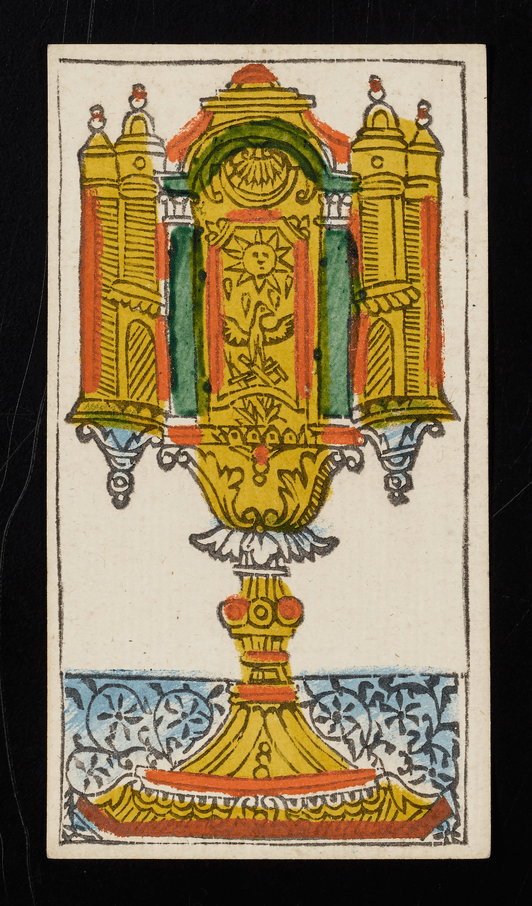
I was in a state of excitement as all of this was going through my head. I rushed upstairs to where the party was still going on to tell everyone what was happening. As I stepped into the room my eyes fell on a number of objects. There was Arthur’s sword, leaning up against a wall, alongside his staff. There were a few other staffs in the room too. These were Druids, remember. Then I looked down and on a small table in front of me there was an elaborate, medieval-looking silver goblet with a stem, not unlike the one represented as the Ace of Cups in the Tarot (see above). It was sitting on a circular silver tray. So there they were, the Four Hallows of the Holy Grail, right before my eyes, a sword, a stave, a cup and a disk, confirming what had been going through my head only moments before. All of this must have come pouring out of my mouth in a stream of excited blathering as I demanded that Arthur knight me there and then, which he duly did.
This was the third time I’d been under Arthur’s sword. The first time was when we’d met, back in the 90s, when I was writing a book about the Criminal Justice and Public Order Act and he was involved in a road protest, which is one of the things the Act was designed to stop. I was raised as a Brother Knight at Avebury stone circle: as he said, as someone whose feet were firmly planted in the 20th century, but whose values ran parallel to his own. The second time was when we’d secured the contract to write our book together. Then I was raised as a Quest Knight at Stanton Drew stone circle near Bristol, with Ronald Hutton, the historian, as a witness. My quest was to write the book. Finally, this third time, in Glastonbury, in the shadow of the Tor, I was raised as a Shield Knight: as someone who knew what his true identity was. Too many nights spent in Avalon can do that to a man’s brain.
Lineage

I’d already read Witness Against the Beast by now and, after going back to bed, added another couple of names to my imaginary lineage. I was also, I decided, John Bunyan and George Orwell. This was partly based upon the coincidence of names, “Chretien” being another form of “Christian” which is the name of Bunyan’s famous character in his novel. It had also been my assumed name for a while: James Christian. I’m less sure now about Orwell’s role in this, except that I identified with him as a dissident socialist and an Antinomian prophet: as someone who went against mainstream opinion in left wing circles at the time. Like the other two, he was a writer, something I’ve known myself to be since I was a child.
Anyway, that was my fantasy, brought on by chemical excitement late at night in the mystical Isle of Avalon. Do I still believe it? Well yes, but in a metaphorical rather than a literal sense. Between them Chretien de Troyes, John Bunyan and George Orwell represent my intellectual lineage. They are writers that I have learned from. All of them used allegory. All of them wrote for a popular audience. All of them created a lasting legacy, something that I still hoped to achieve.
Meanwhile, of course, I was marrying my Eastern Mind with my Western Mind, adding politics to mysticism and bringing King Arthur into the same space as E.P. Thompson. The result was the book, The Trials of Arthur, by CJ Stone and Arthur Pendragon, completed within the year. It was first published in 2003 and then revised and extended in 2012. It’s a book about protest and spirituality, about Celtic Romance and the Criminal Justice Act, about fighting for the land without going to war; a book about spiritual revelation and political rebellion, all at the same time.
—The Trials of Arthur: Second revision 2023 is available here.
—Story first appeared here.
About CJ Stone
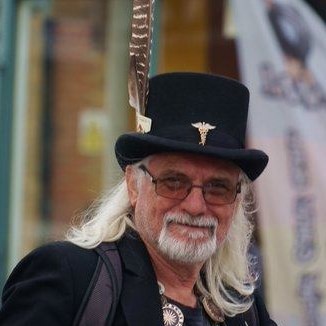
CJ Stone is an author, columnist and feature writer. He has written seven books, and columns and articles for many newspapers and magazines.
Read more of CJ Stone’s work here, here and here.
Whitstable Views
How to use it!
- Make sure you share and like our articles on Facebook and Twitter/X, and whatever other social-media platforms you use. Join us on Facebook here: @whitstableviews
- You can read and contribute articles for free but in order not to miss any, please subscribe to get regular free updates.
- To do so, press the “Subscribe” icon on the bottom right hand corner of the screen. This will take you to the option to sign up. (It disappears as you move the text down then reappears at you move it back again!)
- Please engage by leaving comments on the website, rather than on social media. Let’s get a debate going. All our contributors welcome the chance to engage with YOU.
- To all writers out there, we want to hear YOUR views too, so do submit your own articles. Read our submissions page on how to do this: https://whitstableviews/submissions/
- Finally, to keep Whitstable Views alive and independent please donate if you feel able to do so. As little as £1 would help. Details are on the donations page here: https://whitstableviews.com/donate
 Whitstable Views
One Comment