
by
Spring

It was a bright, blustery day on 4 February as we gathered on the beach to pay our last respects to Paul Anderson, our good friend, who had died in the early hours of New Year’s Day. After that we processed along Middle Wall to St Mary’s Hall, led by a marching band playing Downtown, the Petula Clark number, stopping traffic along the way.
The event was coordinated by Sue Goodrum, the celebrant. Various people spoke. The opening eulogy was by Clare Tindall, Paul’s partner of 17 years. It was moving, funny, warm and heartfelt, a real tribute to the man she had shared her life with, and cared for with such devotion and diligence as his health deteriorated in the last few months before his death.
The hall was packed. There wasn’t enough room for all of us and there was overspill into the entrance hall, plus the event was being livestreamed. We were joined by people from the UK, from Italy, South Africa, Australia, Thailand, Sweden, Canada, New Zealand, France, Mexico, the USA, Spain and Ireland.
Paul was an important figure, both in Whitstable and the world. He was a DJ and community organiser. He put on events around Kent, free parties and gatherings, in pubs, clubs and in fields. In his last years he was holding parties on the beach, every Bank Holiday Sunday, as well as DJ sets down the Coach and Horses. His very last public act, only hours before he died, was to play a set at a friend’s New Year party.
That was especially significant. Paul loved new things. He was always up to date with everything. He had the latest computer, which he had learned to navigate with all the skill of a teenage hacker. He had the latest phone. He played the latest sounds. His signature music was deep house, that euphoric blend of computer-generated bass-lines and American R’n’B, all played over a relentless, thumping 4/4 beat.
It seems strange to describe a funeral as “life-affirming” but that’s precisely what it was. We were gathered here in memory of a man who had touched our lives. There were people there who I hadn’t seen in years. That was always Paul’s great skill: bringing people together. It was his life’s mission. Whether on the dance floor in a club, around a table or down the pub, he loved to watch the interaction of other human beings enjoying each other’s company.
After the eulogies there was food, all of Paul’s favourites, made with love by Georgia Wells, Rosie Ochs and other people in the community. At 8pm Paul’s last set was played, all those specially selected tracks he’d put together to welcome in the New Year, full of secret messages about love and respect and the purpose of life, and people danced their hearts out, whooping and stomping to the radical beats as they filled the air like a temple of sound.
A fitting testament to the great man’s life. Here in our hearts. Never to be forgotten.
Paul’s last set:

Summer

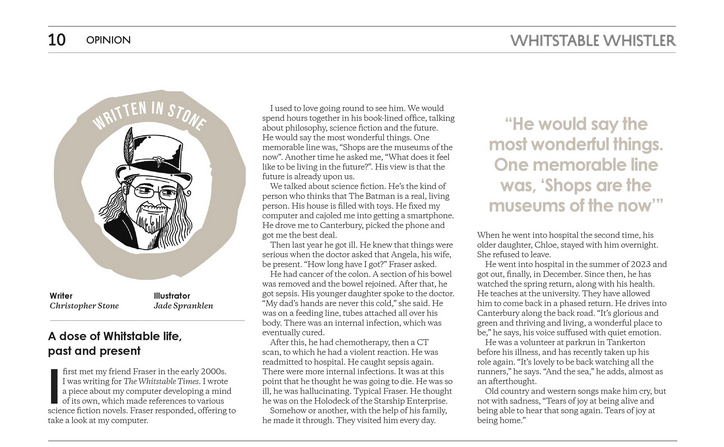
I first met my friend Fraser in the early 2000s. I was writing for the Whitstable Times. I wrote a piece about my computer developing a mind of its own, which made references to various science fiction novels. Fraser responded, offering to take a look at my computer.
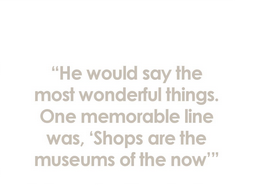
I used to love going round to see him. We would spend hours together in his book-lined office talking about philosophy, science fiction and the future. He would say the most wonderful things. One memorable line was “shops are the museums of the now”. Another time he asked me, “what does it feel like to be living in the future”? His view is that the future is already upon us.
We talked about science fiction. He’s the kind of person who thinks that The Batman is a real, living person. His house is filled with toys. He fixed my computer and cajoled me into getting a smart phone. He drove me to Canterbury, picked the phone and got me the best deal.
Then last year he got ill. He knew that things were serious when the doctor asked that Angela, his wife, be present. “How long have I got?” he asked.
He had cancer of the colon. A section of his bowel was removed and the bowel rejoined. After that he got sepsis. His younger daughter spoke to the doctor. “My dad’s hands are never this cold,” she said. He was on a feeding line, tubes attached all over his body. There was an internal infection, which was eventually cured.
After this he had chemotherapy, then a CT scan, to which he had a violent reaction. He was readmitted to hospital. He caught sepsis again. There were more internal infections. It was at this point that he thought he was going to die. He was so ill he was hallucinating. Typical Fraser. He thought he was on the holodeck of the Star Ship Enterprise.
Somehow or another, with the help of his family, he made it through. They visited him every day. When he went into hospital the second time, his older daughter, Chloe, stayed with him overnight. She refused to leave.
He went into hospital in the summer of 2023 and got out, finally, in December. Since then he has watched the spring return, along with his health. He teaches at the University. They have allowed him to come back in a phased return. He drives into Canterbury along the back road. “It is glorious and green and thriving and living, a wonderful place to be,” he says, his voice suffused with quiet emotion.
He was a volunteer at parkrun in Tankerton before his illness, and has recently taken up his role again. “It’s lovely to be back watching all the runners,” he says. “And the sea,” he adds, almost as an afterthought.
Old country and western songs make him cry. Not with sadness: “Tears of joy at being alive and being able to hear that song again. Tears of joy at being home.”
Autumn


Patsy Rowden lives in an upper floor flat on Cornwallis Circle. The view from her living room shows a children’s play area, people walking their dogs, and an arc of neat little houses surrounding the green. It’s an iconic scene. Whitstable at its best.
Inside the flat is light and airy: predominantly white, with a glass table, a fluffy mat, a settee, a comfy chair and a TV. What makes the décor slightly unusual are the pictures on her walls. I spot a photo of the Moai of Rapa Nui: those enigmatic Easter Island statues, like blind gods gazing blankly into the distance.
That’s when it strikes me. “Have you been to Easter Island Patsy?”
“Yes, twice. The first time I went I cried.”
After that I spot a map. It’s immediately recognisable as the Earth’s southernmost continent, a spacious stretch of white, with circular lines of latitude like a target surrounding the South Pole.
“And Antarctica, Patsy? Have you been to Antarctica too?”
She has, yes. That was on a trip circumnavigating South America. She’s been around the world six times, she tells me, on cruise ships, teaching English as a foreign language to the crew. She’s also lived in Israel, on a kibbutz, and in Turkey and Italy. She has enjoyed a lifetime of travel and adventure.
She says that friends sometimes ask where she would most like to live, given the choice. She tells them: “Whitstable. It’s my dad’s town. I spent 30 years travelling. Now I’m retired I want to sit back a bit.”

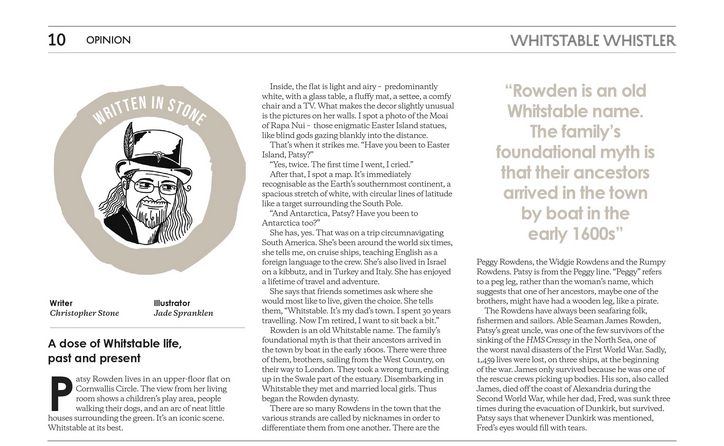
Rowden is an old Whitstable name. The family’s foundational myth is that their ancestors arrived in the town by boat in the early 1600s. There were three of them, brothers, sailing from the West Country, on their way to London. They took a wrong turn, ending up in the Swale part of the estuary. Disembarking in Whitstable they met, and married, local girls. Thus began the Rowden dynasty.
There are so many Rowdens in the town that the various strands are called by nicknames in order to differentiate them from one another. There are the Peggy Rowdens, the Widgie Rowdens and the Rumpy Rowdens. Patsy is from the Peggy line. “Peggy” refers to a peg-leg, rather than the woman’s name, which suggests that one of her ancestors, maybe one of the brothers, might have had a wooden leg like a pirate.
The Rowdens have always been seafaring folk, fishermen and sailors. Able Seaman James Rowden, Patsy’s great uncle, was one of the few survivors of the sinking of the HMS Cressey in the North Sea, one of the worst naval disasters of the First World War. 1,459 lives were lost, on three ships, at the beginning of the war. James only survived because he was one of the rescue crews picking up bodies. His son, also called James, died off the coast of Alexandria during the Second World War, while her dad, Fred, was sunk three times during the evacuation of Dunkirk. Patsy says that whenever Dunkirk was mentioned, Fred’s eyes would fill with tears.
Winter

My friend Charlie Rouse died in August. He was 69 years old.
I knew him from the 80s, when I first came to Whitstable. I used to drink at the Labour Club. His dad, Tom, had been a founder member, and Charlie was a regular.
He had an Alsation, Gelert, who followed him everywhere. He was never on a lead. Charlie only had to whistle and Gelert was at his heel.
When I first heard that Charlie was dying, I was reluctant to go and see him, but my friend Mary persuaded me. She was going and wanted moral support. So I went to accompany Mary rather than to see Charlie.
I’m glad I went. He was in Cheerful Sparrows ward in the QEQM hospital in Margate. Mary and I both thought that was kind of ironic, given the circumstances. In fact it turned out to be perfectly apt.
He was asleep when we went in. He was surprised to see us. He said he’d been dreaming. He’d been fixing the toilet in the ward, he said. “You should see the state of it. Horrible.”
Typical Charlie. Even his dreams were practical. He told me once that if he’d been on the Titanic he wouldn’t have panicked. He would have spent his time scouring the ship for things to make a life-raft out of.
He was laughing and joking with us, putting us at our ease. I said, “you’re remarkably cheerful Charlie, given the circumstances.”

“It comes to us all in the end, the wise man and the fool,” he said.
“Which are you, Charlie, wise or fool?”
“I’m the fool,” he said, and laughed.
We spent an hour or so chatting about old times. He was clearly ill, painfully thin with swollen ankles, but he had his wits about him. He was all there, sparkling and alive. When we left I shook his hand and asked if I could visit again? He said he would be pleased to see me.
I never did see him again. That illness of his was much more catastrophic than his demeanour suggested. He died within a fortnight of our visit.
So I want to pay tribute to my old friend. He was Whitstable born and bred, the son of a fisherman. In his younger days he’d been a merchant seaman, continuing the seagoing tradition, but later became a tiler. There are kitchens and bathrooms throughout Whitstable that bear the mark of his trade. Had he been an artist rather than an artisan, he could have signed his work, and everyone would have been able to admire it. As it is, most of it will remain anonymous.
He’s survived and will be sadly missed by his son, Tom, his daughter-in-law, Marjorie, his two grandsons, Charlie (3) and Freddie (1) and his brother Tony.
Tom told his mum that when he was at the hospital just before he died, Charlie thanked him for being there. “I would’ve been in the pub by now,” he said, joking to the end.

More from the Whitstable Whistler:
About CJ Stone
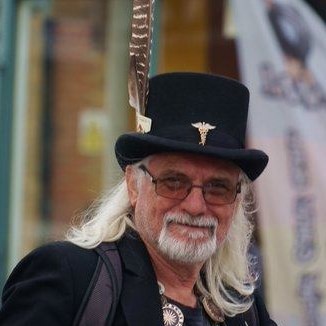
CJ Stone is an author, columnist and feature writer. He has written seven books, and columns and articles for many newspapers and magazines.
Read more of CJ Stone’s work here, here and here.
Whitstable Views
How to use it!
- Make sure you share and like our articles on Facebook and Twitter/X, and whatever other social-media platforms you use. Join us on Facebook here: @whitstableviews
- You can read and contribute articles for free but in order not to miss any, please subscribe to get regular free updates.
- To do so, press the “Subscribe” icon on the bottom right hand corner of the screen. This will take you to the option to sign up. (It disappears as you move the text down then reappears at you move it back again!)
- Please engage by leaving comments on the website, rather than on social media. Let’s get a debate going. All our contributors welcome the chance to engage with YOU.
- To all writers out there, we want to hear YOUR views too, so do submit your own articles. Read our submissions page on how to do this: https://whitstableviews/submissions/
- Finally, to keep Whitstable Views alive and independent please donate if you feel able to do so. As little as £1 would help. Details are on the donations page here: https://whitstableviews.com/donate
 Whitstable Views
One Comment