
Thoughts on Pinball
by
I must admit, I sometimes cry in movies. You invest in the characters, then some heart-rending scene takes place and – you can’t help it – suddenly you’re in fits, tears streaming down your face. Sometimes it happens in public, in the cinema, or at home with your family, and you do your best to suppress the emotion. But you can’t. The tears are still there, welling up, and you find yourself surreptitiously dabbing the corner of your eye, hoping that no one will notice.
I think the last time it happened in public was during a showing of Belfast, Kenneth Branagh’s vivid evocation of his childhood in the city of his birth. I’d never liked Branagh before. I thought of him as one of the London luvvies, the self-congratulatory Thespians who never tire of reminding you just how artistic they are. What Belfast does is to remind us of his background, where he comes from, and it sheds new light on his art and how he pursues it. I’ve had a grudging respect for him ever since.
unpredictable

Generally, though, I dislike it when I find myself crying at some cliché in a movie. I dislike that the writer has triggered an autonomic response merely by knowing how human psychology works. I’m annoyed at myself for being so predictable. The exception to this was watching Pinball: The Man Who Saved The Game, starring Mike Faist and Crystal Reed. That made me cry and it was entirely unpredictable. In fact I’ve seen it three times now, and it had me in floods of tears every time.
It’s an unlikely vehicle for a tearjerker. It’s a nerd movie, about pinball. Based upon the true story of Roger Sharpe, who in 1976 overturned New York’s 35-year ban on the game, it is functional not flashy: well-written, well-structured, well-acted, it nevertheless keeps its feet firmly on the ground. Like all the best movies, it relies on the characterisation, on the relationships and on the twists and turns of the plot. There’s not a special effect in sight. No explosions, no CGI, no superheroes, the only flashes and bells come from the machines themselves, which are the real stars of the film.
In this sense, it is nostalgic. You don’t see pinball machines any more. Watching the movie is to be reminded what glorious, gaudy works of art they were. It’s to bring back your youth and the lure and romance of the silver ball in its erratic, noisy journey through the maze of the table. I think that’s what made me cry. It brought up reminiscences from the distant past: thoughts and feelings that were locked tight in my muscle memory, that the sight of those machines released.
Love-affair
Very specifically, for me, it brought up one long lost love affair which I had almost, but not quite, forgotten. It was after the affair was over that I began to play pinball in earnest. This was at the Whitstable Labour Club (now the Social Club). It was nearly moribund at the time, losing money and fast going down hill. A bunch of friends and I moved in and took over. We began volunteering behind the bar. We put on gigs and benefits. We redecorated the back room.
I’d always wanted to own a bar. One thing I realised was that a good jukebox was the key to success. We were put in touch with a couple of guys, Alan and Des, who repaired and fitted old-fashioned jukeboxes, and we duly had one installed. They also had reconditioned classic pinball machines available. They asked us if we would like one. We agreed and the machine was put into position.
I wasn’t a young man then. I was already in my thirties, with a failed marriage behind me and no idea what the future might bring. Playing that machine brought back the feelings of my youth. It brought back focus and concentration and a sense of control. That’s what the film emphasises. Like me at the time, the lead character is jobless, divorced, and without any prospects. He’s living in New York, in a furnitureless apartment. Then he discovers a pinball machine in an adult bookstore, meets a woman in an elevator and gets a job writing for GQ magazine.
It’s the tie-in between all these elements that shifts the movie from a nerd-fest into a romantic drama. He soon discovers that the reason he can only find pinball machines in an adult bookstore is that, actually, they are illegal within the city limits. He is approaching the store one day when he is confronted by a police raid, the pinball machines being dragged out and smashed on the sidewalk. The pornography in the store is acceptable. The pinball machines are not.
games of chance
One of the tricks of the film is the metanarrative. An older actor, Dennis Boutsikaris, plays the present-day Roger Sharpe as he intervenes in the script, correcting it every now and then. He steps in on the action and points out that even in movies about real life much of it will be made up. But this scene is not. New York City really did ban pinball machines, from the 1930s, to 1976, when the ban was finally lifted. The reason was that they were viewed as games of chance, as a way for the mob to get children addicted to gambling. Sharpe’s task is to show that they are games of skill not chance, and have nothing to do with the mob.

Alan and Des used to change the machines in the Labour Club every few weeks, bringing in new tables whenever the profits began to dip. They started off with older, electro-mechanical contraptions, with lots of clicking and whirring, and then started introducing more modern electronic devices. My favourite was Black Knight. It was a multi-level, multi-ball machine. You could have several balls crashing around the play deck at the same time. I got so good at it that I was always getting free games. I could put one 50 pence piece in the slot and be playing the game for the rest of the night.
Watching the movie reminded me how physical the game is. It’s not like a video game, which is mainly dependent upon the relationship between hands and eyes. In pinball your whole body is engaged: legs, arms, back, shoulders and hips. Particularly hips. You use your hips to aim. That’s what provides the sexual element. It was mainly young men and teenage boys who liked to play. The machine is positioned about groin height, your hands either side, as if clutching someone’s backside. There are often garish images of well endowed young women pouting at you. You twist your hips to get control. You roll your body, shift, lift your leg, kick, jerk and thrust. It’s this coordination between the sensual body and the eye that makes the game so seductive.
Special When Lit
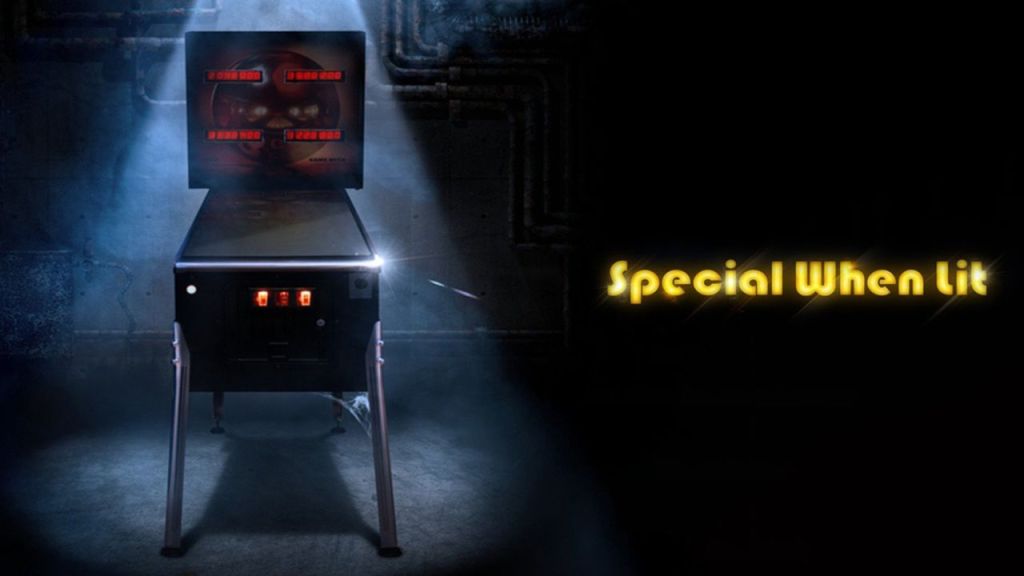
As a supplement to the movie, I also watched a documentary about pinball. Called Special When Lit, it features the real life Roger Sharpe, plus his two sons, Josh and Zak, who are also pinball aficionados. This is much more of a nerdy film, with no tears, but still very enjoyable. It’s full of odd characters and collectors, with more than a touch of Asperger’s thrown in. You see collectors who own hundreds of machines, and one who even keeps logs of where each machine had been in its life before it ended up in his basement, whose whole house is filled with spare parts so he can keep his machines in tip top condition.
Watching both movies made me yearn to play again, to be fully engaged in the pinball moment, immersed in this product of human imagination and ingenuity, with all the lights and bells and bright art work. It made me miss my youth, and that younger adult self who’d stood in the Labour Club playing Black Knight, with a pint or several, shrugging off the remnants of a painful love affair, beginning to look to the future again. In control of the machine. In control of my life.
You can find Pinball: The Man Who Saved the Game on Amazon Prime here.
About CJ Stone

CJ Stone is an author, columnist and feature writer. He has written seven books, and columns and articles for many newspapers and magazines.
Read more of CJ Stone’s work here, here and here.
Whitstable Views
How to use it!
- Make sure you share and like our articles on Facebook and Twitter/X, and whatever other social-media platforms you use. Join us on Facebook here: @whitstableviews
- You can read and contribute articles for free but in order not to miss any, please subscribe to get regular free updates.
- To do so, press the “Subscribe” icon on the bottom right hand corner of the screen. This will take you to the option to sign up. (It disappears as you move the text down then reappears at you move it back again!)
- Please engage by leaving comments on the website, rather than on social media. Let’s get a debate going. All our contributors welcome the chance to engage with YOU.
- To all writers out there, we want to hear YOUR views too, so do submit your own articles. Read our submissions page on how to do this: https://whitstableviews/submissions/
- Finally, to keep Whitstable Views alive and independent please donate if you feel able to do so. As little as £1 would help. Details are on the donations page here: https://whitstableviews.com/donate
 Whitstable Views