
Written in Stone
by
John Butterworth
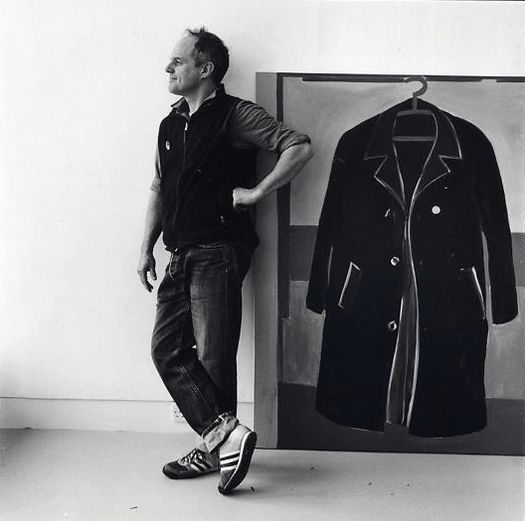
I must admit I don’t understand cricket. I mean, I’ve watched it, I’ve even played it but, unlike other games I’ve been involved with, there seems to be some hidden dimension that I can’t quite fathom.
I’m assuming that John Butterworth does understand cricket. He’s been a coach and player for Whitstable Cricket Club for over 30 years. He also played for Kent over 50s, and now the over 60s team. More recently he played with the England Seniors over 60s team. They were runners up at the World Cup in India in 2024. His most prolific season was in his 60th year, 2022, scoring over 1,200 runs and adding 40 plus wickets for both county and club.
I’ve known John for many years. Before he started playing for Whitstable CC, he was in the Labour Club team. That was back in the 90s. I went to one or two of the games and I could see the appeal. I enjoyed the camaraderie and the beer, but I could never quite follow the conversations.
John moved to Whitstable in 1993. His Mum was already here, having renovated a house in Woodlawn Street. John wasn’t intending to follow her. He was living in London. He came for a visit one weekend, saw an advert for a flat mate in a shop window and thought he’d try it out for six months. He’s been here ever since.
He soon got to know the Whitstable arts set (you know who you are). They were all part of the Whitstable Contemporary Arts Group which used to meet in the East Kent when Max Denning was the landlord.
John is an artist too, as well as a cricketer. He says he’s chosen the hardest two occupations to make a living out of. But he’s kept at it: both the painting and the sport. More recently he’s combined the two, putting on an exhibition called “The Art of Cricket”, which he used to fund his trips to international matches. That’s what the paintings depicted. Cricket grounds around the world. People playing cricket.
I asked what it was about the game that was so appealing? The longer you play, the more nuanced it becomes, he told me, especially with age. It’s about intellect, discipline, strategy, skill. There’s an artistry to it. Unlike other sports, which are fast-paced and short-lived, cricket is leisurely in its unfolding, but it also takes intense concentration. Games within games, the heart of which is a psychological thriller: the mind-game between batter and bowler, each trying to outwit the other.
There’s also a moral dimension. It’s like a metaphor for life. The phrase “it’s not cricket” sums it up. What’s not cricket is what exceeds the boundaries of proper behaviour. The English took the sport around the world. They taught it to the colonised nations, who brought their own aesthetic to the field. Soon they were better at it. There’s a kind of justice in this, he says: the old subjugated peoples outplaying their colonial masters, beating them at their own game.
You can view some of John’s work on his website here.
Mark and Briony Hubbard
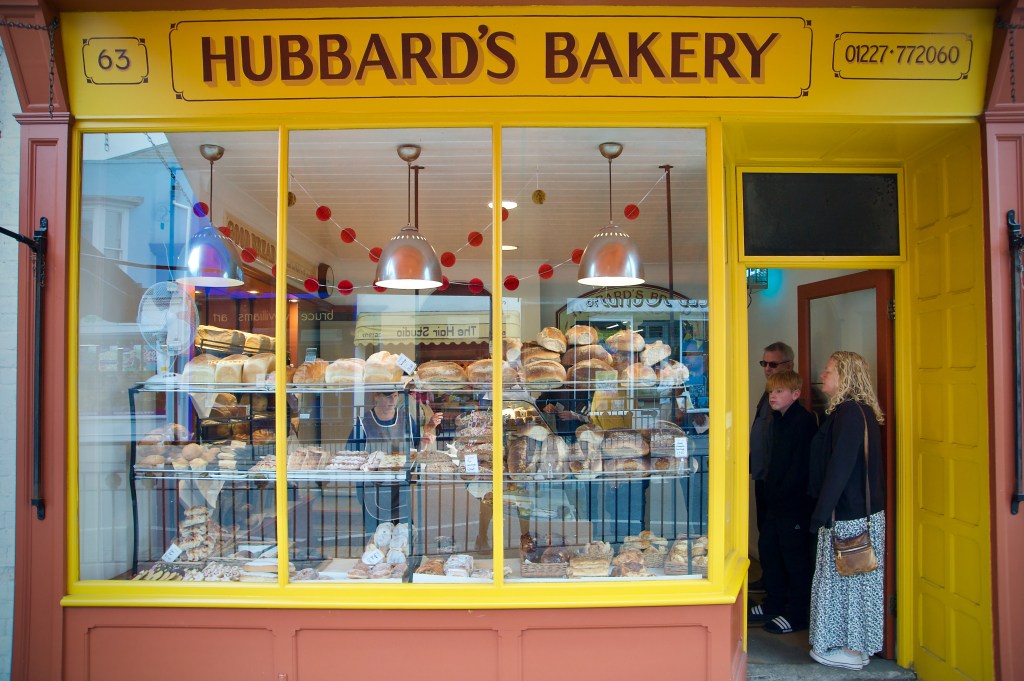
When I first became involved with the Whitstable Carnival I initiated a ritual, the blessing of the Lammas Loaf. Lammas is an ancient Anglo-Saxon festival marking the grain harvest. It takes place at the beginning of August, around the same time as carnival.
I approached Hubbard’s bakery to bake the loaf, and the Reverend Simon Tillotson to bless it. The first blessing took place at All Saint’s Church in 2019. We’ve been following the tradition ever since.
The reason I approached Hubbard’s was because it’s been in Whitstable almost as long as I have. It’s a family run business, owned by Mark and Briony Hubbard. I decided I wanted to talk to them, to thank them for all they do. We met in Tea and Times. I got there first and ordered a tea cake. “That’s looks delicious,” said Mark when he arrived.
It took a second or two for me to twig. “It’s one of yours!” I said, and he laughed.
Mark was born in Whitstable. Briony moved here from Rochester when she was 13. They’ve been married for 38 years and have two children and three grandchildren.
Mark did his apprenticeship in Snooks bakery, in what is now Gilbert’s Cafe. They started off baking from home and delivering door to door. Later they had a unit behind Tesco, and Mark delivered with a van.
They took over their current location in 1993, taking out a private mortgage with the owners. For the first ten years Mark did all of the baking himself. He was on his feet 18 hours a day. Since then they have taken on a team of bakers: five in all, including their son.
I like this couple. They understood the idea of the Lammas Loaf straight away. They never asked for money. When I offered them expenses they turned it down. “Put it back into the carnival,” they said.
They are the model of a small family business, trying to be as inclusive as possible. Mark spoke about the importance of bread for the life of the community. “A good bakery is there for everyone,” he said.
They have kept to their values, making bread in the traditional way. There are four ingredients in a sourdough loaf, they tell me: water, flour, salt and time.
Time is the most important. It takes 10-12 hours for the bread to be ready for the oven. At the end of the shift a batch is prepared and then put into a cooler for storage. At 2am it is removed and left to prove for the rest of the night. In the morning it goes into the oven and after that into the shop.
It’s a measure of their commitment to sustainability that Mark has given up delivering by van and is now using an electric bike, pulling a trailer, hand-delivering baked items to local businesses.
“We’re still happy in the town,” says Mark. “Still enjoying the job.”
You can contact Hubbard’s Bakery via their Facebook page, here.
Eric Fisher
This took place a few years ago. I stopped off in the East Kent for a drink one winter’s evening, and there was Eric Fisher, in a booth by the window, on his own, nursing a pint and looking miserable.
“What’s up Eric?” I asked.
“Pantomime psychosis,” he said, and rolled his eyes.

Whitstable people will know Eric. He was born in St Helier’s Nursing Home in Castle Road, where all the Whitstable natives took their first breath back in the day. A member of the Jellybottys in the 80s, and of the Trouser Trumpets now, he’s part of the fabric of this town, what makes Whitstable what it is.
He worked at the Marlowe Theatre for 17 years. He was a backstage technician, one of the guys who moved the scenery about. It was Eric’s job to haul the scenery into the flies above the stage or to push it into the wings, before bringing on the new scenery, to set the stage for the next section of the play.
In order to do this efficiently he would have to keep up with the script. There would be various lines which would act as signals, so the technicians would know to get ready for the next burst of activity. All of this would be marked in the script.
It’s a crucial job, as important in its way as what the actors do. It helps with the suspension of disbelief. Without the smooth transition from one scene to the next the plot would falter, the spell would be broken, and the audience would be jerked back into rude reality.
He must have witnessed hundreds of plays in his time. Mostly these were good plays: plays that had stood the test of time, with actors who played their parts, with characters who came alive, with plots that were compelling and psychologically true, with poetry and wit and humour and emotion: everything that makes theatre the great art form that it is.
But once a year things are different. At Christmas the usual fare is replaced by pantomime, a unique form of theatre, meant to appeal to a child’s sense of the absurd. But for an adult backstage, listening to it again and again, it can start to cause ructions in the psyche.
Imagine having to pay close attention, two shows a day, for seven whole weeks – the same jokes, the same audience participation, the same call and response – till every line is ingrained into your subconscious, playing on an endless loop in the theatre of your brain. That’s pantomime psychosis, the bane of every backstage technician.
This can get so bad, Eric told me, that when friends inadvertently said something that resembled a line in the panto, he would find himself involuntarily reciting the next line back to them, much to their bemusement. So spare a thought, next time you attend pantomime with your five year old. Behind the scenes there’s a bunch of theatre workers going quietly insane.
The Trouser Trumpets: https://trousertrumpets.co.uk/ The Jellybottys: https://www.youtube.com/thejellybottys
Anita Meyer
I believe in magic: by which I mean, I believe in the power of focussed imagination to make a change in the world.
One way of practising magic is to build a shrine. You place significant objects in a prominent place in your house, and then you contemplate them. It’s a form of meditation.
It’s how I got to know Anita Meyer. I put up a picture of my shrine on Facebook, and she sent me a picture of hers.
Later I went round to view it. Mine is on a set of shelves in my office. Hers festoons a Victorian fireplace in her upstairs living room.
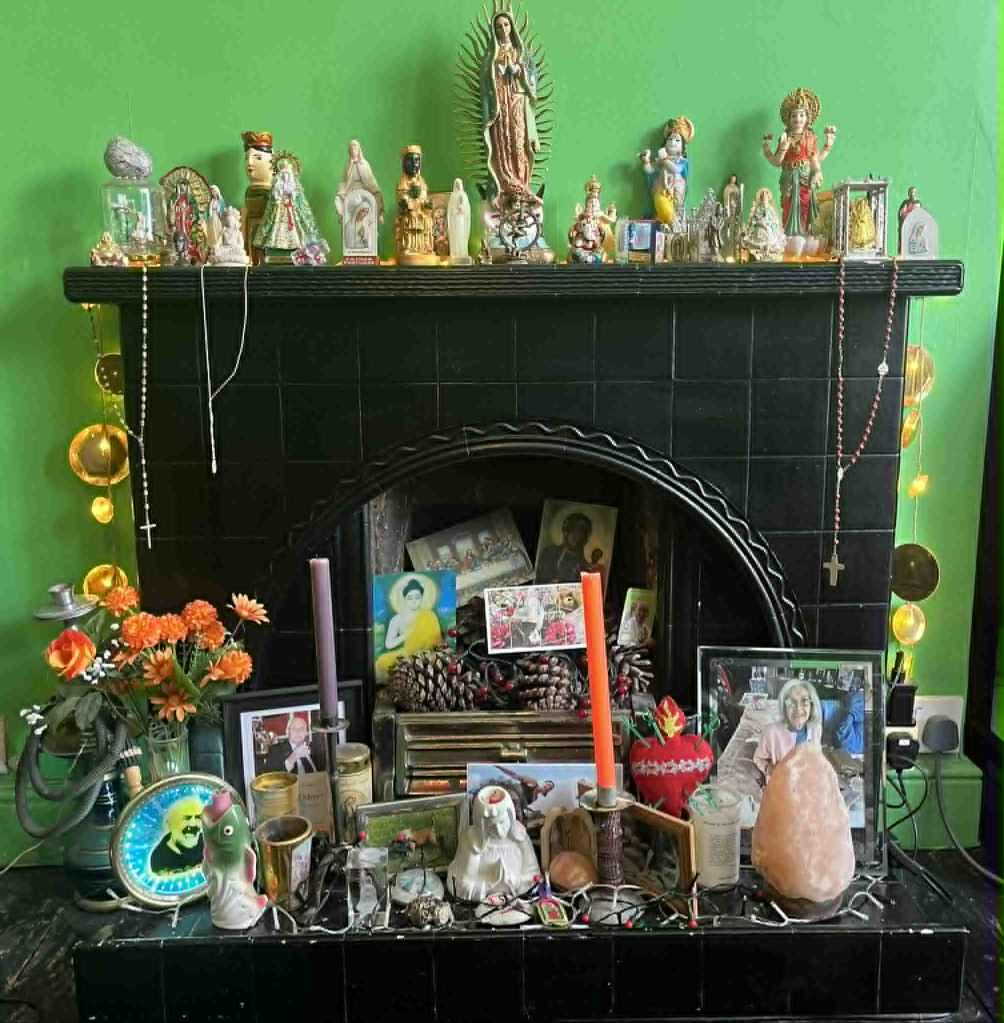
I’m looking at a picture of it now. The fireplace is black, the wall behind it green, while the objects reflect a variety of different colours.
It’s a cornucopia of living imagery, of gods and goddesses from around the planet: of Black Madonnas and Virgins from Europe, of Buddhas and Hindhu deities from Asia, of crucifixes and sacred hearts and candles, of fairy lights and incense and photographs of her dear departed: her mum and dad, her brother and aunt, and her dog, Bear.
At the centre on the top is a statue of Our Lady of Guadeloupe, who looks to be emerging from a seed pod. She is definitely the focal point of the display, being taller than all the rest. Underneath is a tiny Shiva, the Hindu god of destruction. There’s a Krishna, a Lakshmi and a Ganesh. There’s the Macarena, the Virgin of El Rocio, Our Lady of Fatima and Our Lady of Montserrat, plus, hidden away in the background, an icon of the Madonna of Czestochowa, which is the first of the images she discovered, in a church in Poland, and which is what started her collection.
She told me that all the images were of female figures at first, but that over the years she’s allowed a few male images to muscle in on the scene.
Some of you will know Anita, of course. She ran a belly dancing class down the Horsebridge for a number of years and was involved with the Fishslappers parade during the Oyster festival. She’s also involved with the Blessing of the Beasts, along with Christine Walton, who makes the costumes. They are the two Handmaidens accompanying the Blessing-Giver: though you probably wouldn’t recognise either of them as their faces are usually hidden behind masks. This year they turned up as malevolent crows, threatening the audience with their incessant (and very realistic) cawing.
Her and Christine also ran the Gypsy Tart Cabaret at the Waterfront Club, until it was taken over. They are currently looking for a new venue. The idea is to bring back a bit of old, weird Whitstable while promoting Kent Cabaret artists. They don’t take money themselves and would like as much of the cover charge as possible to go to the artists, hence the need for an affordable venue.
Perhaps if we all focus on our shrines we can make this wish come true.
You can read the entire collection of The Whitstable Whistler on their website, here: https://www.brightsidepublishing.com/whitstable-whistler-main/
About CJ Stone
CJ Stone is an author, columnist and feature writer. He has written seven books, and columns and articles for many newspapers and magazines.
Read more of CJ Stone’s work here, here and here.
Whitstable Views
How to use it!
- Make sure you share and like our articles on Facebook and Twitter/X, and whatever other social-media platforms you use. Join us on Facebook here: @whitstableviews
- You can read and contribute articles for free but in order not to miss any, please subscribe to get regular free updates.
- To do so, press the “Subscribe” icon on the bottom right hand corner of the screen. This will take you to the option to sign up. (It disappears as you move the text down then reappears at you move it back again!)
- Please engage by leaving comments on the website, rather than on social media. Let’s get a debate going. All our contributors welcome the chance to engage with YOU.
- To all writers out there, we want to hear YOUR views too, so do submit your own articles. Read our submissions page on how to do this: https://whitstableviews/submissions/
- Finally, to keep Whitstable Views alive and independent please donate if you feel able to do so. As little as £1 would help. Details are on the donations page here: https://whitstableviews.com/donate
 Whitstable Views