Talk at the unveiling of the memorial to the casualties
St Michael’s Hernhill, 21 March 2026
by
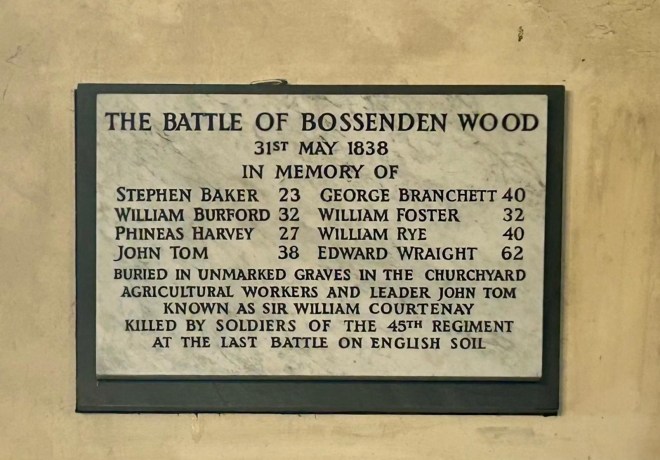
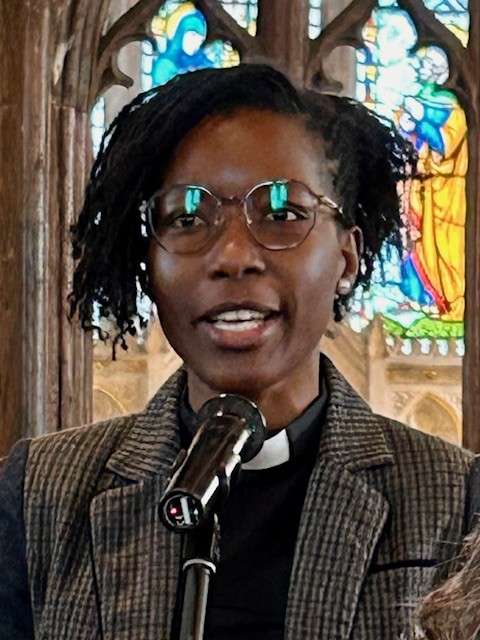
St Michael’s Hernhill was packed on Saturday 21 March for the unveiling of a memorial plaque to the casualties of the Battle of Bossenden Wood. The service was led by the vicar, Rev. Cathrine Ngangira and the ceremony was performed by Sandys Dawes of Mt Ephraim. There were speeches by Peter Willcock, Churchwarden, Sean Sayers, from the group who campaigned to create the memorial and Cllr Kevin Kemp, chair of Dunkirk PC. Also there was a dramatic reading by three girls, Sophie, Frankie and Lora, from Year 6 of Hernhill C of E Primary School, of a poem written for the occasion, ‘The Ballad of Bossenden Wood’.
Here is the speech given by Sean Sayers.
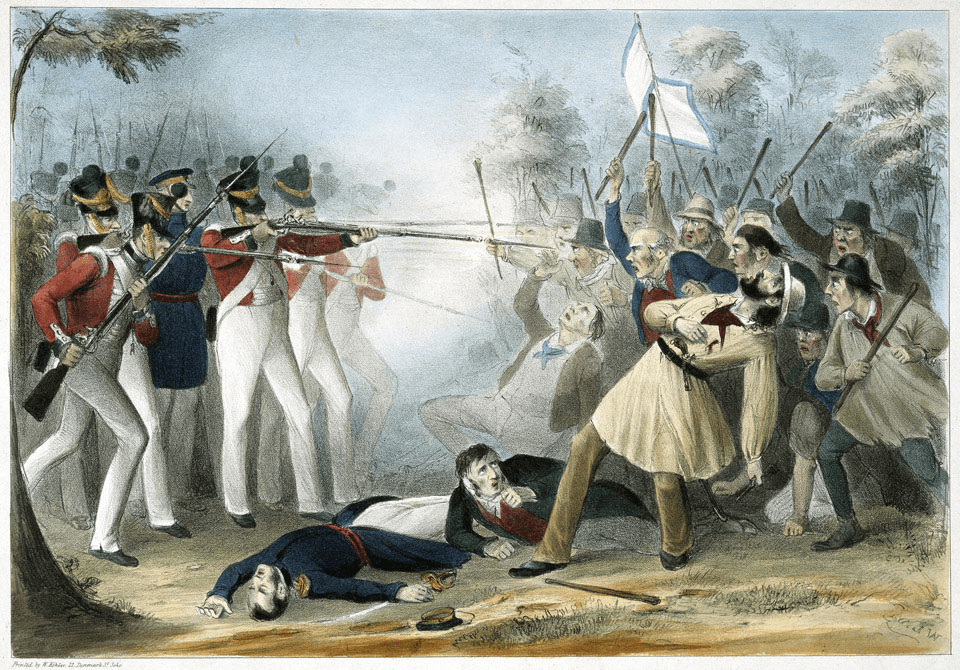
As many of you will know, the battle took place on 31 May 1838 in Bossenden Wood near Dunkirk, between Canterbury and Faversham. It followed an uprising by agricultural workers led by the flamboyant character of John Nicholls Tom who dressed in scarlet robes and styled himself Sir William Courtenay, Knight of Malta. He was a millenarian preacher and charismatic orator. He had spent some time in Barming mental asylum near Maidstone, it is not clear why. He has sometimes been dismissed as deluded and mad, and his followers as his ignorant dupes, but all that is very questionable.
The Battle of Bossenden Wood was not an isolated event. It was the last in a long series of uprisings by agricultural workers in the 1820s and 1830s that were responses to the poverty and distress in the countryside (and particularly in East Kent).
In the days before the Battle, Courtney led group of agricultural workers on a march around the farms in the area, gathering support. The marchers brandished a loaf of bread on a pole as they went, the traditional symbol of hunger.
The civil authorities panicked. There were no police in those days so they called out the army. 150 soldiers from the 45th Regiment of Foot (not a local but a Nottinghamshire Regiment) were sent from Barracks in Canterbury where they were garrisoned. Courtney had gathered quite a number of supporters, but they began to melt away – fearful, no doubt about what was about to happen. By the time the soldiers reached Bossenden Wood only about forty of the labourers remained. They were armed only with farm implements and cudgels. Courtney was the only one with a gun. He immediately shot one of the soldiers, Lt Bennett. The soldiers then opened fire with their muskets and charged with fixed bayonets. They killed eight and wounded many others (the same number of fatalities as at the much better known Peterloo massacre).
Lt Bennett’s body was buried with full military honours in Canterbury Cathedral where there is a marble memorial to him. Courtney and the workers who were killed were buried in unmarked graves in the churchyard of St Michael’s, Hernhill (there was no church at Dunkirk, the nearest village to the battle site). Until now, the only memorial to them was a wooden board outside the Church put up recently which lists their names and ages but gives no explanation of the circumstances of their deaths. It is now worn and tatty (we hope it will be renovated).
The battle was an event not only of local but of national significance, it is often described as the `last battle on English soil’. To understand its significance, it needs to be seen in its historical context. After the Napoleonic Wars, there was a deep recession in agriculture. The introduction of machinery was putting farm labourers out of work and depressing their wages. The punitive Poor Law of 1834 forced those who needed welfare assistance into prison-like Workhouses where families were broken up. There were extremely repressive laws which forced protest underground.
Workers fighting for their livelihoods claimed to be members of a clandestine army led by `Captain Swing’ who threatened to smash threshing machines and burn haystacks. They were often dismissed as “luddites”. In fact, they were fighting against the harsh effects of capitalism in agriculture and they played an important role in the development of the movement for equality and justice.
Until recently the battle remained almost unknown, perhaps because of the tendency to dismiss it as a `riot’ led by a madman. However, interest in it and understanding of its importance have been growing recently. Last year, three men from Dunkirk placed a stone marker at the site of battle and succeeded in getting it included on Ordinance Survey maps. Quite separately, a small group – the Battle of Bossenden Wood Memorial Group – started a campaign to publicise the battle and to foster understanding of its significance.
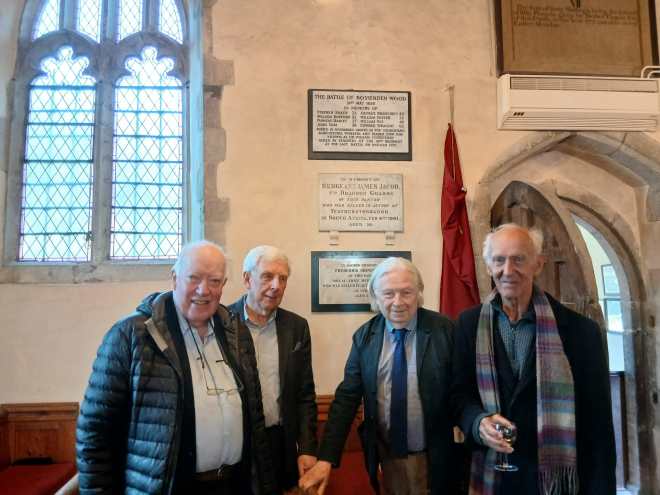
In 2020, in response to the Black Lives Matter movement, the Church of England undertook to review the monuments in its churches. We wrote to request a permanent and fitting memorial for the casualties of the Battle of Bossenden Wood and for an explanatory notice to be placed near Lt Bennett’s memorial in Canterbury Cathedral.
To our surprise we found that we were knocking on an open door. Both the Church in Hernhill and the Cathedral responded very positively, they welcomed these ideas. But church bureaucracy moves very slowly. It took five years for the church to give the go ahead. We then appealed for funds. There was a rapid and very generous response. Working with the church in Hernhill, we commissioned the marble plaque which is now being unveiled. Canterbury Cathedral have promised to put an explanatory notice by Lt Bennett’s memorial.
These are real achievements, real milestones in the long struggle for a fairer and more just society. But they are not the end of the story. The group has a Facebook group and a new web site with maps, videos and articles about the battle and news of further activities. We are organising a music and cultural Festival at Mt Ephraim on the anniversary of the battle, 31 May. The struggle goes on.
Sean Sayers, Battle of Bossenden Wood Memorial Group
Facebook: https://www.facebook.com/groups/bbwmemorialgroup/
Web site: https://battleofbossendenwood.org/
The Ballad of Bossenden Wood

by

Mrs J Woodcock and Year 6 pupils of Hernhill C of E School

Come gather close, young hearts and minds
And listen to our tale,
Of Kentish woods and troubled men,
Where hopes and fears set sail.

In May of eighteen thirty-eight,
Near Hernhill’s wooded ground,
A curious band of farmers walked,
Their voices rising sound.

They followed a man called Courtenay,
Though his name was Tom, it’s true,
He spoke of hardship, hope and change
For the poor and weary crew.

“Stand tall, my friends! I am with you!
A better life we’ll see,
not more hunger, no more pain –
Freedom will set us free!”

But lawmen came to bring him in,
Led by Mears that morn;
Courtenay drew a pistol then,
And violence was born.

Nicholas Mears fell to the shot –
Trouble had begun;
Word spread fast and soldiers called
To see this man undone.

In minutes short the clash was done,
And shot and bayonet roared;
Courtenay and faithful followers
Lat silent on the floor.

Eleven souls were lost that day
In Bossenden’s wooded stand;
A moment grim, a story told
Across our English land.

Remember them, their hopes and fears,
Their courage, though it stood,
We gather here to mark the place
Of Bossenden Wood.
About
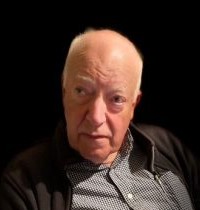
Sean Sayers is Emeritus Professor of Philosophy, University of Kent, Associate Professor of Political Theory, Canterbury Christ Church University, and Visiting Professor of Philosophy, Peking University, Beijing. He has held visiting appointments in Colorado, Massachusetts, Sydney, Istanbul, Shanghai, Wuhan, and Beijing.
Whitstable Views
How to use it!
- Make sure you share and like our articles on Facebook and Twitter/X, and whatever other social-media platforms you use. Join us on Facebook here: @whitstableviews
- You can read and contribute articles for free but in order not to miss any, please subscribe to get regular free updates.
- To do so, press the “Subscribe” icon on the bottom right hand corner of the screen. This will take you to the option to sign up. (It disappears as you move the text down then reappears at you move it back again!)
- Please engage by leaving comments on the website, rather than on social media. Let’s get a debate going. All our contributors welcome the chance to engage with YOU.
- To all writers out there, we want to hear YOUR views too, so do submit your own articles. Read our submissions page on how to do this: https://whitstableviews/submissions/
- Finally, to keep Whitstable Views alive and independent please donate if you feel able to do so. As little as £1 would help. Details are on the donations page here: https://whitstableviews.com/donate
 Whitstable Views