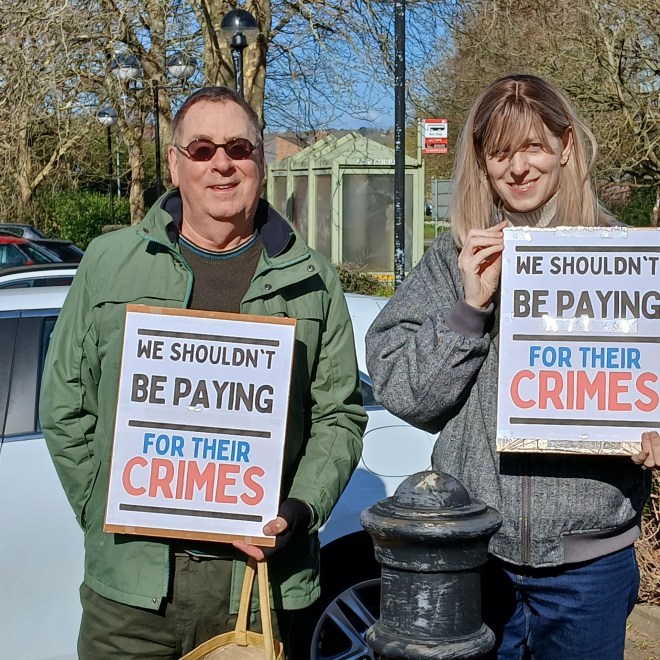
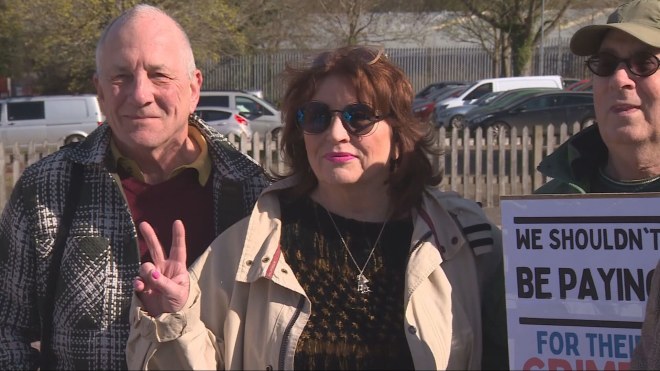
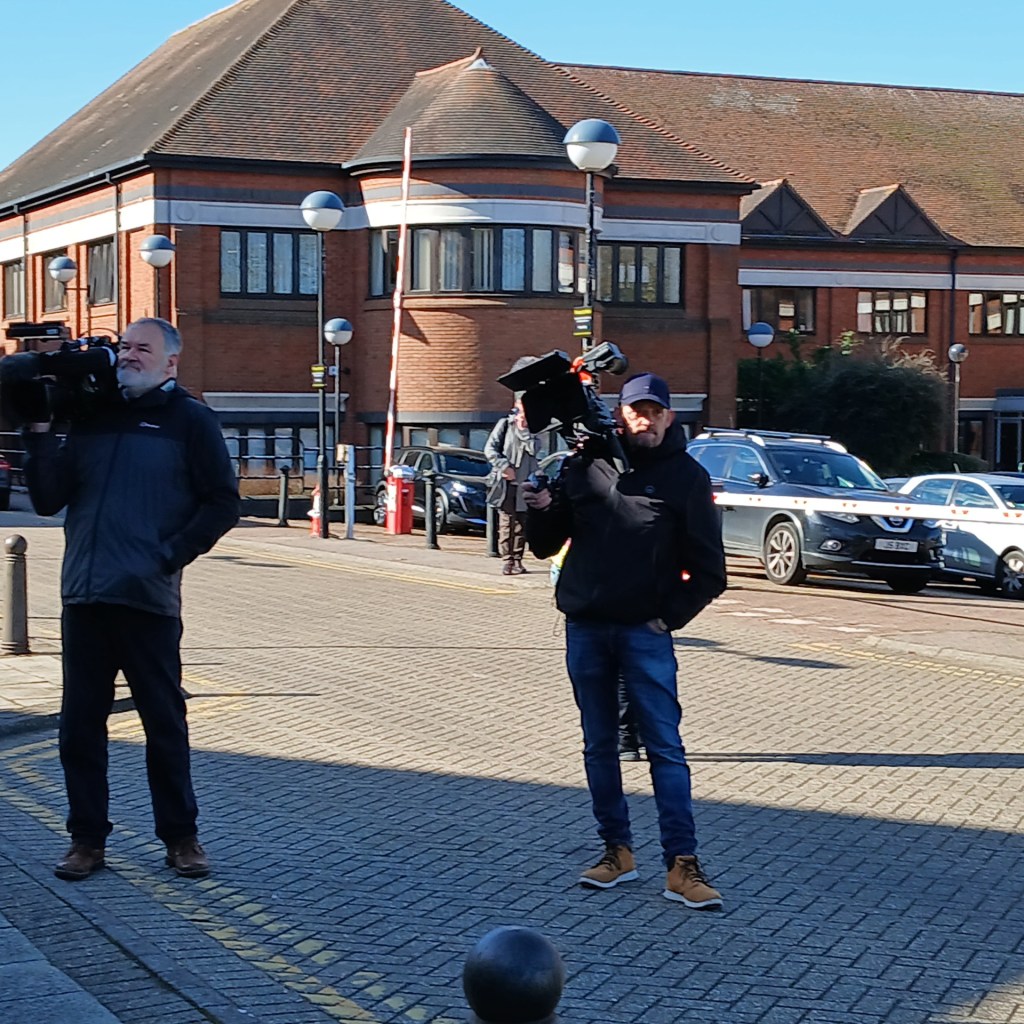
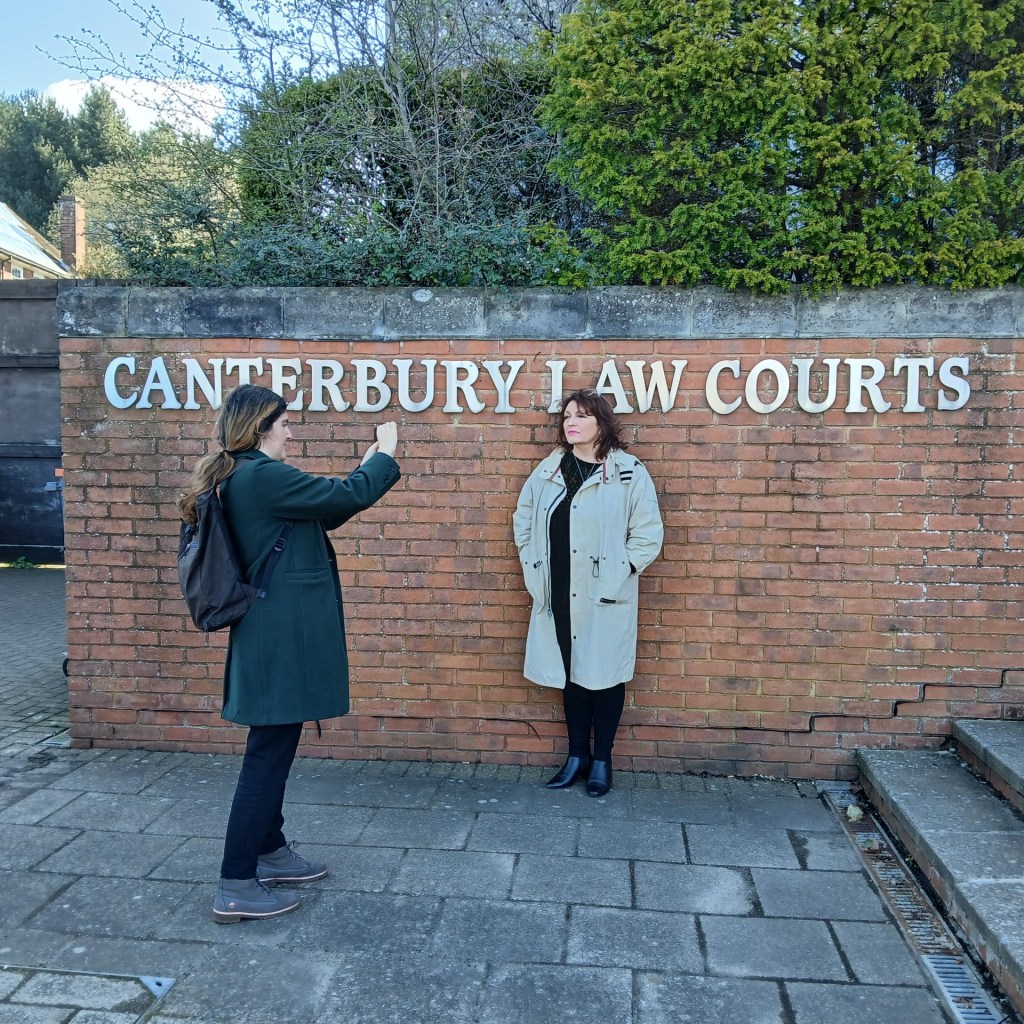
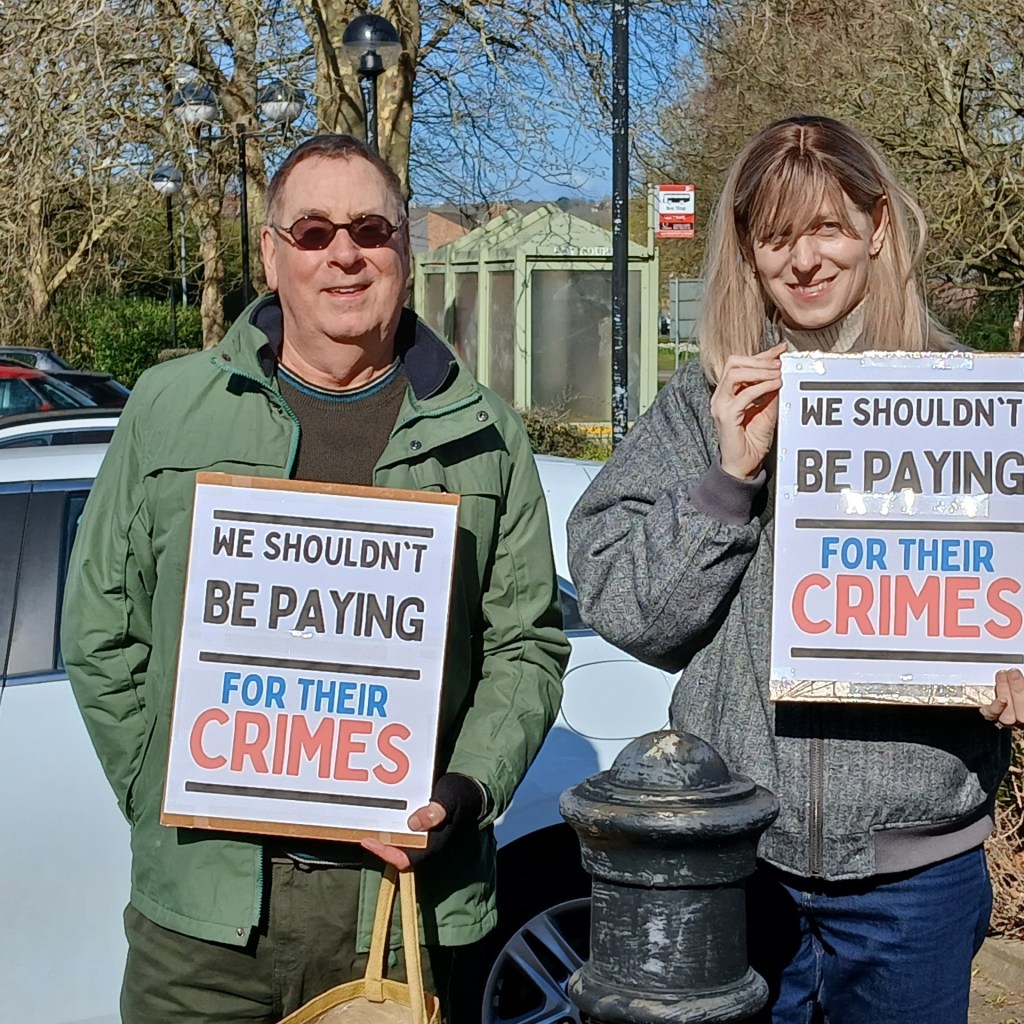
Photo – water campaigners Mike Slade and Victoria Falconer.
Put forward in in court on 26th March 2026 against a legal claim from South East Water for her 4-year payment boycott to Southern Water
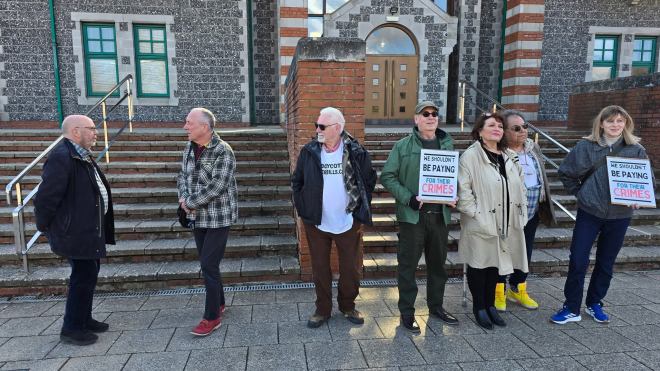
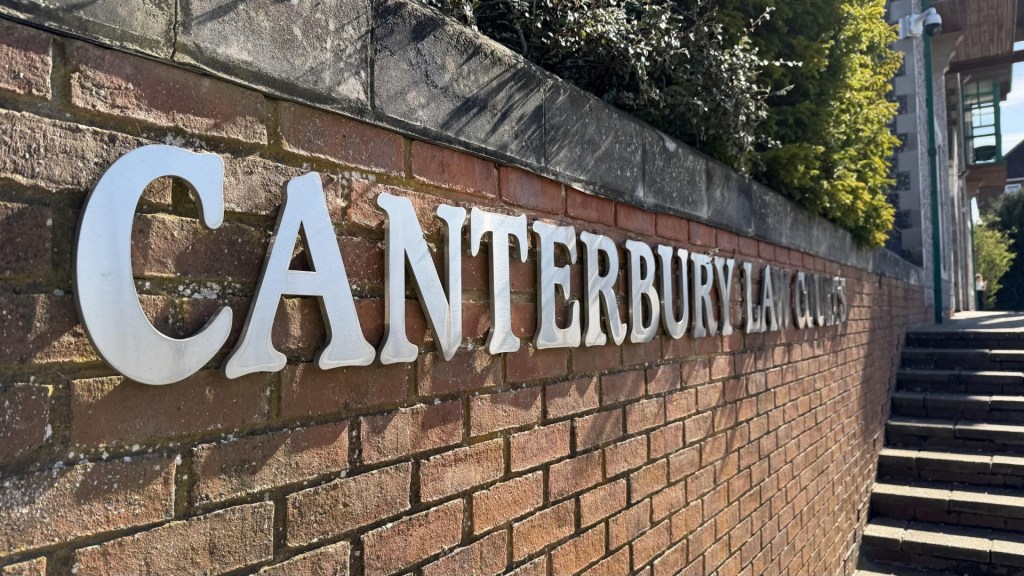
On Thursday 26 March 2026 I attended a hearing at Canterbury County Court in order to defend a claim made against me, and my husband (as joint water account holders) for the sums I had withheld from paying to Southern Water since 2021, in protest at the company’s criminal offences regarding illegal spills of sewerage into our seas and waterways.
I had already submitted 8-pages of detailed defence in January of this year, coupled with 24 pages of evidence concerning Southern Water’s environmental permit breaches from 2021- 26 but in court, for the sake of “clarity” and “brevity”, I asked to present a summary of my defence. Judge Furness, who presided over the case, allowed me to do so, enabling me to air the consumers’ often untold side of the story regarding the “legalised scam” our privatised water industry is considered to be.
It was clear that Judge Furness was not only fair but also sympathetic to my argument though, as expected, judgment was given to South East Water against me—principally because, (and as my defence summary sought to graphically illustrate), water consumers have no access to a court in which we can take our disputes regarding inadequate service and importantly, receive judgment on those disputes because water companies are protected by statutory law. Under the Water Industry Act 1991, the companies claim immunity from any consumer rights—while stating, in effect, that they are statutorily obliged to offer water services and we as customers are statutorily obliged to pay them, not matter how unacceptable those services are.
Only the regulatory bodies, like Ofwat, have the power to hold water companies to account, but, as I argued in my defence, neither Ofwat nor the consumer complaints process are fit for purpose due to a “merry-go-round” of conflicting interests.
Importantly, I put forward that this amounts to a breach of Article 6 of the Human Rights Act and simply asked for the judge to withhold giving judgment while referring my case to a higher court. That was something Judge Furness stated he did not have remit to do as a small claims hearing can only determine if a sum is owed or not.
I have had many questions asked by other customers since the case so I’m pleased to share the whole of my Defence Summary here and I will also apply for a transcript of the hearing.
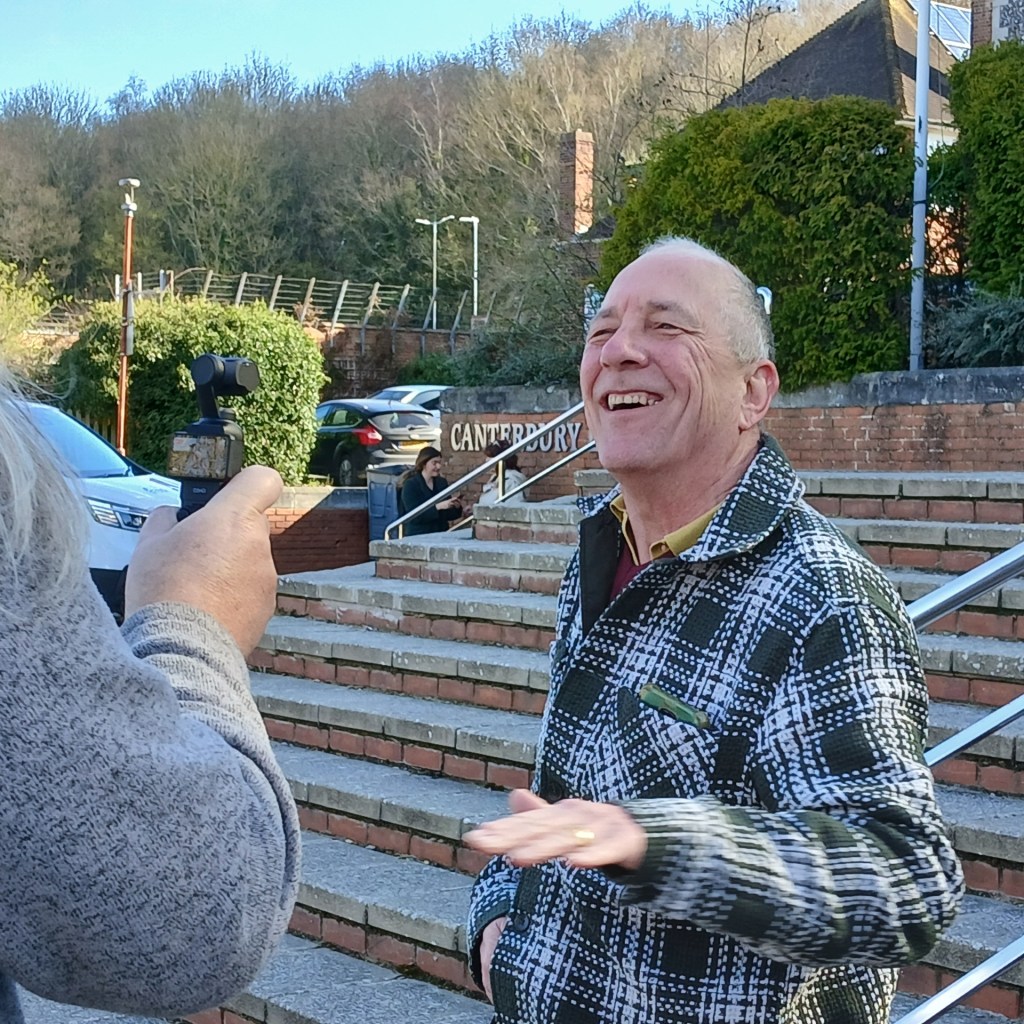
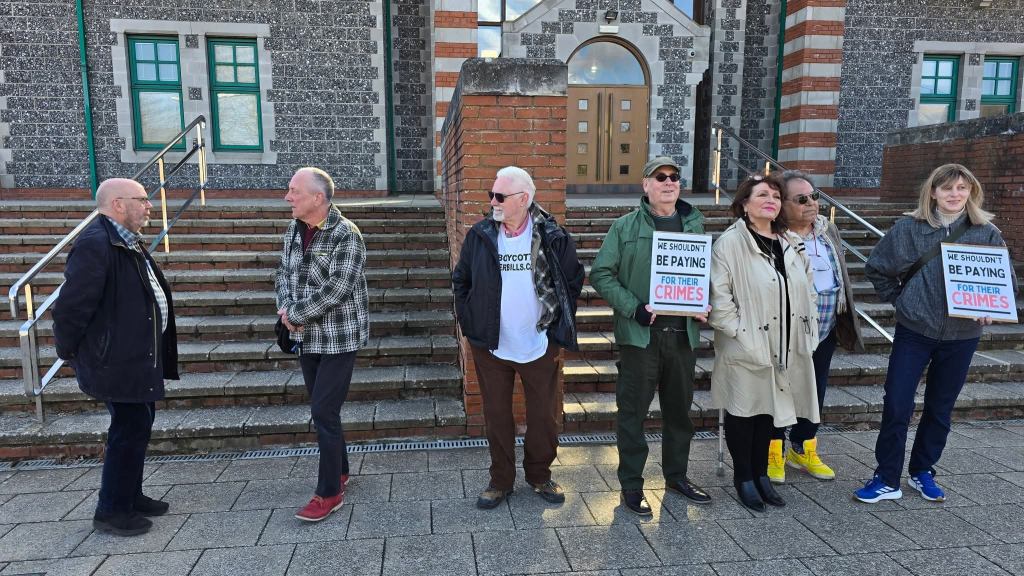
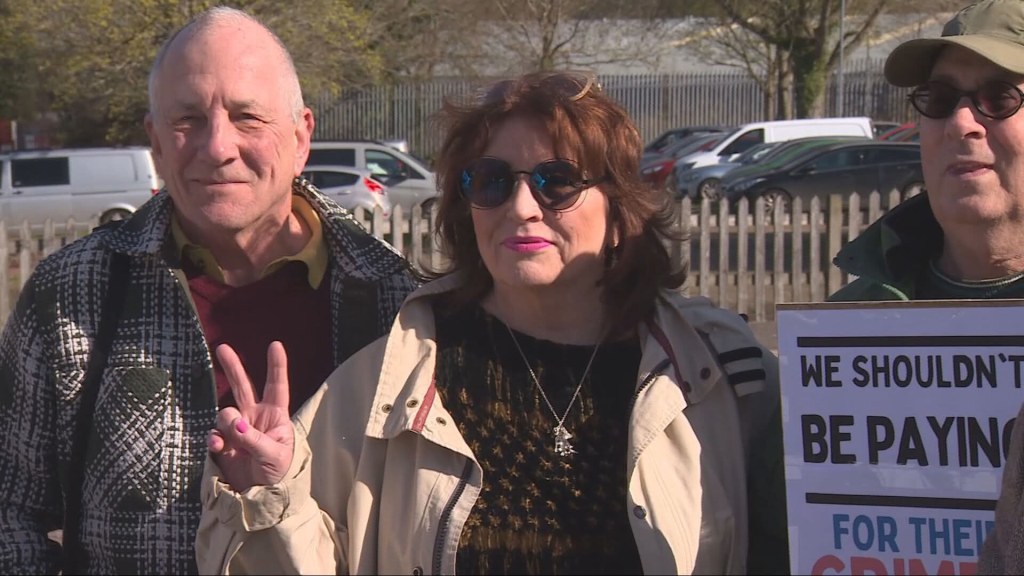
Thanks to everyone who came along to support, and also report on the case, including Chris Stone, Jon Eldude, Mike Slade, Victoria Falconer, Tessa Musgrove, Chris Dash, Green Party councillors Mark Hood, Andy Harvey and Peter Campbell, Channel 4 News, Kent Messenger News and ITV Meridian News.
Thanks also to everyone who came to the pre-hearing protest in Margate the week before—where my case was previously scheduled.
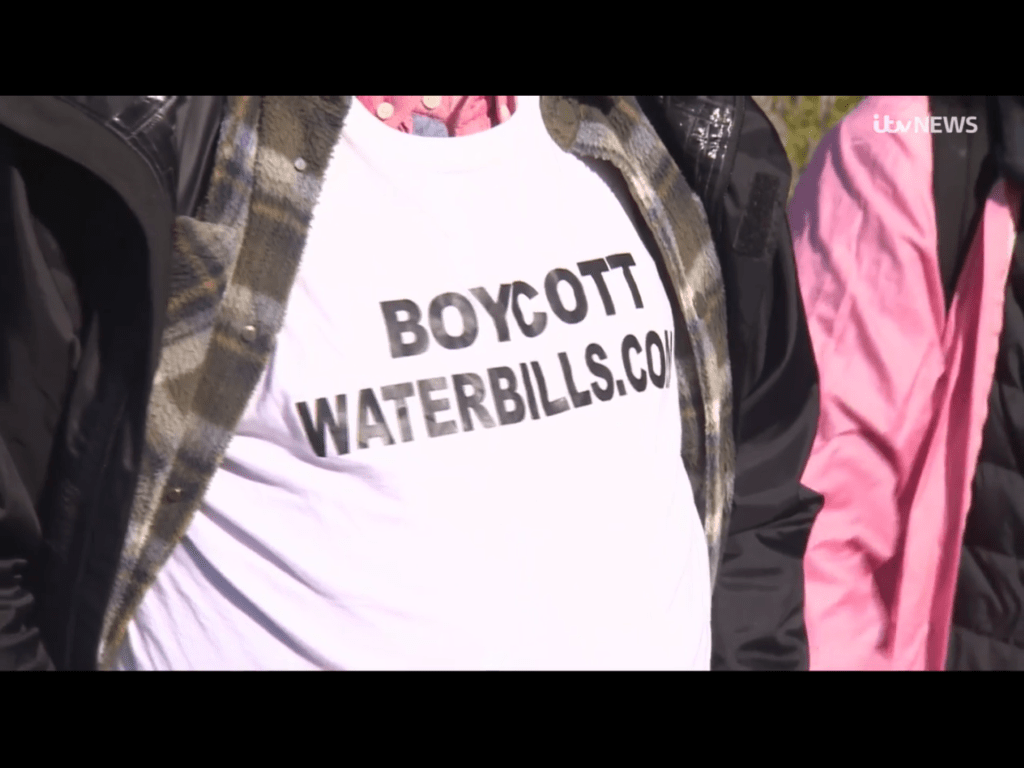
This is not the end of the road regarding my campaigning for justice for water customers—stand by for further action from Boycott Water Bills.
See: www.boycottwaterbills.com for more in due course.
For clarity regarding South East Water’s claim:
In my area, Southern Water is responsible for wastewater services while South East Water is the water provider.
I have continued to pay South East Water for its water provision services but my husband and I are in dispute with Southern Water due to its inadequate wastewater management and following the company’s criminal offences in 2021, for which it received a record criminal fine of £90m, we began withholding payment to Southern Water after sending the company due notice of this.
At that time, Southern Water refused to consider a discounted payment from us relating to its unsatisfactory wastewater service (as would be usually possible under the Consumer Rights Act 2015), though a precedent has since been set for this by the 50% discount awarded to another payment boycotter, Ashley Clark—then a Conservative Canterbury City councillor—and a 100% discount that was given to another campaigner, Rosemary Rechter in Walmer, Kent. (Evidence in the public domain via news articles I broke to The Times newspaper and others and Ashley Clark’s own letter acknowledging this.).
Regarding Evidence of Southern Water’s failure to provide an adequate wastewater service in accordance with their environmental obligations under the WIA 1991:
I have submitted extensive evidence to the court of Southern Water’s crimes and permit breaches from 2021 to 2026 as the basis of our dispute with Southern Water but it is actually South East Water that has made this claim for payment against us—in a role as Southern Water’s “billing agent”.
A barrier to dispute resolution re this claim
While legal action in a small claims court such as this may be usual in cases of non-payment, in this instance it appears to be a barrier to us obtaining dispute resolution with Southern Water because that company is not here today to answer to the dispute and stated in a letter to me (dated 24th June 2025 and submitted with my evidence) that it is “not party to the Claim made against you/us by South East Water.”
South East Water is a “water only” company and, as stated in a letter to me (dated 29th May 2025 submitted with my evidence and defence) they: “do not provide waste water services and have no direct knowledge of waste water collection, treatment and subsequent discharges from sewerage works to the environment.”
I hope the court can appreciate that due to Southern Water’s absence in these proceedings, and South East Water’s declared lack of knowledge about the issue at the heart of this dispute, I am at a disadvantage in respect of holding Southern Water to account for our non-payment. Also, I have limited legal knowledge and so I will be trying my best to put forward my own defence without a barrister.
Resolution regarding Identity of the Claimant
Firstly, regarding the query pertaining to Identity of the Claimant, as cited on my submitted Defence, I can confirm that South East Water has now finally submitted to me evidence of its contractual role as Billing Agent for Southern Water which I now accept. This happened to cross with my delivery of my Defence for the case first scheduled for 9th February – perhaps upcoming court action finally prompted the company to respond to my requests – but it would have helped this defence if they had submitted this to me earlier within the last 4 and a half years as the failure of the Claimants to properly disclose the legal/contractual relationship between the two companies materially hampered our ability as Defendants to make a counterclaim in timely fashion.
Sum Claimed
Regarding the Sum in Question – a running total given within South East’s witness papers shows the figure of £1648.97. But I note that includes the sum of £160 for these court costs which it seems is surely premature since this case has not yet been heard? Or do I have to pay South East Water for their court costs even if judgment is found for us today?
We have made no counter claim but in essence:
We do not believe that the amount claimed by South East Water for Southern Water is due because Southern Water has failed to provide an adequate waste water service in accordance with their environmental obligations under the Water Industry Act 1991.
In my Defence Submission, I offered evidence to the court which shows Southern Water to be a serial offender regarding pollution of the environment with its unpermitted sewage discharges and we believe that UK water companies such as Southern Water, and its billing agent, South East Water, are using small claims courts to evade responsibility for poor service via a narrow interpretation of the Water Industry Act 1991.
Absence of a contractual relationship
I cite the Human Rights Act to challenge the assertion given in correspondence to me (see letter dated 1st August 2023) that “no written legal contract exists between water companies and customers”, so in effect we have no proper recourse to the law and no rights to make any kind of claim against water companies, however unsatisfactory their services may be. If this is legally unchallengeable, then water companies would appear to have all the advantages of being private companies, when it comes to taking profits, and none of the disadvantages because they insist they are protected by statute from any legal claims against them – as complaints can only be dealt with by a regulatory authority such as OFWAT.
Regulatory bodies are not fit for purpose
I have submitted evidence that the existing regulatory bodies are not fit for purpose and that ifit is accepted that as Defendants we have no court or tribunal in the UK to which we can take our disputes regarding service, and, importantly, receive a decision regarding them, then a rejection of the right to have a defence heard is actually counter to Article 6 of the Human Rights Act.
Our defence re the Human Rights Act
Previous claims against water companies have been rejected despite the authority of the Supreme Court in the Manchester Ship Canal decision (See: ) either in tort, because claims for damages have not been particularised or in contract, because there is said to be no right to make a claim against water companies other than the statutory rights of compensation afforded by the Water Industry Act 1991 via the water services regulatory authority, OFWAT.
It is our position that, taking account of the Manchester Ship Canal decision, the statutory regime under which compensation for water company customers is established actually contravenes Article 6 of the Human Rights Act 1998 (link provided in my Defence Submission) which the court will be aware of, (and which quote: “guarantees the right to a fair trial, ensuring everyone is entitled to a fair, public hearing within a reasonable time by an independent, impartial tribunal established by law. It applies to both criminal charges and civil rights, including the presumption of innocence.”) and in order to remedy this contravention, the UK courts are obliged to consider defence claims made by customers, including any counterclaim where applicable.
In particular we say that:
The remedies available to consumers under the statutory scheme, either through OFWAT or the consumer complaints handling processes at Consumer Council for Water (CCW) or Water Redress Scheme (WATRS/CEDR) are insufficient and in principle contravene Article 6.
OFWAT is not a “court” and the remit of CCW and WATRS is limited and does not extend in either case to adjudicate on disputes relating to regulatory enforcement including environmental duties under s 3 of the Water Industry Act 1991;
OR
If those remedies are sufficient in principle, they are ineffective in practice as a result of the inadequacies of OFWAT’s operations and/or the conflicts of interest evident in the composition of CCW [and WATRS]
And I have submitted detailed evidence of the latter in terms of:
OFWAT having been under investigation by the Office for Environmental Protection (OEP) for failing to comply with its legal duties relating to the monitoring and enforcement of the water companies management of sewerage. (See: with the OEP concluding that there had been two failures to comply with environmental law by OFWAT. And those are:
- Failing to take proper account of environmental law with regards to duties on sewerage companies and its duty to make enforcement orders.
- Failing to exercise its duty under environmental law to make enforcement orders.
I have also submitted evidence concerning what has come to be known as the “revolving door” or “merry-go-round” between OFWAT and the water companies it is tasked with regulating, with senior former OFWAT staff having moved on to roles at water companies, including Cathryn Ross (Thames Water), Andrew Beaver (Northumbrian Water) and Iain McGuffog (South West Water). (See:
OFWAT cannot therefore be seen as an adequate forum for dealing with the statutory obligations of the water companies.
CCW
I have also submitted evidence of such a “merry-go-round” or “revolving door” existing within the Board of CCW and the water companies by which former company executives now sit on CCW’s board and even occupy Chief Executive status.
CCW cannot therefore be seen as an adequate forum for dealing with customers’ complaints.
CCW’s remit is also limited and complaints concerning charges made by the water companies have been rejected on the basis that CCW does not have the power to instruct water companies to remove valid charges from an account or to consider whether charges are valid.
WATRS
WATRS has no remit to challenge charges made by water bodies to their customers. Under the rules of the WATRS scheme it cannot be used to adjudicate on disputes on the regulatory environment of water companies. The water companies’ environmental obligations are set out at s 3 of the Water Industry Act 1991 and are, according to WATRS, only enforceable by the Secretary of State.5
Absence of consumer choice
We, the Defendants are unable to exercise any kind of consumer choice by going to another company because Southern Water is a monopoly waste water service provider in Kent – as is South East Water for water provision, and regarding unacceptable service for the latter, in January 2026, during a “major incident”, South East Water left tens of thousands of customers without water, prompting Kent MPs to demand action in parliament. Helen Grant, MP for Maidstone, stated the following: “South East Water is failing at every level. How can anyone reasonably be expected to pay their water bills, let alone accept yet more price rises, when the company repeatedly fails to meet the most basic standards of service?
Re Article 6

As stated, the court will be aware of the general application of Article 6 to civil claims in the UK and its basic principles. As Defendants we cite the main aspects of Article 6 which we consider to be relevant regarding our Defence:
We say our defence is an arguable right in domestic law and related to the scope and manner in which we, as the Defendants, can exercise our rights to such a defence or counterclaim against poor service from the relevant water companies.
We say it cannot be right that in a modern civic society consumers are forced to pay for services which are not being provided or which seriously pollute our seas and waterways and damage our precious environment – while denying customers a means of challenging this through the legal system.
We have issued no counterclaim. Our defence is simply against the enforcement of the debt against us, to the extent that the quantum of any counterclaim on our part is found to be not quantifiable by the court, that is not a bar to Article 6 applying since disputes under that Article can include the right to a “healthy environment”, in this case one free from illegal sewerage overspills.
If Article 6 applies, as we say it does, it confers on us as Defendants a right to have this dispute heard in a court which has the power to make a decision. Neither the OFWAT process for compensating consumers nor the water companies’ own complaints procedures (CCW and WATRS) can been seen as a “court or tribunal” for these purposes:
In particular, the OFWAT compensation process does not give consumers an opportunity to challenge the actions of the water companies which are interfering with their rights to a “healthy environment”. Consumers do not have the right to make representations to OFWAT or to make any kind of appeal against its conclusions.
Even if it can be said that the OFWAT process is properly imposed by statute in the pursuit of a legitimate aim, the acknowledged failures of OFWAT to operate effectively have impaired our ability to exercise our rights as Defendants against this claim.
CCW, as the main body managing complaints from water customers is not an independent and impartial tribunal, for the reasons set out above. Its composition does not guarantee its impartiality.
Neither CCW nor WATRS have the legal remit to consider the types of claim advanced by us, as the Defendants.
Crucially, as Defendants we have no court or tribunal in the UK to which we can take this dispute and, we suspect, that includes this small claims court.
Conclusion:
We believe a rejection of the right to have a defence heard contravenes Article 6 of the HRA.
We therefore ask that this case should be referred to a higher court to consider the Article 6 issue and/or to conclude that the amounts claimed by Southern/South East Water are not payable by us as the Defendants because Southern Water’s obligation under the Water Industry Act 1991 is not simply to take sewerage away from our property but to dispose of it “in a way that does not cause harm to the environment.”
An assertion from South East Water that no contractual relationship exists between a water company and its customers only serves to underscore the Human Rights issue at the heart of our defence – that we have no court or tribunal in the UK to which we can take our disputes regarding inadequate service and receive judgment on those disputes.
Gallery
(Click on images to enlarge)






Articles and links:
ITV Meridian News article: https://www.itv.com/news/meridian/2026-03-26/court-orders-campaigner-to-pay-unpaid-southern-water-wastewater-bills
Press Association article: https://www.heraldscotland.com/news/national/25972768.court-orders-campaigner-pay-unpaid-southern-water-wastewater-bills/
Kent Messenger article: https://www.kentonline.co.uk/whitstable/news/judge-orders-protestor-to-stump-up-1-445-after-four-year-bo-338284/
For more information visit boycottwaterbills.com

Julie Wassmer is a Whitstable-based author, TV writer and environmental campaigner. She has successfully fought a number of environmental issues, including fracking in Kent and tree clearances by Network Rail. Her Whitstable Pearl crime novels are now a major TV series, starring Kerry Godliman.
Whitstable Views
How to use it!
- Make sure you share and like our articles on Facebook and Twitter/X, and whatever other social-media platforms you use. Join us on Facebook here: @whitstableviews
- You can read and contribute articles for free but in order not to miss any, please subscribe to get regular free updates.
- To do so, press the “Subscribe” icon on the bottom right hand corner of the screen. This will take you to the option to sign up. (It disappears as you move the text down then reappears at you move it back again!)
- Please engage by leaving comments on the website, rather than on social media. Let’s get a debate going. All our contributors welcome the chance to engage with YOU.
- To all writers out there, we want to hear YOUR views too, so do submit your own articles. Read our submissions page on how to do this: https://whitstableviews/submissions/
- Finally, to keep Whitstable Views alive and independent please donate if you feel able to do so. As little as £1 would help. Details are on the donations page here: https://whitstableviews.com/donate
 Whitstable Views