The Club has changed its name, but not its values
by
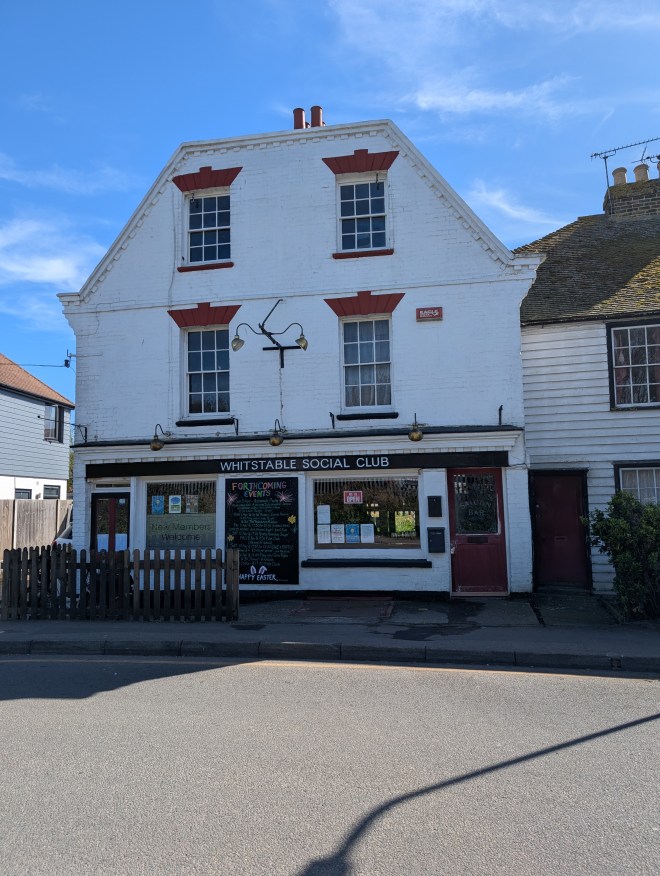
The rumours have been swirling about the town for months, but we can finally confirm, what everyone already knew: the Whitstable Labour Club is about to change its name and become the Whitstable Social Club. It has also disaffiliated from the Labour Party.
The new name has been painted on the front of the building. The new constitution will be ratified on the 6th April.
It has not, however, changed its values. As its new constitution states:
The Club is a not-for-profit community organisation and as such all members are encouraged to support and assist in the activities, development and improvement of the Club. The Club fully acknowledges the values of the local founders of the Club and will therefore give priority to providing the people and voluntary organisations of Whitstable with an environment and facilities to promote the enjoyment of members and to enhance the Whitstable community in accordance with its status as a registered Asset of Community Value.
The Club is committed to treat everyone equally, regardless of gender, gender reassignment, ethnic origin, race, religion, disability, age, sexual orientation or political persuasion. The Club will not tolerate discrimination, harassment, bullying, abuse, or victimisation based on any protected characteristic. The Club will ensure it treats people fairly and with respect and that it will provide access and opportunities for all members of the community to take part in and enjoy its activities.
To provide a meeting point and a means for the membership to make new friendships and generally enhance their social activities.
To provide a venue for progressive and left-wing meetings, events, music and films; and afford to its members a means of social enjoyment, mutual helpfulness, music events and recreation.
To strengthen the bonds between the Club and the local community.
To maintain and develop the Club premises so as to provide the best possible facilities for members and visitors.
To apply any profits of the Club in furthering the objects of the Club.
To apply for and operate a licence for the sale of alcohol drinks under the Licensing Act 2003.
The last clause is obvious. It is a licensed club whose purpose is to provide a salubrious place for the consumption and enjoyment of alcohol. The reference to the local founders makes it clear that the aims and the values of the Labour Party, as it was then, still apply. The reference to left-wing meetings makes it clear that the Club still remains a space for radical political discourse. The references to community makes it clear that the Club is reaching out to the wider community in order to support people and their needs.
Arches
Older residents will remember the original Club as being under the railway arches, where the Alimo used to be. The building has been empty for a number of years.
The Club opened on the August bank holiday 1978. There were 20 founder members, who each put in £20. A further £300 was donated by the local Labour Party branch, and then more money elicited to provide the cash float and to fill up the fruit machine. The jackpot was won on the first night. The place very nearly didn’t open as – ironically – the draymen were on strike. They had to find an alternative brewery and buy in stock from the cash and carry.
The first person to be served at the bar was Fred Rowden. Nick Turner was the man pulling the pints. Two Labour stalwarts in an overwhelmingly Conservative county.
I first became involved in 1984, six years after it opened. By then it was in a much reduced state. The finances were a wreck. Money was going missing, no one knew where. The Labour Party had virtually washed its hands of the place, and there was an infiltration of BNP supporters with far-right and racist views.
I had not long since moved to Whitstable. I was living in a shared house around the corner, in Cromwell Road. I quickly became involved with the Miner’s Support Group, which met every Friday night. The strike still was at its height and, as well as collecting on the street, we started holding benefits at the club. There was a large back room with an arched ceiling. It soon became obvious that this would make the perfect venue. The old committee were ejected, and a new committee was formed.
My good friend and flatmate, Julian Spurrier, who was a solicitor at the time, got a special occasion license at the Magistrates Court for this first Miner’s Support Group benefit. This set the precedent. Benefits counted as special occasions, which meant every time we threw a benefit we could get a late license. Thus the Club became Whitstable’s first late-night venue. We started to put bands on. They would play for free, in exchange for which they were allowed to use the back room as a practice space. It was win-win all round. The club made money, the cause made money, the bands got an audience, the audience got entertained and Whitstable got a venue.
Previous Chairs included Stan Guildford, Max Denning, Richard Haw and Dan Allen.
Alan Davies
One of the bands who became a regular down the Club was the Jellybottys, who had a hit with their song Peter Cushing Lives in Whitstable.
Alan Davies, the comedian, mentioned it on QI.
He had his first gig in the Club.
One day he had a gig in the University and I approached him. I had just started writing my column in the Guardian. I said, “you had your first gig in the Whistable Labour Club. I probably put you on. Why don’t you come and play a memorial benefit for us?”
He gave me a superior looking side-long glance: “I’m going up in the world, not down,” he said.
Later he apologised. It was meant as a quip, he said, but it had come out wrong.
Paul Anderson
Another early supporter was Paul Anderson, “Oz”, who got his first residency at the Club. He used to do a set every Wednesday night. He was always available to do gigs for us, for whatever benefit we wanted to support. Only weeks before his death we were in negotiation about a benefit for Palestine. His last words to me were in the form of a text:
“As for a benefit, I would love to help out anyway that I can. We can use my sound system and lights. I’m going through a bout of illness at the moment and have been out of action for a few months, but I am hoping to get back involved with kids again. X.”
He died just over a month after this message. His name is now on the honorary members board, on display in the back room.
New Premises
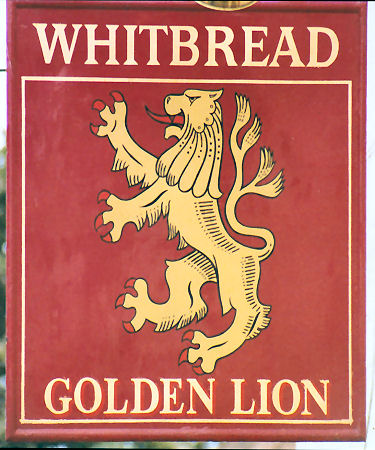
The club moved premises in 1996. The owners of the old building (British Rail, as it was then) had put up the rent so much that it was impossible to keep the business going. It was cheaper to buy than to rent. I wasn’t around for that. I was wandering the country, living in a converted ambulance, writing a book about hippies.
The new premises – the same building it is in now – had previously been the Golden Lion. It is an 18th century wooden structure that, rumour had it, had once stood where the railway bridge is now, on the junction of Oxford Street and Canterbury Road. Being made of wood it was dismantled and then re-erected in its current position, in order to make way for the railway line.
The new premises needed a lot of work, which was done entirely by volunteers. That has always been the Club’s ethos. Run by the membership, for the membership. Andrew Ling was the “Clerk of Works” overseeing the order of improvements and arranging supplies of materials etc. A basic team of about 20 people got together to do the work, lead by Julian Spurrier, John Annoot and Paul Witherall. They came in under budget and ahead of time.
Andrew says: “Most people worked for free and were rewarded with a few vouchers for free pints or a crusty roll—what was heartening was how many of the members were encouraging and approving of our efforts—of course there was a lot of banter about how soon the place would collapse due to our ineptitude or how slow and lazy we all were, but there was a tremendous feeling of togetherness and enjoyment.”
Julian‘S Legacy
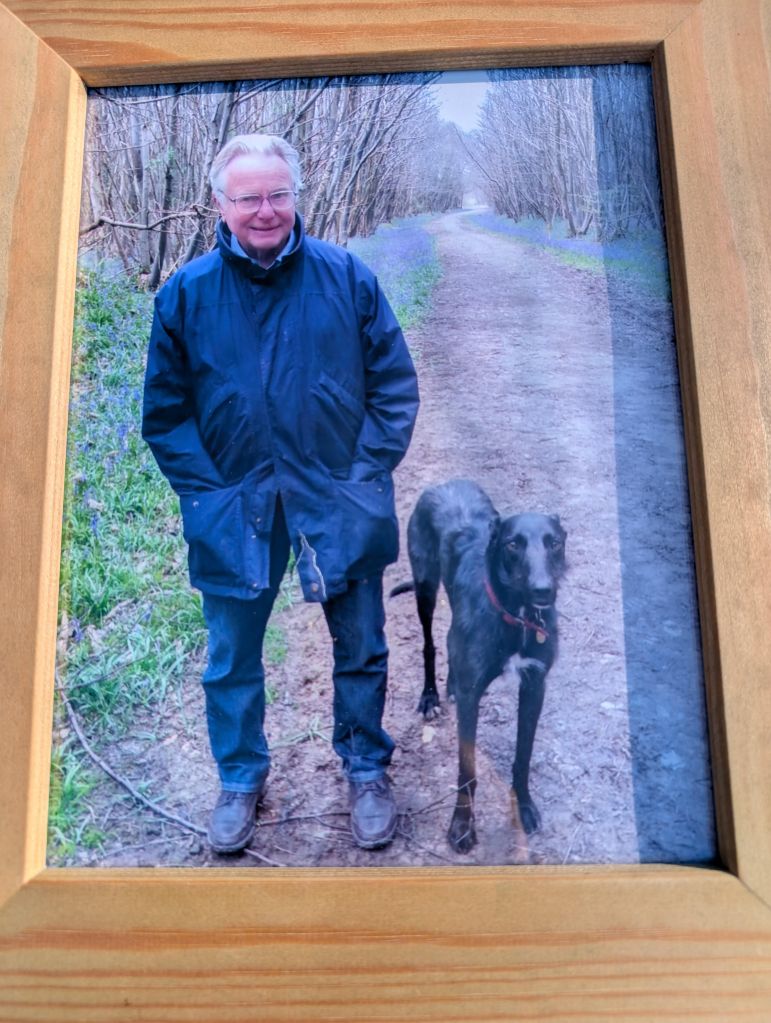
The legal work was done by Julian Spurrier. It was Julian’s idea to buy the place, as well as the house next door, in order to obviate problems with the neighbours. It was also Julian who devised the structure of ownership, whereby the building is held in trust on behalf of the membership. It is a members club, meaning that it is controlled by its members. In a very real sense, the Club is Julian’s legacy. It is Julian’s spirit that inhabits these old walls, a combination of sociability and socialism; friendship, equity, openness; kindness, inclusivity, community. Kindness was Julian’s watchword. Kindness means to see everyone as your kind, your kin. When we drink a pint in the Club, it is Julian’s presence that stands beside us, urging us to value each other’s company and to live in peace.
The New Chair
The new chair is Claire Baker. In 2022 the Club was declared a warm space, to help people who were struggling with the cold in the winter. That was when Claire became involved. She quickly realised the community potential of the space. She helped put on food and to organise games. Her energy and enthusiasm was infectious. The Club committee recognised her talent and suggested she join them. Which she did, becoming Chair in 2023.
She says: “At my heart is the Club. Lot’s of people come here when they’ve got no one to talk to. It’s nice to help people when they need it.”
She adds that the central concern of the Club is inclusivity: “Anyone can walk in here and feel safe. A woman on her own can walk in and never feel unsafe.”
The Club is like her second family she says.
There is something happening almost every night. A folk club and a film club. Various sports. A pool night, a darts night. Cribbage. Quizzes. Comedy nights, music nights (and afternoons in the summer). Something for everyone. Everyone is welcome.
Finally some reflections on the name: The Whitstable Social Club. It is the only designated social club in Whitstable. The word “social” has the same root as the word “society”. It is related to the word “socialism”. It also means companionship or friendship. It reflects the old left-wing principle that it is society as a whole – men and women, black and white, gay and straight, young and old, religious and non-religious, middle class and working class – that is the source of all wealth, not the so-called “entrepreneurs” who claim it for themselves. It is also a reminder that real value doesn’t just come from money. It comes from community. From companionship. From engagement. From friendship. From caring for each other. From helping each other. From love.
Without love we are nothing.
You can follow the Club on Facebook here: https://www.facebook.com/TheWhitstableLC
Relaunch Party
The relaunch party will be on Saturday 5th April. The Club will be closed till 3pm, after which the ribbon will be cut by Julie Wassmer, author of the Whitstable Pearl mystery series.
Then we party:
- Food provided by Sue.
- Entertainment from Adam Reggio, from 17.00
This will be an open day. Non-members are welcome to come along.
Forthcoming events:
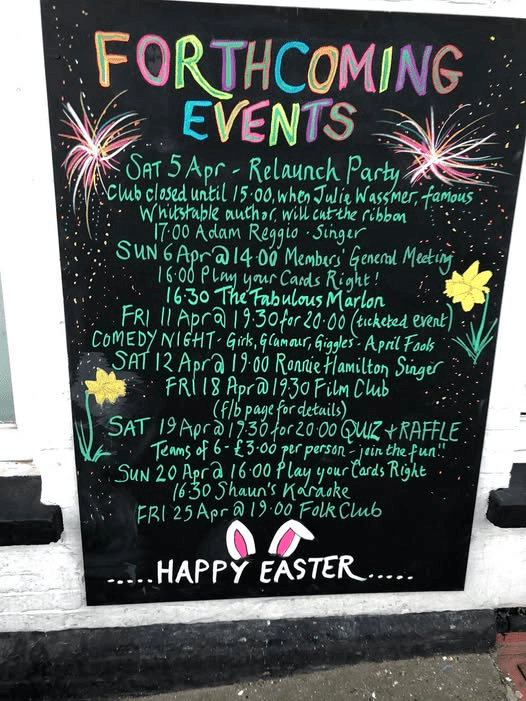
Sunday 6 April
14.00 Members’ General Meeting to approve new Constitution and Rules
16.00 Play your Cards Right
16.30 The fabulous Marlon

Friday 11 April
19.30 for 20.00 Comedy: Girls, Glamour, Giggles
Tickets £6/£8 from https://ticketlab.co.uk/event/id/31094/Girls-Glamour-GigglesAprilFools
Or £8/£10 on the door
Saturday 12 April
19.00 Ronnie Hamilton, singer
Friday 18 April
19.30 Film Club
Saturday 19 April
19.30 for 20.00 Quiz and Raffle
Teams of six, £3 per person
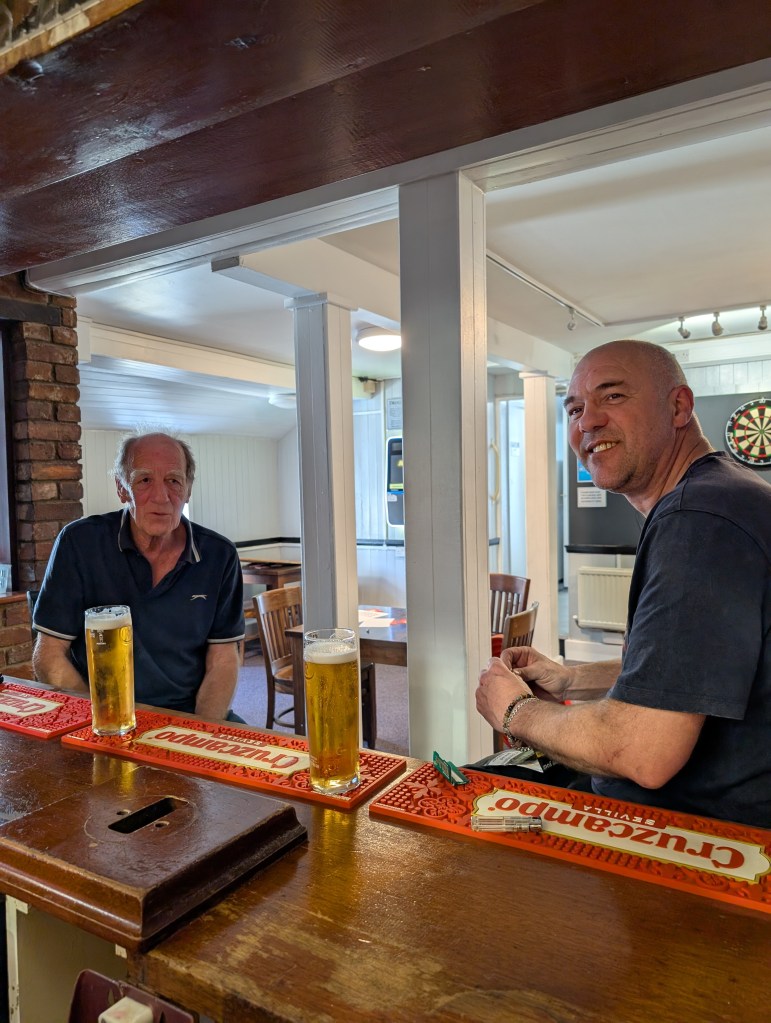
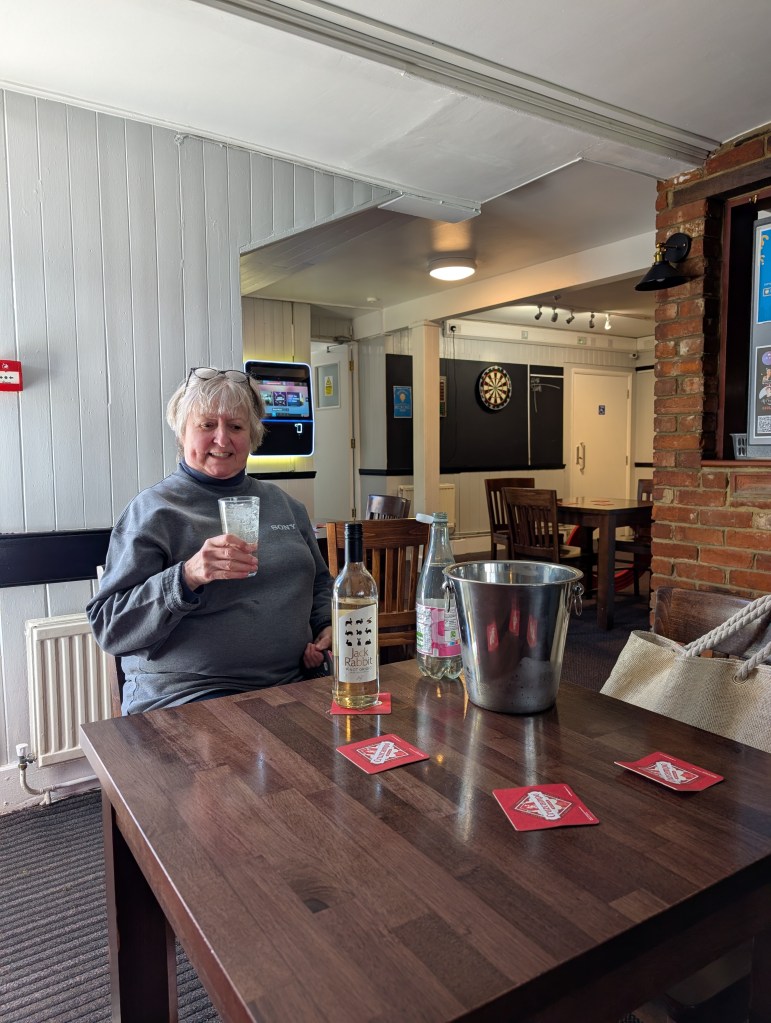
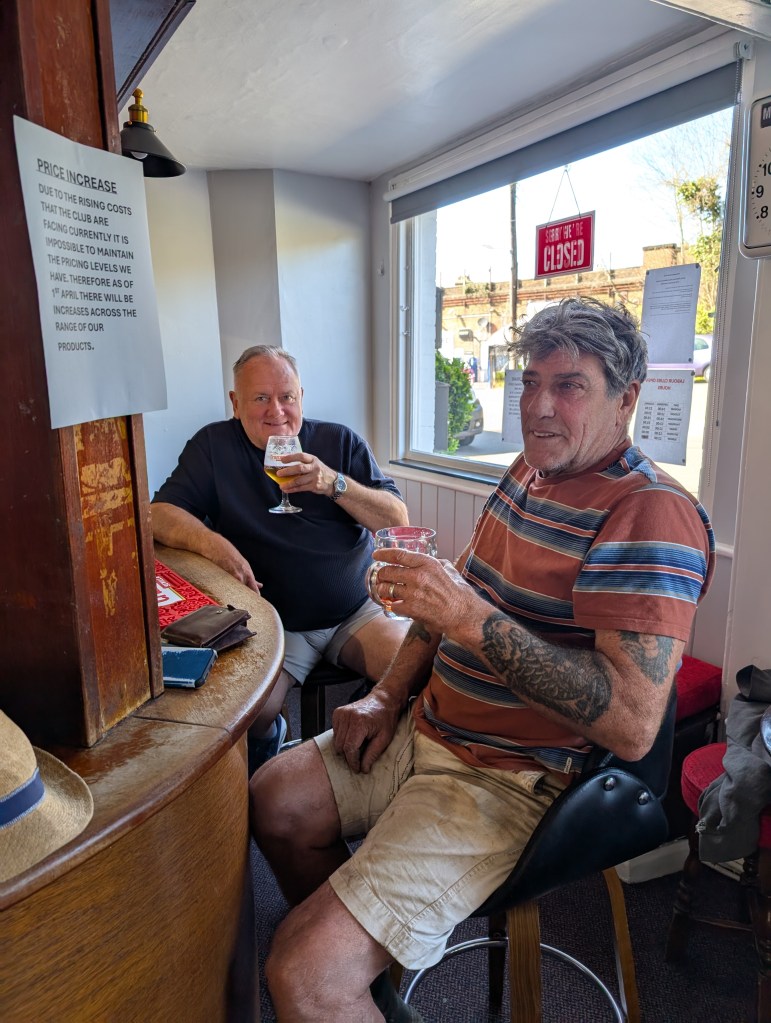
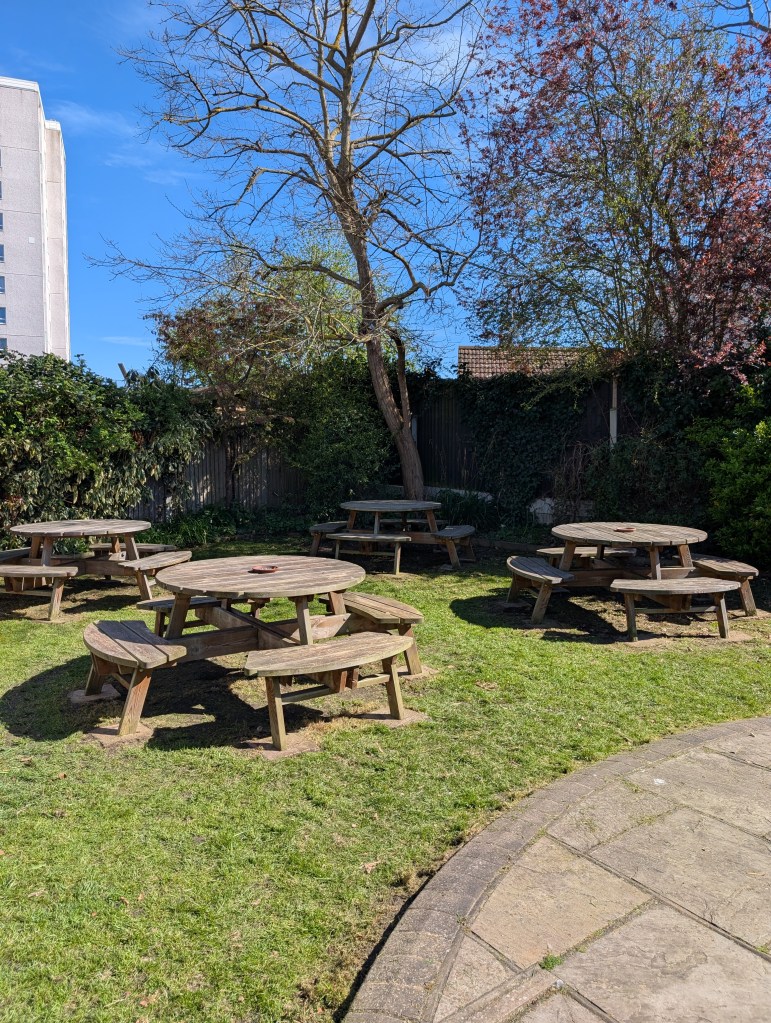
A welcome from the members
(Click on images to enlarge)
About CJ Stone
CJ Stone is an author, columnist and feature writer. He has written seven books, and columns and articles for many newspapers and magazines.
Read more of CJ Stone’s work here, here and here.
Whitstable Views
How to use it!
- Make sure you share and like our articles on Facebook and Twitter/X, and whatever other social-media platforms you use. Join us on Facebook here: @whitstableviews
- You can read and contribute articles for free but in order not to miss any, please subscribe to get regular free updates.
- To do so, press the “Subscribe” icon on the bottom right hand corner of the screen. This will take you to the option to sign up. (It disappears as you move the text down then reappears at you move it back again!)
- Please engage by leaving comments on the website, rather than on social media. Let’s get a debate going. All our contributors welcome the chance to engage with YOU.
- To all writers out there, we want to hear YOUR views too, so do submit your own articles. Read our submissions page on how to do this: https://whitstableviews/submissions/
- Finally, to keep Whitstable Views alive and independent please donate if you feel able to do so. As little as £1 would help. Details are on the donations page here: https://whitstableviews.com/donate
 Whitstable Views
Lovely piece. Thank you Chris .
LikeLiked by 1 person
Great
LikeLike
Hi Chris. Very interesting article. My husband and I visit Whitstable regularly and have been going into the Labour club periodically for around five years. We visited in May and were made to feel very welcome as usual. The helpful bar staff usually ask a member to sign us in. We visited again in July but experienced a very different vibe. A female customer (presumably a committee member) sidled up to the bar and quietly said to the staff member that she didn’t recognise us and we needed to be challenged. We were asked if we were members (no), we were asked if we knew a committee member (no). They then didn’t know what to do, and neither did we, so we left and won’t be returning. Shame that only the friends of committee members can use the social club. This restrictive attitude will surely result in the club missing out on much-needed custom.
LikeLike
Sorry to hear about your experience Paula. The club aims to be as welcoming as possible, but, of course, there’s no accounting for every individual member. I will pass on your concerns to the committee.
LikeLike