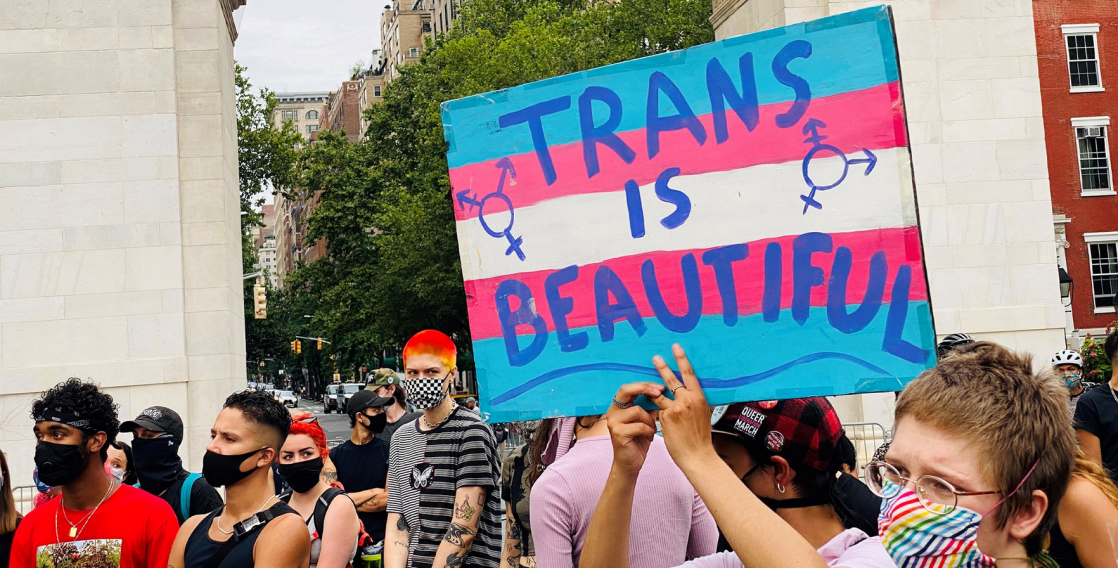
An opinion piece on the Supreme Court ruling on a definition of sex, the Equality Act and implications for transgender rights.
by
‘Every social stratum has its own “Common Sense” and its own “Good Sense,” which are basically the most widespread conception of life and of man [sic].’
— Antonio Gramsci, The Prison Notebooks

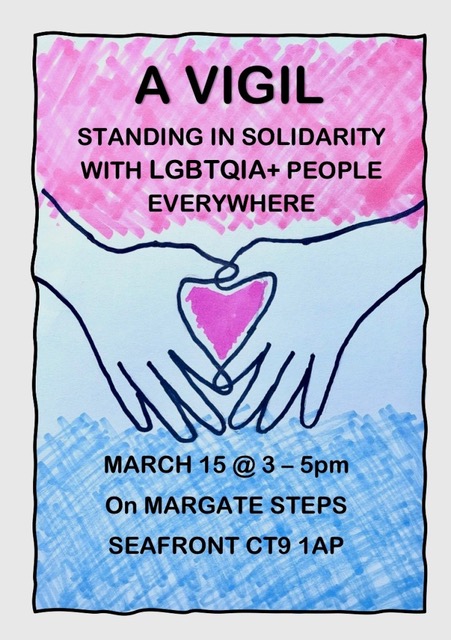
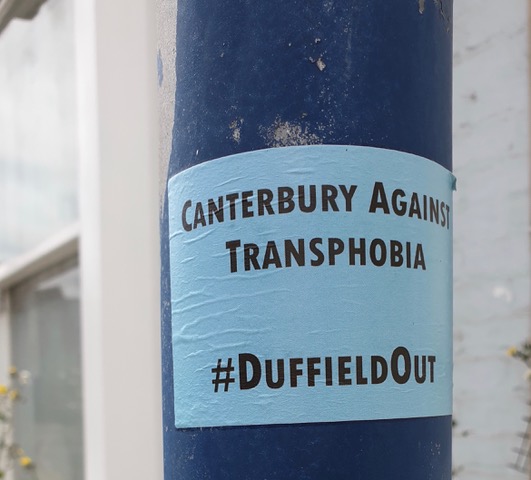
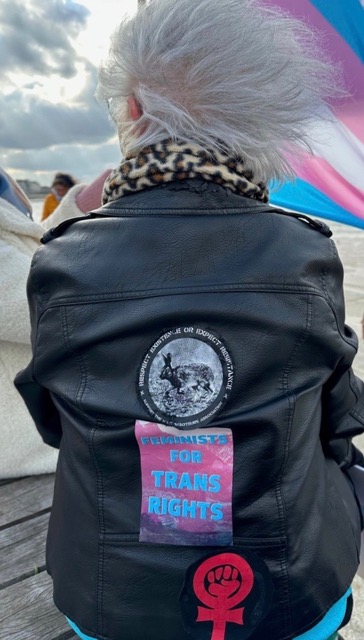
Shortly after the International Day of Trans Visibility came the Supreme Court ruling that, for the purposes of the Equality Act, the definition of a woman is based on biological, natal sex, to the exclusion of trans women. A couple of weeks earlier, a solidarity rally had been held in Margate, where the organisers kindly offered an opportunity to speak from the point of view of a feminist trans ally, as follows:
‘In 1971 I joined the Gay Liberation Front, went on the first Pride protest march, and began meeting trans people. Activists campaigning for legal and social rights, and the right to be who they are. Their courage should be honoured. They were inspired by the New York group that supported young homeless queer people – STAR: Street Transexual Action Revolutionaries. Some people deny that trans people were part of the lesbian, gay, bisexual and women’s movements. Which is why it’s necessary to state: that’s not true. This history must not be erased. There were trans people there from the beginning, of course, just as there have always been trans people and there always will be.
‘And now we have to oppose threats to such gains as have been made since the days of Gay Liberation. In the United States, as well as demonising and kicking trans people out of their jobs, passing vicious laws against them, and denying visas and passports, in an act of desecration, Trump’s henchmen have removed the T from the Stonewall National Memorial.
‘And, let’s make no mistake, the right wing, after smashing reproductive rights, has marriage equality and our other legal safeguards in its sights as well, and has its hateful counterpart in this country. To counter a worsening global situation we need international solidarity. Attacks on trans people are part of an assault on all human rights especially those of people of colour, women and queer people. Closer to home, we have to contend with the same bullshit. I have the misfortune of having an MP who contributes to a climate of prejudice and ignorance, while claiming to champion women’s rights.
‘One way or another, I’ve been involved in the Women’s Liberation Movement since the late ‘60s. I would have thought that, if someone defines themselves as a feminist yet finds themselves saying the same things as Putin, Orban, Badenoch, Musk, Farage, Meloni, or the inane, draconian edicts of King Donald himself, that they might think again.
‘Apparently not!
‘Personally, I would like to reclaim radical feminism from the way it’s been used or misunderstood of late – i.e., with the use of the acronym ‘terf’: ‘trans-exclusive radical feminist – to take back what I understand as its original, accurate meaning: transformational and intersectional politics, tackling the very roots of oppression.
‘I can’t see anything feminist, or radical in a good way, about hating, persecuting, or ridiculing people, or taking away their human rights to safety, to healthcare, to freedom of movement, and freedom from harassment. Nor do I think it’s particularly feminist to insist on the dualism of men and women based on reductively defining us by our reproductive organs – in fact that’s the very ideology feminism set out to dismantle and denaturalise! However important biology is, it is not destiny. Claiming narrow restrictive roles to be natural, fixed and immutable, in fact, is a basic tenet of patriarchal, authoritarian and fascist power structures.
‘We know that nature is much queerer than that. Those of us who refuse to be defined and confined reject the imposition of such heterosexist crap. We resist the attempted erasure of ANY group of people! Trans-inclusive radical feminism has revolutionary potential. What is radical, I suggest, is challenging all the policing which punishes us if we transgress the norms …’
After the Supreme Court’s decision on 16th April JK Rowling entitled the occasion ‘TERF VE Day’. The contribution she made toward funding the legal case begs the question, of course, as to why rich individuals with no apparent expertise in issues can wield such influence over legislation and policies affecting whole countries. Just as concerning, however, is the snarky, smug way in which the vitriolic animus toward trans people has become commonplace, as expressed in such tweets. It amazes and distresses not only trans people, their allies, friends, and families, but should surely alarm anyone with a shred of decency. Why should even a fraction of the fury that should rightly be directed at perpetrators of the epidemic of male violence against women and femicide and the institutions that enable them, the governments who cut funding to refuges or don’t punish rapists, and systems that subjugate women globally, be targeted at trans women?
‘A victory for common sense’ was how many people greeted the court’s decision. This concept is always interesting: what exactly is common sense, and how is it created? Is it an unchallengeable reality that is easily observed, comprising self-evident truths? Or is it more accurate to see it, as in Gramsci’s theory, as referring to ‘the prevailing beliefs and ideas within a society, often taken for granted and not critically examined … a complex, ever-changing construct influenced by … historical context, social structures, and power dynamics … both a reflection of lived experience and a tool for maintaining existing power structures.’
Not all feminists are popping champagne corks in celebration of the Supreme Court’s judgement, or feeling that women’s rights have been progressed by it. The jubilation expressed in triumphalist scenes outside the court was not shared by many of us, who found it appalling. Giving the lie to the notion that the decision clarified the definition of sex while still protecting trans people’s rights was the way another, wider intention was stated by the banner: ‘Women are born, not some bloke with a form.’ (The form referred to presumably being a Gender Recognition Certificate.) Which brings to mind – not in a good way – Simone de Beauvoir’s adage, ‘One is not born a woman, but rather becomes one;’ i.e., our role is formed, socially constructed, created by the society in which we live, not inherent. This was a riposte to biological determinism, a consciousness-raising precept that denaturalised what was seen as normal and correct in the way masculinity and femininity are lived or performed.

This was crucial for the Women’s Liberation Movement. It struck a chord with many of us who did not identify ourselves by our reproductive equipment and rejected the heterosexist edict that women and men are complementary but unequal beings. The struggle against this ideology continues globally. That is not to deny that women are subjugated in various material ways because of being categorised as a biological group or class; this is a political structure, hence subject to political struggle to change it.
The slogan waved outside the court recalled the callous attitude expressed by the 1979 book, The Transexual Empire, whose author advocated that ‘transexualism’ should be ‘morally mandated out of existence.’ In other words, trans people shouldn’t exist, a view echoed these days by many who opine they don’t actually exist, are either predatory men in frocks or deluded. The validity of people’s lives is traduced and they’re deemed valueless, and when seeking to align their physical selves with how they wish to live they’re attacked, and portrayed as a threat to natal women. Whereas, as Judith Butler says, in an article forensically analysing Trump’s Executive Order ‘Defending Women from Gender Ideology Extremism’: ‘of course the dignity, safety and well-being of women should be secured, but if we value these principles, then it makes no sense to secure one group’s dignity, safety and well-being by depriving another group of dignity, safety and well-being.’ (‘This is Wrong’, London Review of Books, 3rd April 2025)
We could view this from another angle: that of considering how a decent society might best accommodate and protect all its citizens without pitting their various rights against one another, or othering some of them in dehumanising ways. The overlap with right-wing sexist ideology and policy here can’t be overlooked. There’s even a feminist version of the white supremacist Great Replacement Conspiracy Theory, which thinks biological women will be supplanted by physically altered men. (Don’t get me wrong; I’d put nothing past Stepford Wives/Black Mirror technology these days, but that is risibly removed from the reality of actual trans people’s lives.)
Approaching this with a different frame of reference, we might start with the knowledge of the reality that there are hundreds of thousands, indeed millions, of trans people all over the world, part of the world’s myriad and diverse beings as much as any of us. And what sort of world do we want to live in, or work towards? For anyone who does not wish to inhabit one where groups of people are persecuted, excluded, or erased, who’s concerned with social justice, that’s a primary question or principle.
Although the court’s decision is said to contradict the original intention of the 2010 Equality Act, the consequences are dreaded by many, as groups of activists termed ‘gender critical’ (an oxymoron if ever there was one, as all feminism stems from critiquing gender), and organisations such as the Equalities and Human Rights Commission, gear up to put pressure on public bodies. Kishwer Falkner, chair of the EHRC, says they will ‘pursue’ the NHS. In one of the most chillingly reductive statements in the recent ‘debate,’ which should set alarm bells ringing, Falkner opined at a recent women and equalities select committee that ‘most people would recognise that biological sex is a categorisation which accords with reproductive functions. So a woman is a person whose body is designed to produce eggs and a man is a person whose body is designed to produce sperm.’ Apparently further litigation may challenge the legality of Gender Recognition Certificates.
The organisation FiLiA, which focuses on ‘sex-based rights’, and believes that GRCs create a ‘legal fiction’ says ‘… we must see an end to policies that ignore the needs, rights, dignity and safety of women and girls. … Governments, regulators and public bodies must now review and clarify their policies and guidance. It is their responsibility to ensure the law is understood and implemented. … Women can continue to hold the powers that be to account using the Equality Act …’
Small wonder that many trans groups and others, like the Good Law Project, believe trans rights have been set back by this court ruling, as an even more hostile environment is created. They are not alone, as shown the following weekend by the outrage and solidarity of thousands of people at quickly-organised demonstrations all over the country protesting against it.

At the Margate solidarity rally, I finished by saying
‘… Whose body is it anyway?
‘We are, each of us, a precious part of the whole, part of communities, families, societies, but we are also individuals, adult human beings, with a right to bodily autonomy. Our bodies are ours, our minds are ours, our lives are ours. They do not belong to the state, or any monomaniac bigot, fundamentalist or mean-minded right-wing idiot.
‘So, we must do everything we can to oppose their cruelty. Keep striving for an expansive, open-hearted politics, for a decolonised imagination that creates a world in which many worlds exist.
‘Together with other communities of resistance working for liberation, with joy and love, we can affirm and celebrate our common humanity.’
Which seems like common sense to me.
ABOUT:
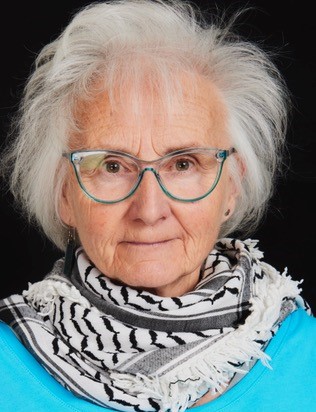
Frankie Green, aka Hewett, was born in London, lives in Whitstable and has been taking part in various political activities since the 1960s: anti-apartheid movement, the Vietnam war, the Gay Liberation Front, the Women’s Liberation Movement, the Palestine Solidarity Campaign and local environmental actions. She runs a feminist music archive and collects stuff on a blog.
Whitstable Views
How to use it!
- Make sure you share and like our articles on Facebook and Twitter/X, and whatever other social-media platforms you use. Join us on Facebook here: @whitstableviews
- You can read and contribute articles for free but in order not to miss any, please subscribe to get regular free updates.
- To do so, press the “Subscribe” icon on the bottom right hand corner of the screen. This will take you to the option to sign up. (It disappears as you move the text down then reappears at you move it back again!)
- Please engage by leaving comments on the website, rather than on social media. Let’s get a debate going. All our contributors welcome the chance to engage with YOU.
- To all writers out there, we want to hear YOUR views too, so do submit your own articles. Read our submissions page on how to do this: https://whitstableviews/submissions/
- Finally, to keep Whitstable Views alive and independent please donate if you feel able to do so. As little as £1 would help. Details are on the donations page here: https://whitstableviews.com/donate
 Whitstable Views
A brilliant argument against the idea that gender can be defined by biology. Incisive, angry and uplifting. Stuart Feather
LikeLike
This is an unpopular and regressive viewpoint.
Rosie Duffield and JK Rowling are right, and in fact we all know Women are Female.
The truth is being reasserted.
LikeLike
It is exhausting to see you make this same leap as the people you criticise – that acknowledging femaleness means accepting every role or expectation based on it. All of your arguments come down to your misunderstanding of phrases like “biological determinism” and “biology is destiny”.
The mistake you’re making is like this:
“Blind people are people who can’t see.”
“How DARE you reduce blind people to their lack of vision!”
Of course blind people, and female people, are individuals with hopes, dreams, likes, dislikes, hobbies, temperaments, relationships, and personalities that vary widely. But the thing that makes them specifically blind people, or female people, is a fact about their body, and these facts are relevant to the way they move through the world. In the case of female people, it is a fact about half the population, and one that is so significant that every person in existence was born from one of these people. Without male and female, humans would not exist from one generation to the next. If sex was as invisible and as socially irrelevant as blood groups, we would not have all this extravagantly constructed meaning around it – clothes, roles, behaviours, archetypes, etc. These vary between time and culture, are influenced by technology, landscape, religion, etc: but they are not disconnected from biology. They are always constructed around the real, flesh and blood fact of male and female. There is a reason why “woman”, “man”, “mother”, “father”, “son” and “daughter” are among the oldest words in every language, far before any concept of chromosomes or biology or hormones. Have you considered that, if sex wasn’t as important as it is, people who call themselves transgender would have no concept of “man” or “woman” to mimic? It is a real case of wanting to have your cake and eat it. Men will insist they can take on the social meaning of “female” (impossible anyway) and at the same time deny and disregard that all of this meaning continues to be generated because femaleness is real and important.
Some aspects of “social sex” or “gender” are less important and more changeable, like whether pink is a feminine or a masculine colour – have at it. Others are closer to the core of why sex exists and are very consistent, while others are somewhere in between. For example, I read an article by a middle-aged transvestite recently that argued that it is wrong to say breastfeeding is something women do, because it enforces a patriarchal gender role on some people and restricts it from others. Yet, this is deranged. If “breastfeeding” is a female gender role, it is clearly so because women give birth to children & through adolescence & matrescence their body changes to be able to nourish their babies. Men cannot do this; the ones that seek to suffer from a paraphilia & put their desires ahead of both mother and baby’s needs. Breastfeeding is as natural, fixed & immutable as it gets. It doesn’t mean we need to force all women to have babies. It does mean that when they do, their relationship with and responsibility to their babies is different from men’s, and to celebrate them, support them or protect them from discrimination in law means recognising this fact. If you’d read the ruling, you would see that if one assumed the Equality Act was written by reasonable people, they could not possibly have meant to include men with an “F” on their certificate in breastfeeding protections, and exclude women with an “M” on their certificate. That would be cruel and nonsensical.
Not all women want to have a baby. Not all women are fertile. Not all women are straight. Yet, their femaleness is relevant in every case & does not make her interchangeable with a male. A woman who doesn’t want to have a baby faces different levels of risk & responsibility than a man does, because it is she who gets pregnant. A woman wtih fertility issues carries a different grief and needs different healthcare to a man, because her relationship with childbearing is different to his. A woman who is gay has a different sort of potential and limitation in regard to having a baby than a gay man would. All young women in work may be treated differently because their employer knows they may take time off for pregnancy & maternity leave; men are not. In order to protect & support women in law, these differences need to be recognised. It isn’t about “reducing women to their reproductive organs” -> “insisting the role of women must is to use those organs, get pregnant and have babies” which seems to be the reasoning you are running with.
You, personally, cannot seem to acknowledge sexual difference without assigning a value hierarchy to it. So you think that for men and women to be equal, you need to deny sexual difference. The mind boggles that you can’t see the huge error in reasoning you are making here.
For me as a young girl who stuck out, who didn’t share the interests of other girls or behave like they expected me to, and preferred to play with boys, reminding myself that the only thing that made me a woman was my femaleness and that everything else was up to me was a comfort. I could figure out which expectations I could toss (I’ll never watch reality TV, contour my face, or wear heels casually, and I still love sci-fi & programming) & which ones would serve me well to try to follow (learning how to interact with women and men socially, as a woman) Whereas, if femaleness isn’t what all women have in common then what is? A desire to be perceived as female? (Aside from being an admittance that woman = female, it’s offensive & unworkable in law.) An attempt to fit whatever the current social meaning of “woman” is? Then you risk tying us all to roles & behaviours that we would rather change or be free from & you kill the variety and diversity that female people come in. And yet that’s what you’re accusing us of. What could you call this? “Social construct determinism”?
LikeLike