The General Strike, one hundred years on: a revolution betrayed
by
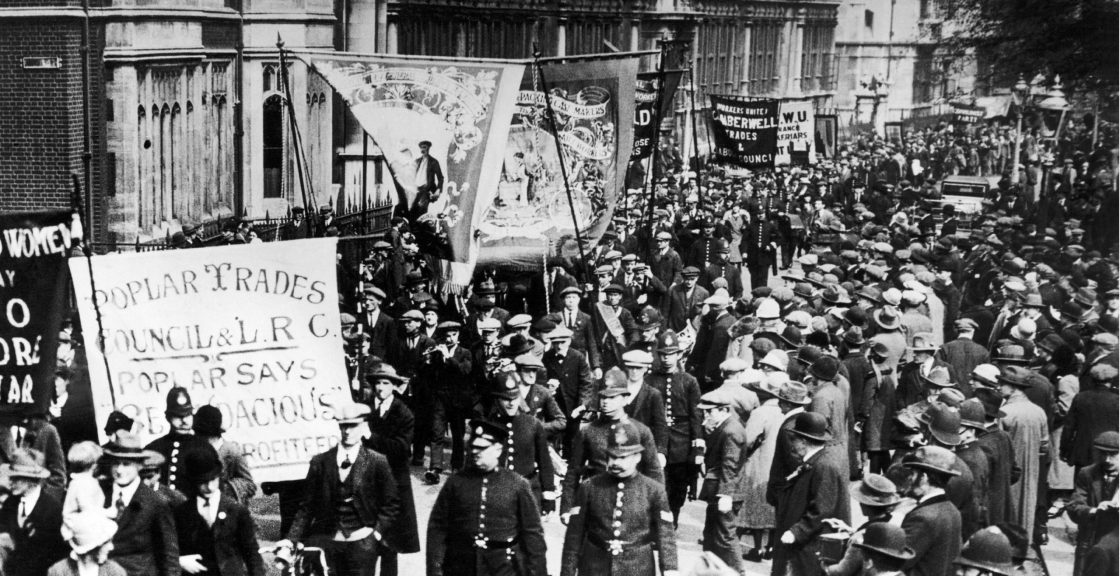
Nine days in May 1926 was probably the closest Britain has come to a revolution. It was preceded by “Red Friday” in 1925, in which the government, in the face of united opposition from the trade union movement, was forced into a humiliating retreat from the coal owners’ plan.
On Friday 31 July, after a cabinet meeting that lasted late into the night, the government agreed to a nine-month subsidy and a government commission in return for the coal-owners abandoning their plan to cut wages.
At the time, 1400 companies owned 2500 collieries, with 613 of them producing 95% of the nation’s coal. The later Tory prime minister Neville Chamberlain called them “the stupidest and most narrow-minded employers I know.”
But, as the Communist Party noted, Red Friday was only a “strategic retreat”. In his Notes of the Month in Labour Weekly, R P Dutt, the party’s leading theoretician, added that: ”The Royal Commission, as always, is only a smokescreen for the preparation for a decisive battle. There is no escape from future conflict”. [1]
This was demonstrated among others by the almost immediate establishment of a strike-breaking non-governmental Organisation for the Maintenance of Supplies (OMS).
A statement by the leadership of the Communist Party described this as “the most definite step to organised Fascism yet made in this country.” [2]
In October 1925, 12 leading members of the Communist Party were arrested for sedition. In November they were sentenced to six months in jail. A few weeks later 167 striking miners in Wales were arrested and charged with disturbing the peace and rioting. The government was clearly attempting to isolate the most militant sections of the movement.
The attitude of the General Council was summed up by J R Clynes, secretary of the National Union of General Workers: “I am not in fear of the capitalist class. The only class I fear is our own.” [3]
Throughout 1925, as the government prepared measures for the coming conflict, the TUC leadership desperately sought for compromises, mainly at the expense of the miners. In March 1926 the Royal Commission Report was published, and was met with a weakening of their position on the part of the TUC negotiators. Contrary to their previous position of opposing any reduction in wages, they suggested the miners should take “efforts to obtain an equitable settlement of outstanding differences” and that “negotiations should be continued without delay . . . to reduce points of difference to the smallest possible dimensions.”
Nevertheless, in the last few weeks before the strike, the government was refusing any compromise and the TUC was forced into a position where it had no alternative but call the strike.
On the eve of the strike, the miners’ leader A J Cook wrote: “To my surprise and alarm I heard quite by accident on Saturday evening about 9pm that the Negotiating Committee of the TUC were closeted in Downing Street with the Prime Minister. I could feel no other apprehension, seeing that I had not been informed, that they were presumably discussing the miners’ case in the absence of the miners’ representatives.” [4]
The TUC were not scared of defeat. They were scared of victory. When the strike was called on 3 May, the response shocked even the TUC. In addition to over 1m miners who were already locked out, 1.5m workers in the docks, the iron and steel industry, transport and printers came out on strike, rising to 1.7m in the final days.
In addition, many workers who were being held in line for the “second wave”, in particular the engineers, were demanding to know why they had not been called out.
In many areas, particularly where the Communist Party had some influence, Trades Councils formed councils of action that controlled all aspects of life. The Edinburgh Strike Bulletin reported “there has been a constant stream of applicants to the offices and many business firms have been on the doorstep . . . The Committee believe that in a few days practical control of all road traffic will be in their hands, and that the OMS . . . will find their occupation gone.” [5]
In an explanation of class solidarity, my uncle told the story about one of the few known Tory voters in a South Wales town of 100,000 people who was put in charge of the barrier controlling one of the main access roads. He would sooner have disobeyed his own mother than orders from the Trades Council.
Dual Power
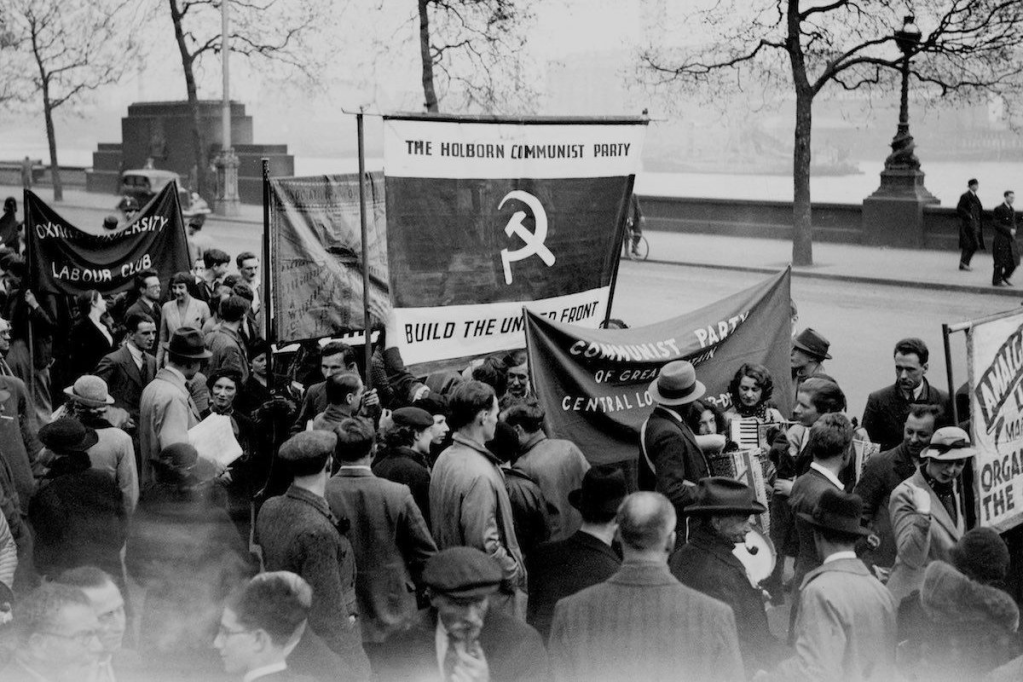
Effectively, there was dual power, and the strike was only getting stronger. Aid for the strikers flooded in from all over the world. Soviet trade unions alone collected £1,250m for the strikers, which the General Council refused, though the miners’ union gratefully accepted.
The General Council of the TUC meanwhile was looking for any pretext to call the strike off. They found one in Sir Herbert Samuel, head of the Royal Commission, who hastily returned from his holiday in Italy and was immediately met by leaders of the TUC. They came up with the Samuel Memorandum. This contained vague recommendations of reorganization of the industry, together with cuts in wages, but crucially included no guarantees of government backing. (They later disowned it, and claimed Samuel was negotiating purely on his own behalf.)
“J H Thomas [the rail union leader] said to me personally, when I asked him whether the Government would accept the Samuel proposals and what were his guarantees: ‘You may not trust my word, but will you not accept the word of a British gentleman who has been Governor of Palestine?’ ” [7]
On May 12, on the basis of the vague promises contained in the Samuel Memorandum, the TUC called off the General Strike. The miners were left alone, and remained out until November, when they went back under significantly worse conditions.
Was there a revolutionary situation in Britain in 1926? Quiet certainly not. The miners’ demands were purely defensive: not a penny off the pay, not a minute on the day! But the momentum that developed during the nine days in May definitely turned it into one. Something the TUC was completely unprepared to take advantage of even if it had wanted to.
The Communist Party, meanwhile, had only been formed six years earlier and numbered just 5000 members, who faced arrest and harassment throughout the strike.
Whether or not there was a revolutionary situation in Britain in 1926, dual power was developing in large areas of the country. The Communist Party was too young to take advantage of it and the TUC, dominated by the most reactionary constitutionalists, was incapable of doing so but instead devoted all its efforts to undermining the strike that it itself had called.
Nevertheless, the strike had far-reaching effects. Miners’ leader Arthur Horner wrote: “. . . in the end the victory of the coalowners was a Pyrrhic victory. The very severity of the settlement which they imposed on us . . . made our claim for nationalisation inevitable.
“If there had been no ’26 there would not have been such a tremendous feeling for nationalisation after the Second World War.” [8]
What the Manifesto on the General Strike issued by the All-Russian Council of Trade Unions called “the greatest strike in the world” [9] remains a high-water mark of the British working-class movement.
- James Klugmann, History of the CPGB, The General Strike, 1925—1926, p. 38.
- R. Page-Arnot, The General Strike, Origins and History, p. 52
- Report of the Proceedings of the 57th Annual TUC, 1925, p. 386–387
- Arnot, The General Strike, p. 144.
- Klugmann, The General Strike, p. 160.
- A. J. Cook, Nine Days in May, p. 20.
- Arthur Horner, Incorrigible Rebel, p. 93.
- Klugmann, The General Strike, p. 322.
Platform Films
It’s been a hundred years since Britain had its first and only general strike. Now a recently discovered unique documentary THE GENERAL STRIKE tells the story of the strike, how close it came to success and the disastrous consequences of its failure.
The film, made in the early 1970s, tells how workers across the country came out in support of over a million miners who had been locked out of work for refusing to accept lower pay.
With moving testimony from people alive at the time, the film vividly illustrates how the strike was opposed by the full force of the British establishment and how it was finally betrayed by union leaders.
The result was the catastrophic social collapse of the 1930s, but the film also show how close Britain came to a revolution which would have changed the course of history.
This powerful 70 minute documentary has now been made available for screenings and viewings by award-winning radical filmmaker Platform Films. You can buy a copy of the film on memory stick, DVD or via an online link. The cost to institutions including trades councils is £60, to individuals and union branches the cost is £20.
There is no additional charge for screening the film publicly but donations are welcome.
Please e-mail norm6344@gmail.com for more details.
About:

Dave Westacott is a former journalist and translator living in Vienna.
Whitstable Views: How You Can Help
- Make sure you share and like our articles on Facebook and Twitter, and whatever other social-media platforms you use.
- Follow the site to get regular updates about new articles when they appear. Press the “Follow” icon in the bottom right hand corner of your screen and that will take you to the option to sign up. (It disappears as you move the text down, then reappears as you move it back up again!)
- Leave comments on the site rather than on Facebook. Let’s get a debate going. All of our contributors are willing to engage with you if you leave a comment.
- To all writers out there, we would LOVE you to make a contribution. Read our submissions page for details on how to go about that: https://whitstableviews.com/submissions/
- Finally you can donate. As little as £1 would help. Details on the donations page here: https://whitstableviews.com/donate/
 Whitstable Views