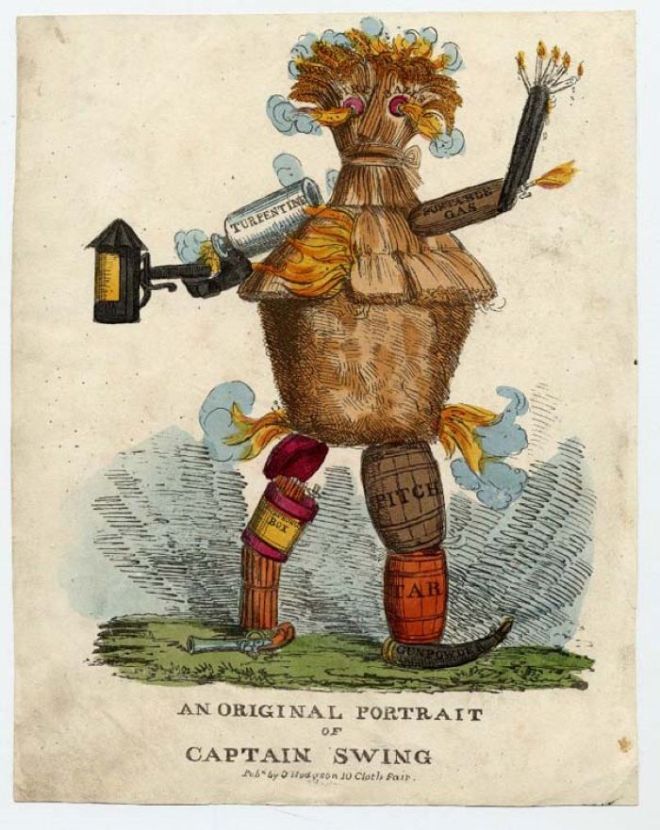
The Swing Riots and the Battle of Bossenden Wood
by

Walk through the orchards and quiet lanes of Kent today, and it is hard to imagine the county as a landscape of rebellion. However, in the early nineteenth century, rural Kent witnessed two dramatic uprisings led not by political figures but by ordinary farm labourers. The Swing Riots of 1830 and the Battle of Bossenden Wood in 1838 were moments when the poorest workers stood up against the forces reshaping their lives.
By the 1820s, pressures on rural families were mounting. Enclosure had fenced off common land that once provided firewood, grazing and a degree of independence. Wages were falling, rents were rising, and the arrival of the threshing machine threatened the winter work labourers relied on to survive. For many, mechanisation was not progress but a direct threat to their livelihoods.
Captain Swing
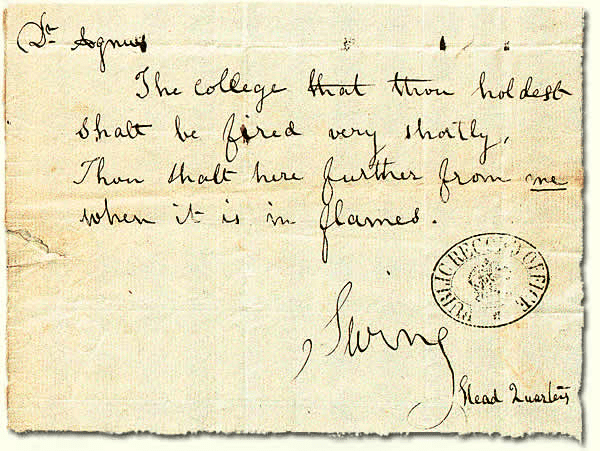
The Swing Riots erupted in this atmosphere of desperation. Beginning in Kent and spreading across southern England, the protests took their name from the mythical “Captain Swing”, whose signature appeared on letters demanding higher wages and the destruction of threshing machines. Labourers gathered at dusk to break the machines that symbolised their dispossession, and in many places they turned their anger on the institutions they believed kept them in poverty — attacking threshing machines, setting fire to ricks, confronting farmers, parsons and magistrates, and in some areas damaging tithe barns or workhouses as they demanded fair wages and relief from hardship.
The rioters directed their anger at three forces they believed were responsible for their misery: the tithe system, which required payments to support the Anglican Church; the Poor Law guardians, accused of abusing their power over the poor; and the rich tenant farmers, who had been lowering wages while introducing labour‑saving machinery. Those captured faced charges of arson, robbery, riot, machine‑breaking and assault. Punishments included imprisonment, transportation to Australia and, in some cases, execution. 252 were sentenced to death (though only 19 were actually hanged, including two brothers from Blean, William Packman, 20 years and Henry Packman, 18 years, who were executed on Pennenden Heath in Maidstone on Christmas Eve, 1830.
Life became even harder after the Poor Law Amendment Act of 1834 abolished outdoor parish relief for able‑bodied people. The workhouse became the only form of support, with families separated and conditions deliberately harsh. For labourers already living on the edge, the new law felt like a final blow.
John Nichols Tom
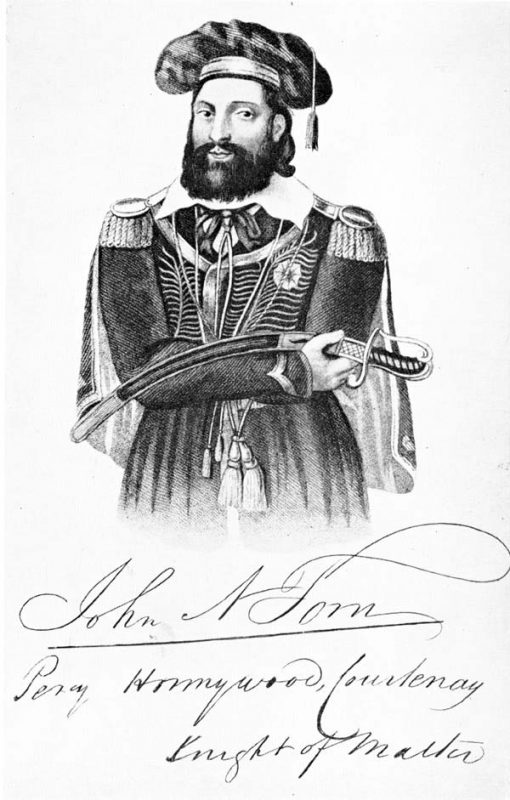
It was into this world that John Nichols Tom stepped — a former wine merchant who reinvented himself as “Sir William Courtenay.” After a conviction for perjury and several years in Barming Asylum, he emerged preaching millenarian ideas and promising peace and prosperity to the poor farm workers who followed him. To men who had lived through the Swing Riots or had grown up in their shadow, Courtenay’s message resonated. He led his followers through the villages of Blean, Dunkirk, Hernhill and the surrounding countryside, gathering support as he went. Many saw him as a champion who spoke to their grievances: low wages, harsh overseers and a system stacked against them.
When constables attempted to arrest him, he shot one dead, prompting a rapid military response. Soldiers confronted the group in the Battle of Bossenden Wood, where a brief but deadly clash left Courtenay, eight followers, Constable Nicholas Mears and Lieutenant Henry Boswell Bennett dead.
Seven of the agricultural workers who died alongside Courtenay are buried with him in unmarked graves in the churchyard of St Michael’s, Hernhill. Their resting place remained unmarked for nearly two centuries, until a permanent memorial plaque was installed on 21 March by the Battle of Bossenden Wood Memorial Group. Lieutenant Bennett was buried with full military honours in Canterbury Cathedral. At the same time, Constable Mears was laid to rest in Boughton under Blean.
Today, these stories are often overlooked, yet they shaped the social and political landscape of Kent. They remind us that the county’s rural workers were not passive victims of change but active participants in their own history. Their struggles helped spark debates about labour rights, poverty and the responsibilities of landowners — debates that still echo today.
Bringing the History Back to Life
This spring, Kent’s radical history bursts into life at the Swing Riots and Bossenden Rising Festival, taking place at Mount Ephraim Gardens, Faversham, on Sunday 31 May 2026.
Designed as a family‑friendly day out, the festival offers creative art activities for children, face painting, dressing up, and plenty for visitors of all ages to discover.
Enjoy live performances from Gypskazz, Nigel and the Dreamlanders, The Iron Wharf Band, The Marsh Family Singers, Cside Swindle, and a lively Mummers Play by the Bossenden Bodgers.
Also included, a short play …to carry the weight by HJS, featuring:
- Dan Rafferty as Thomas
- Emma Brooks as Kate
- Desmond Crilley as Harry
- History advisor—Jo McCoy
Alongside the entertainment, visitors can explore craft stalls, local food traders, a bar, blacksmithing demonstrations, engaging talks, and newly created historical interpretation boards.
The festival offers a unique chance for families, history lovers, and local residents to connect with these extraordinary events in the very landscape where they unfolded.
Tickets are available on Eventbrite and cost £5–£10 for the full day, with free parking included.
Follow this link: https://www.eventbrite.com/e/swing-riots-and-bossenden-rising-festival-tickets-1987322733794
Alternatively, scan the QR Code below.

Supported by: Unite Community Kent Branch, Unite Ashford District Branch, Unite Community SE Region, National Education Union, North Kent Trades Council, British Agricultural History Society, KCC Councillor Rich Lehmann.
Whitstable Views: How You Can Help
- Make sure you share and like our articles on Facebook and Twitter, and whatever other social-media platforms you use.
- Follow the site to get regular updates about new articles when they appear. Press the “Follow” icon in the bottom right hand corner of your screen and that will take you to the option to sign up. (It disappears as you move the text down, then reappears as you move it back up again!)
- Leave comments on the site rather than on Facebook. Let’s get a debate going. All of our contributors are willing to engage with you if you leave a comment.
- To all writers out there, we would LOVE you to make a contribution. Read our submissions page for details on how to go about that: https://whitstableviews.com/submissions/
- Finally you can donate. As little as £1 would help. Details on the donations page here: https://whitstableviews.com/donate/

