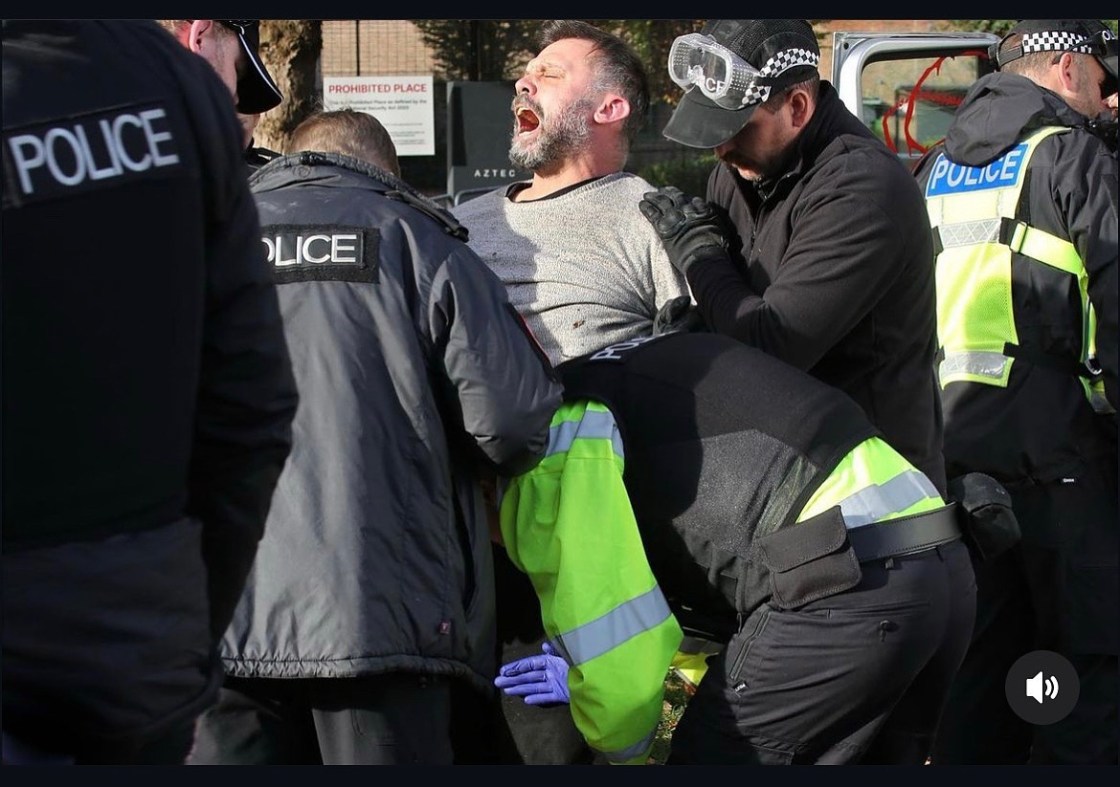
An Activist’s Story
Interview by Diane Langford
Full of trepidation, I boarded a train en route to London to witness court proceedings in the trial of my friend Sebastian Lock. If the case went against him, Seb was facing a three-month custodial sentence and a hefty fine. The outcome could affect a pending court case in which he will face charges of conspiracy to commit criminal damage, due to go to court on October 4th, 2027, at Stafford Crown Court. The latter charges carry a maximum of ten years in prison. His actions against Universal Defence Security and Solutions in Cannon Street, London, a ‘military consultancy’ advising Israel how to more effectively massacre Palestinians in Gaza, are part of a noble tradition of direct action to prevent war crimes.
Angie Zelter, for example, founder of the group Trident Ploughshares, was nominated for a Nobel Peace Prize by Mairead Maguire. Angie has previously been to the West Bank with the International Solidarity Movement where she took part in many actions designed to protect Palestinians against the violence of the Israeli army and settlers. She has recently been arrested for simply holding a sign with words written on it.
As the train pulled out of Whitstable Station, I received the incredible news that the prosecution had dropped all charges against Seb and he was free to talk about the case without restrictions. One of the first questions that struck me was about the seemingly chaotic approach adopted by the courts, pressing on with intimidatingly punitive decisions, while unexpectedly dropping others at the last minute. What was Seb’s take on that?
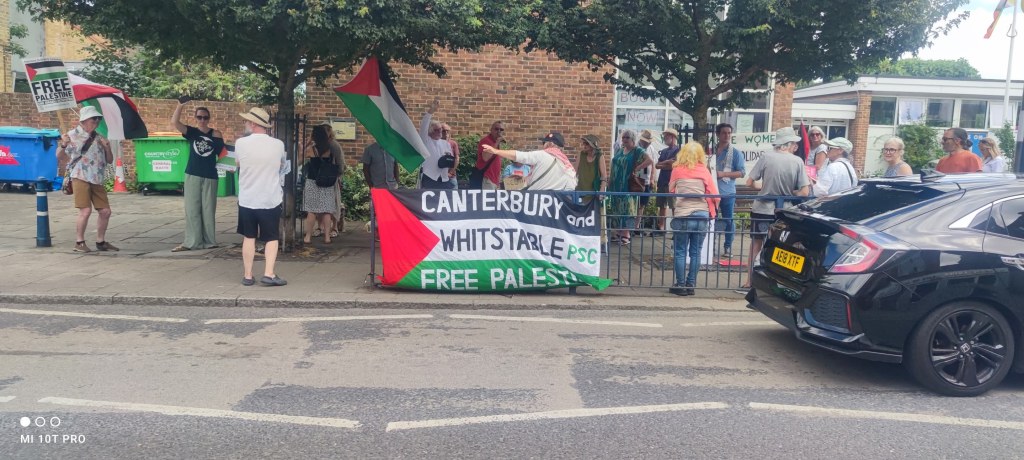
We’d first met at a local gathering outside Whitstable Library where the assembled crowd was joining hundreds of thousands across the UK in calling for an immediate, unconditional ceasefire and an arms embargo on Israel. His activism developed by reading articles in Whitstable Views, and participating in local Palestine Solidarity events in Whitstable and Canterbury.
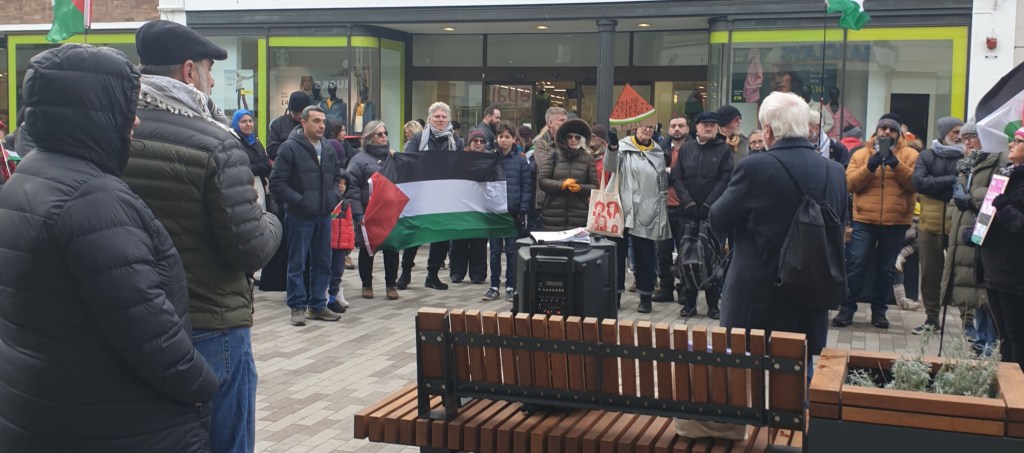
When I spoke to Seb the day before Nakba Day, I asked what had motivated him to become an activist as a teenager. He told me how anguished he’d been by Israel’s brutal killing of Rachel Corrie. Had she lived, Rachel would have been a similar age to him. Her horrific murder in 2003, as she tried to protect Palestinians whose homes were being bulldozed in Rafah, affected him deeply. He was especially moved by the way her parents, Cindy and Craig, had immediately called out her killers and demanded justice for their daughter.
Seb grew up in Sittingbourne and describes himself as a ‘tear-away.’ His teenage home life was ‘not ideal’ and he longed to find his ‘own people.’ He was struggling with the knowledge that wherever Britain had intervened as the colonial power, people were suffering bombing, dispossession, occupation and apartheid. His first political actions were against the Iraq War. Hence, he was alerted to the faux democracy and deliberate lies of governments, foreshadowing what’s happening now.
Flatmates complained about all the newspapers and Guardian cuttings piled up in the communal living room. ‘In the early to mid 2000s, I was reading about Palestine during the Second Intifada.’ It wasn’t until a few years later, that he clocked that weapons Israel uses to commit its heinous war crimes were being manufactured in the UK, practically on our doorstep.
He came to Whitstable often, sitting on the beach to watch the sunset, to meditate, and wind down. Gradually, he made friends locally and moved into a shared flat. He worked as a labourer to sustain himself and studied the history of the Nakba, joining the dots, matching his knowledge to his activist aspirations, which enabled him to have more confidence to explain the occupation to members of the public who visited our local stalls, meetings and demos. By now he was getting his information from platforms like The Electronic Intifada, The Canary and Whitstable Views.
During our interview, Seb told me how relieved he was to find a group of seasoned campaigners who were ‘dedicated and responsible.’ He’d been conscious too of the intergenerational nature of the group, which included people of all ages and backgrounds and was linked to a dynamic national PSC campaign network. His activism ‘suddenly snowballed’ in 2023. One of the events he cites as a pivotal learning curve was the lecture given on February 7 2025, on the University of Kent campus, by Dr Shahd Hammouri entitled, ‘What we learned from the genocide and how to move forward in the fight for justice.’
Aware that some Palestine Actionists have expressed scepticism about the efficacy of marching, I asked Seb for his perspective. While committed to Direct Action (DA), he agrees that the solidarity movement for Palestinian liberation can only succeed if all its component parts work together, observing red lines such as the Right of Return.
You have to be fit to climb up to the roof of an Israeli arms factory. Older activists such as Angie Zelter and our younger, fitter comrades like Seb, have created a powerful dynamic. He makes a distinction between Non Violent Direct Action (NVDA) and Direct Action (DA). While identifying Boycott, Divestment and Sanctions (BDS) as ‘absolutely crucial to the movement,’ he disagrees that boycotting is an act of NVDA or DA. ‘I see it more broadly as part of the anti-Zionist movement.’ The framing of ‘Anti-Zionist,’ rather than ‘Pro-Palestinian’ could be the subject of a separate essay. These are important discussions that form the multi-layered tapestry of our campaigns. Seb was clear, ‘I support all resistance against oppression, and the Palestinian resistance particularly,’ he told me. These actions, coupled with the huge marches organised by the PSC and its coalition partners, and countless other actions, large and small, across the whole country, mean the public have become increasingly educated. All forms of support for the Palestinians have skyrocketed, especially BDS.
Over the period of Seb’s involvement with activism, he was an invaluable member of our team, helping with setting up events such as Poetry for Palestine, 9 May, 2024.

He loved this event so much that he’s asked me to name all the artists who took part. They were: revered Kent poets, Setareh Ebrahimi, Iranian-British multi-disciplinary artist and performer, who read her own distinctive poetry and also presented the event; Maggie Harris, winner of the Guyana Prize for Literature; Barry Fentiman Hall, Medway-based, originally from Yorkshire, his books include The Unbearable Sheerness Of Being. Local poets were joined by Zita Holbourne, trade union activist, community and human rights campaigner, visual artist, curator, poet, writer and vocalist, and Anthony Anaxagorou, acclaimed British-born Cypriot poet, fiction writer, essayist, publisher and poetry educator. Students from the University of Kent wowed us with their original poems. Haneen and Hatem Kiwan, a Palestinian brother and sister, duo played their inspirational music between sets. Delicious food was cooked by a member of our Canterbury Palestinian community highlighting her authentic Palestinian cuisine. Our International Women’s Day Rally featured our beloved Dr Shahd Hammouri and Basma Doukhi. Louise Regan, Chair of National PSC, was also an inspiring speaker, again Haneen and Hatem performed. Both events brought poets and musicians together to honour Palestinian culture and point out Israel’s sickening cultural appropriation that forms part of the Nakba.
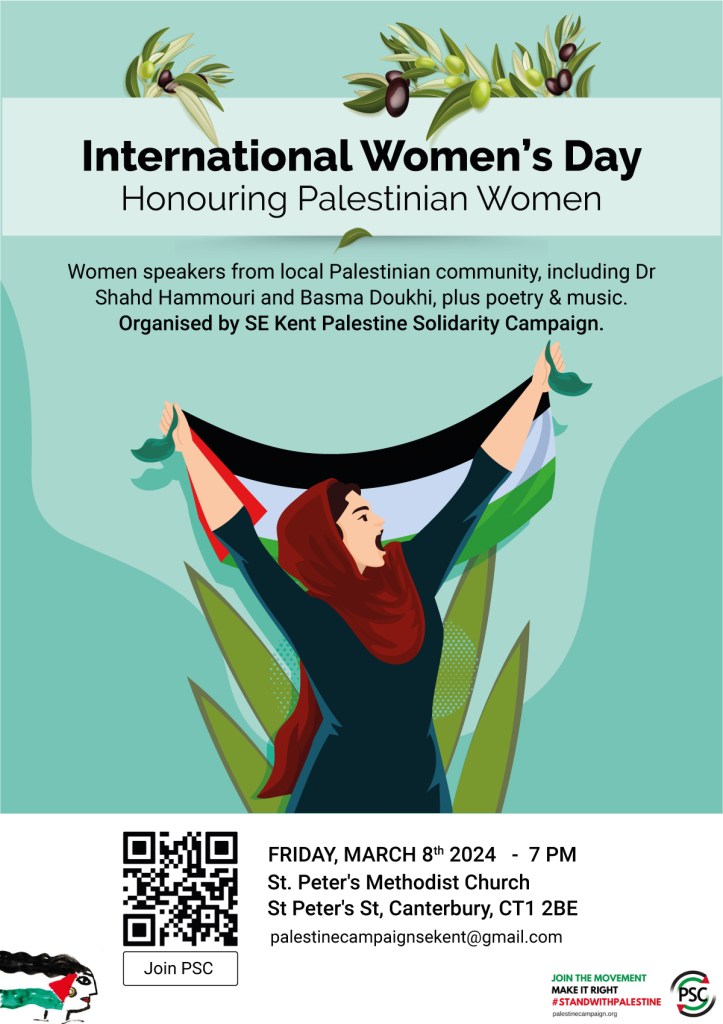
When SE Kent PSC fund-raised to enable students and others on a low income to travel up to London for national marches, Seb took on the task of organising the coach which stopped at multiple destinations en route, where activists and supporters met up for the first time, a great bonding experience. He made many new friends that day.
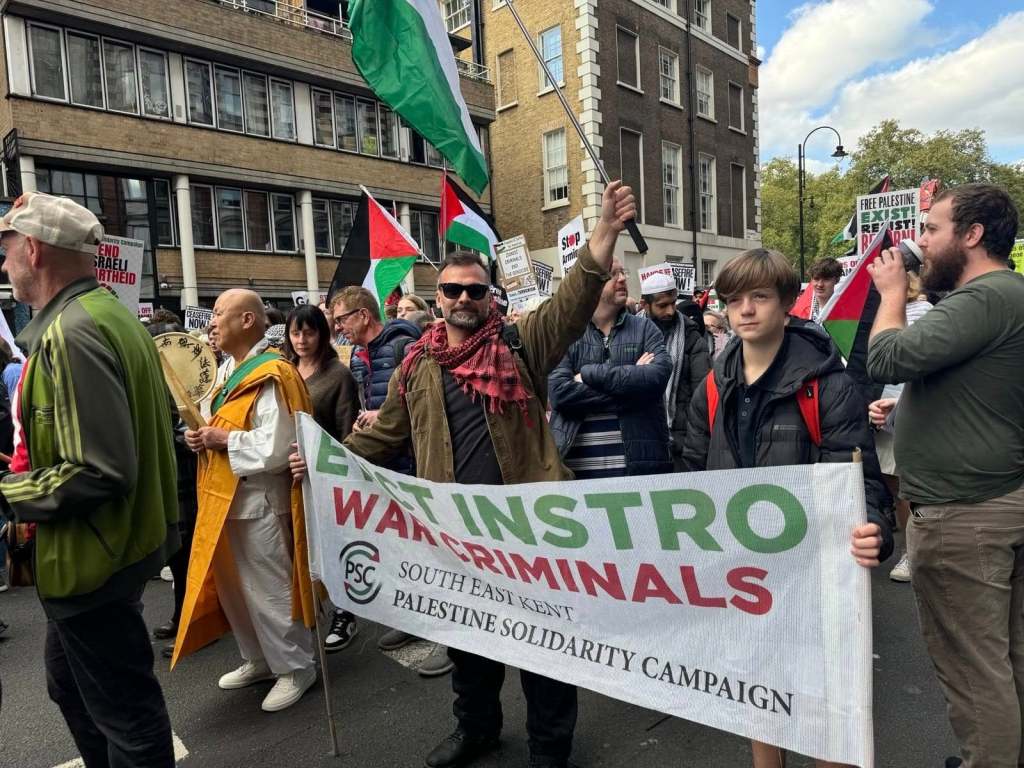
At one of our Kick Elbit out of Kent rallies in Sandwich, a poet connected to the Freedom Theatre in Jenin gave a clarion call for direct action, and Seb made up his mind to respond to the call. Since then he’s been arrested and charged at three different actions. ‘The second action was a dual action in Bristol at Aztec West and Filton. The Aztek West building was later closed, after sustained direct action from myself and many other comrades.’ One, still pending, was outside Shenstone, just north of Birmingham. He also took part in a dual action at Filton, not brought to trial.
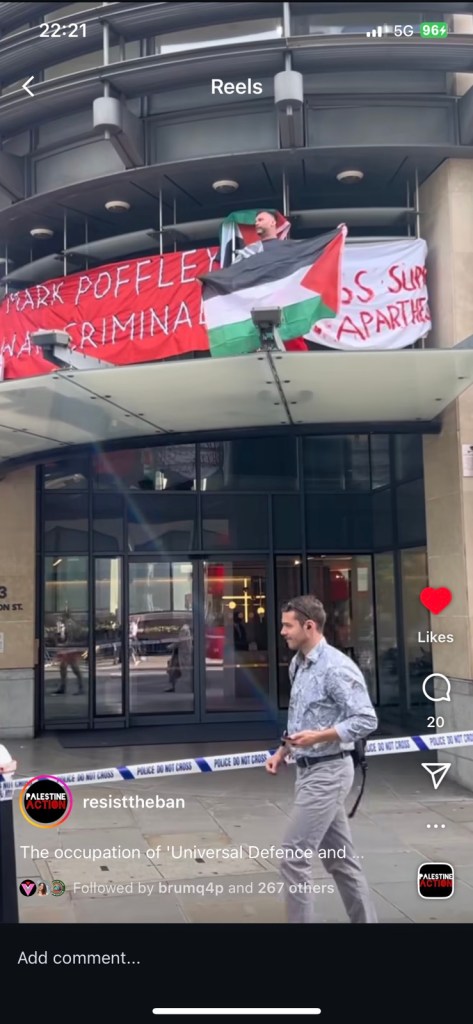
Seb explained, ‘The third action was in Cannon Street London on the balcony of the building where UDSS Universal Defence and Security Solutions Limited is situated. Mark Poffley was a director as well as being a director of Elbit Systems at the time. During the occupation of the raised balcony with huge banners, police closed off the entrance. Later it was found the building could be entered through the rear fire escape. Even though we didn’t manage to shut the whole building down completely, our action drew public and media attention and spotlighted the enmeshment of the military industrial complex, our government and the genocide in Palestine, in which they are complicit. Six weeks after our action, Mark Poffley resigned as one of the directors of Elbit.’
The permanent shuttering of Elbit in Bristol led to the resignation of Elbit CEO, Mark Roper. Seb sees Roper’s resignation as a major victory that completely vindicated his action that day.
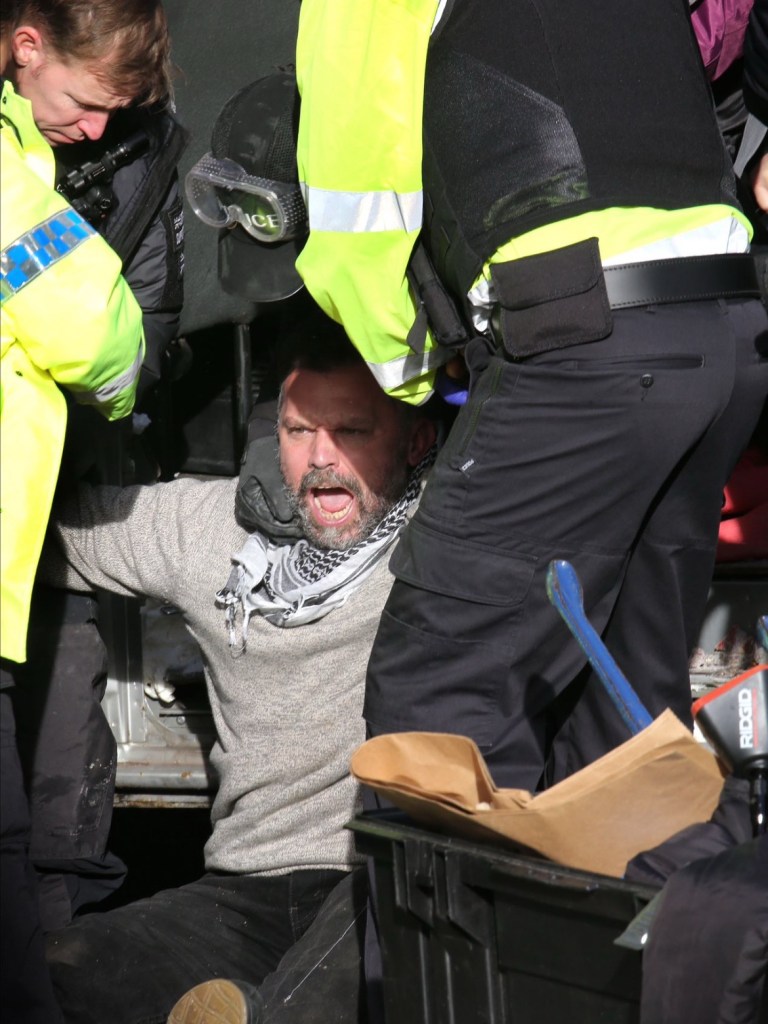
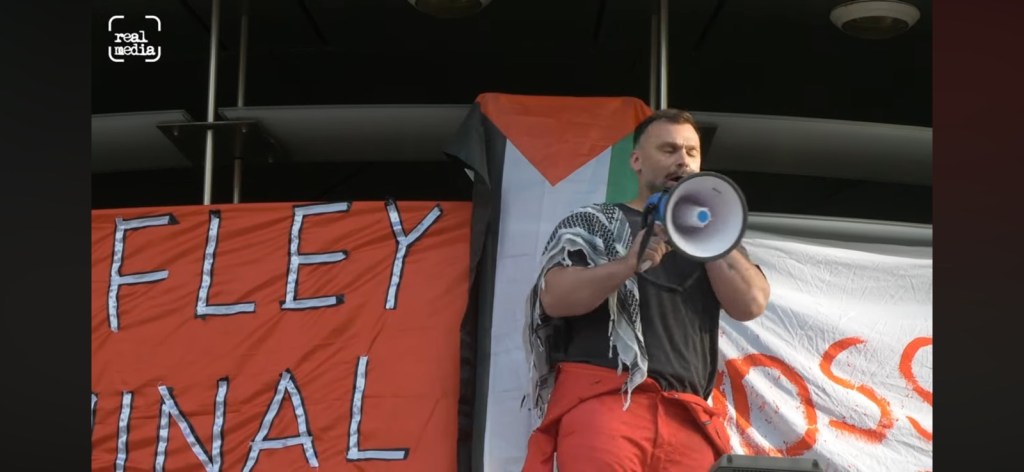
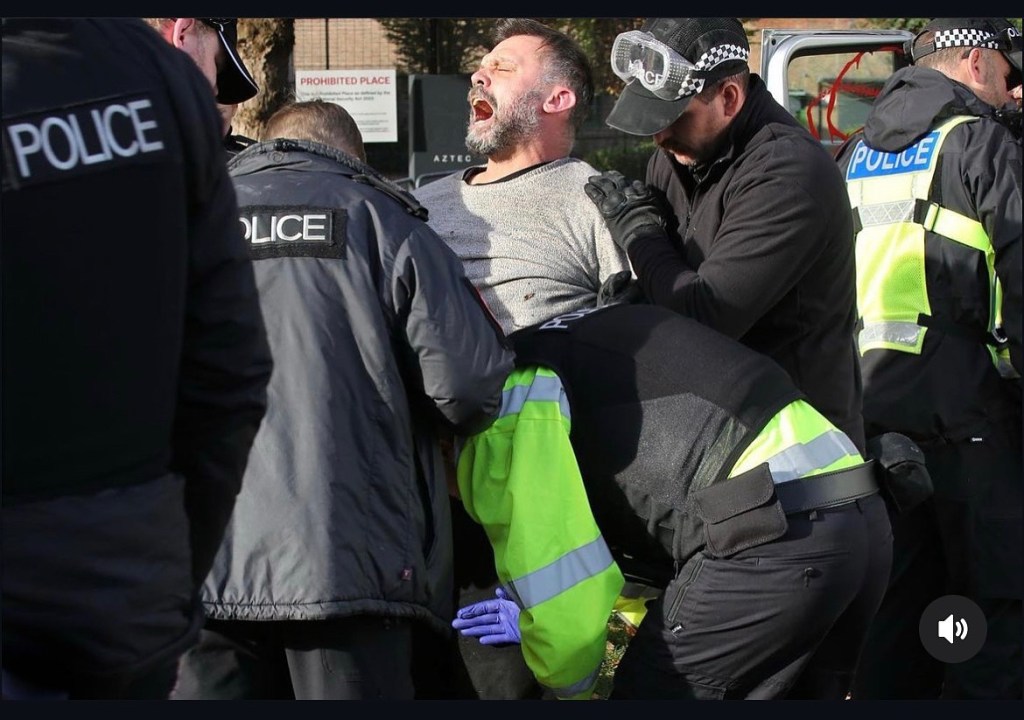
Click on images to enlarge
Why have the courts dropped certain cases and proceeded with others? Seb’s take on this is enlightening. Scores of activists have been made to wait months, even years, for their cases to be brought to court. This is psychological torture. Uncertainty causes severe stress and disruption to people’s lives, including loss of jobs, housing and relationships. When the prosecution in Seb’s case realised their evidence was flimsy and they were unlikely to get a conviction, they blithely dropped the charges at the last moment. Police lies were obvious, turning facts on their head. Whether Seb. and others in his position, will ever get justice and compensation for what they have been through remains to be seen.
I was proud to provide a character reference for Seb and would happily do so again. His commitment to social justice activism is an inspirational example.
Photos
Getty Images has hoovered up everything about our protest movement, demanding £250 to download the images that, nevertheless, can be seen for free by clicking on this link. https://www.gettyimages.co.uk/search/2/image?events=776336749&family=editorial&sort=mostpopular
ADDENDUM
Here are further links, background and information about the issues raised in this interview.
Cruel and unusual punishment, torture and war crimes:
This came to mind when Seb told me that it was the horrific killing by Israel of Rachel Corrie that sparked his activism. More recently we have seen a surge in the numbers of people joining the PSC after imagery showing Israeli soldiers posing triumphantly after turning off the ventilators of orphaned newborns after reducing an emergency maternity room to rubble; soldiers crowing after anally raping a male prisoner using metal pipes; soldiers wearing women’s underwear found in demolished homes; soldiers firing at point blank range on unarmed protesters approaching the apartheid barrier, killing them in cold blood; to mention a few of Israel’s recent atrocities.
Watching amputees, boys and men whose limbs have been deliberately targeted by Israeli gunfire, playing football using prosthetic limbs produced in Gaza under blockade, contributed to the call to kick Israel out of sport, putting the spotlight on FIFA for collaborating with Israel.
Often, it is being confronted with imagery depicting unimaginable cruelty that inspires hitherto observers from the side-lines to break their silence and finally acknowledge that silence is complicity.
The Guardian Newspaper:
Around the time that Seb was accumulating the pile of Guardian articles that annoyed his flatmates, writers like Suzanne Goldenberg were being quietly moved out of their longstanding jobs as Middle East correspondents, under pressure from the Zionist Federation et al.
https://www.theguardian.com/world/2002/aug/12/israel
https://www.theguardian.com/world/2002/oct/17/pressandpublishing.israel
Cartoonist, Steve Bell, was axed after specious accusations of antisemitism.
‘The interpretation by the Guardian made no sense to me, as there is no reference to that play (The Merchant of Venice) in my cartoon, which shows Netanyahu, poised to perform a surgical operation on himself while wearing boxing gloves, the catastrophic consequences of which are yet to be seen. The image itself was inspired by the late, great David Levine’s cartoon of President Lyndon Johnson (LBJ) showing off his operation scar, which Levine draws in the shape of a map of Vietnam.”
https://pressgazette.co.uk/publishers/nationals/guardian-steve-bell-cartoons-sacked-israel
Culture wars, Israeli style:
Following Israel’s plummeting reputation because of its own repulsive behaviour, the regime has ratcheted up its hasbara propaganda, while attempting to stifle support for Palestine. This ongoing operation didn’t start two years ago. In the 1980s Jim Allen’s play, Perdition, was pulled from The Royal Court Theatre after complaints by Zionists.
https://www.theguardian.com/uk/1999/apr/23/fiachragibbons
One of Britain’s greatest living playwrights, Caryl Churchill, was pilloried over her play Seven Jewish Children. Written in 2009, it was intended as an organising tool. It can be staged outdoors on streets and in parks with a mixture of professions and non-actors and only lasts for ten minutes. The playwright asked that donations be collected and sent to Medical Aid for Palestinians.
Lawfare:
The Starmer government, at the behest of a rogue foreign power, is dismantling legal precepts that have been hard won over centuries (since the Magna Carta).
Research by Queen Mary University of London (QMUL) and the protest group Defend Our Juries says that custodial sentences for acts of direct action or civil disobedience were once rare but are now being imposed with increasing length and frequency.
‘So it’s clear that extreme sentences and the level of remand detentions [before trial] at an extreme level are being used to respond to one category of prisoners and that’s prisoners who’ve been detained because they’ve been involved in civil disobedience, direct action as a result of political protest. So there is something going on which is profoundly political. Very often those protesters are reflecting majority rather than a minority view.”
The report describes remand as “the first line of attack”, with the effect of chilling protest and civil disobedience. The researchers found that in 60% of cases, final sentences were more lenient than time already spent in custody awaiting trial. They highlight the “Filton 24”, who were charged with offences connected to a Palestine Action direct action protest at a factory near Bristol run by the Israeli weapons manufacturer Elbit Systems.’
Andy Worthington reported: A huge turnout in London today for the latest Palestinian solidarity march, marking the 78th anniversary of the Nakba (“catastrophe), the blood-soaked founding of the State of Israel, when 15,000 Palestinians were murdered, 750,000 exiled from their homes, and 500 towns and villages were razed to the ground. Because the UK establishment tried to suppress it, after Keir Starmer “called for the prosecution of people who chant the phrase ‘globalise the intifada’ on 30 April, prompting condemnation from pro-Palestinian groups”, as Middle East Eye described it, and after the Metropolitan Police commissioner Mark Rowley lied about organisers repeatedly setting out plans for marches “with an intent to march near synagogues”, which, he said, “feels like antisemitism.” The organisers have never sought to go anywhere near a synagogue, and, on May 1, the Palestine Coalition sent a letter of complaint about Rowley to the Mayor’s Office for Policing and Crime, as reported here: https://jewishvoiceforliberation.org.uk/article/formal-complaint-made-about-met-chief-over-nakba-demonstration-smears/
Labour&Palestine (fronted by Hugh Lanning, former parliamentary candidate in Canterbury and Whitstable), organised a letter to ‘The Secretary of State for the Home Department, The Rt Hon Yvette Cooper MP’ ‘Re: Planned UK Government proscription of Palestine Action under the Terrorism Act 2000:
‘We, the undersigned, including experts within the areas of Law, Politics and Terrorism Studies, strongly condemn the UK Government’s plans to proscribe Palestine Action under the Terrorism Act 2000, and consider this constitutes a significant threat to freedom of expression and civil liberties. Terrorism scholars and experts have repeatedly pointed to the arbitrary, often racialised nature of proscription and its abuse as a political weapon by states to eliminate dissent and political opposition. The absence of a universally agreed upon definition of terrorism allows for the flexible, ambiguous and political usage of the term. The UK government has been warned repeatedly by expert reviewers and civil society organisations that a broad use of the term ‘terrorism’ risks curtailing the freedoms of expression and protest. Furthermore, Counter Terrorism laws expand state repression by weaponising vague terms like ‘support’ (Section 12 of the Terrorism Act 2000) and ‘glorification’ to criminalise dissent, turning protest chants, social media posts, and even solidarity into ‘terrorism’, reinforcing carceral systems that target marginalised communities under the guise of security. Since October 2023 we have seen increasing examples of police investigations and prosecutions of individuals related to their political speech at protests or posts on social media which have been construed by prosecutors as evidence of ‘support’ for terrorism.
Diane Langford is a Palestine Solidarity Campaign activist, novelist, trade unionist, women’s liberation movement activist , LGBTQ and NHS campaigner.
Whitstable Views: How You Can Help
- Make sure you share and like our articles on Facebook and Twitter, and whatever other social-media platforms you use.
- Follow the site to get regular updates about new articles when they appear. Press the “Follow” icon in the bottom right hand corner of your screen and that will take you to the option to sign up. (It disappears as you move the text down, then reappears as you move it back up again!)
- Leave comments on the site rather than on Facebook. Let’s get a debate going. All of our contributors are willing to engage with you if you leave a comment.
- To all writers out there, we would LOVE you to make a contribution. Read our submissions page for details on how to go about that: https://whitstableviews.com/submissions/
- Finally you can donate. As little as £1 would help. Details on the donations page here: https://whitstableviews.com/donate/


One Comment